How to Write an Ebook in 2026: A Step-by-Step Guide
Learn how to write an ebook that sells. Our practical guide covers topic validation, drafting, editing, formatting, cover design, and launching on KDP.
Posted by
 Pablo Yáñez
Related reading
Children Book Illustration: From Concept to KDP
Learn the essentials of children book illustration in our complete guide for indie authors. Covers styles, hiring illustrators, budgets, and KDP print specs.
The Bright Pink Color Code for KDP Book Covers
Find the right bright pink color code for your book cover. This guide covers hex, RGB, and CMYK values, plus KDP print settings and design tips for authors.
Hiring a Book Cover Illustrator: A Practical Guide for 2026
Learn how to find, hire, and manage a professional book cover illustrator. Our step-by-step guide helps indie authors navigate briefs, pricing, and rights.
Ready to design your cover?
Use our AI book cover generator to create tailored book cover concepts in minutes.

You're staring at a blank document, a rough topic, and a nagging question: will this ebook sell, or will it just sit in a folder after weeks of work? That's the right question to ask early. A good ebook isn't only written well, it's validated, structured, polished, packaged, and launched like a product people can find and trust.
The ebook market is still a serious commercial category, with the global market projected to reach $18.693 billion by 2026 (Payhip ebook statistics). That scale matters because your book isn't competing in a hobby space, it's competing in a crowded digital marketplace where topic choice, cover quality, metadata, and launch timing can affect whether readers notice it at all. If you're planning to write an ebook, treat it like a small business asset from the start, not a side project that gets “finished” somewhere later.
Find and Validate Your Profitable Ebook Topic
Topic selection is a business decision before it's a writing decision. A lot of first-time authors start with enthusiasm and end with a manuscript that sounds useful but doesn't match a clear buyer need. That's why the strongest approach is to verify demand first, then write to that demand.
A practical starting point is to research your target market, check what readers are already buying, and look for the gaps competitors leave behind. Reedsy recommends researching your market, choosing a topic, and checking the competition before writing, while Mailchimp also advises looking for authentic demand through keyword and community research (Reedsy). If there's no clear reader need, the topic is probably better suited to a blog post, not a commercial ebook.
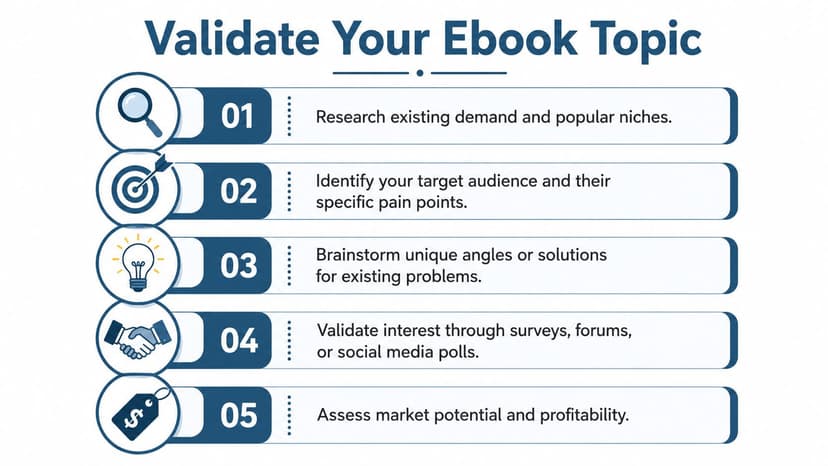
Validate demand before you outline
Start with search and marketplace signals, not with a blank page. AWAI's topic guidance points authors toward keyword research, Amazon demand checks, and unanswered questions in the niche, which is exactly the kind of market-first thinking that keeps an ebook from becoming a generic rehash (AWAI). If people are already searching for the problem, your job is to provide a clearer, more useful answer than what's already ranking or selling.
Use this simple validation filter:
- Clear reader problem: The topic solves one specific pain point, not five unrelated ones.
- Visible demand: Search results, marketplace listings, or community discussions show people care about it.
- Unanswered angle: Existing books or content miss a practical angle, a newer method, or a more specific audience.
- Commercial fit: The subject can support a strong title, a clear promise, and a category that makes sense for Amazon KDP.
- Coverable promise: You can explain the book's value in one sentence without sounding vague.
Practical rule: If you can't identify who the book is for and what problem it solves in one breath, the topic isn't ready yet.
For a faster planning pass, use this free target audience checklist to tighten your reader definition before you write. That step matters because the clearer the audience, the easier it is to choose a topic, promise, and eventual cover concept that all point in the same direction.
Outline and Draft Your Manuscript Efficiently
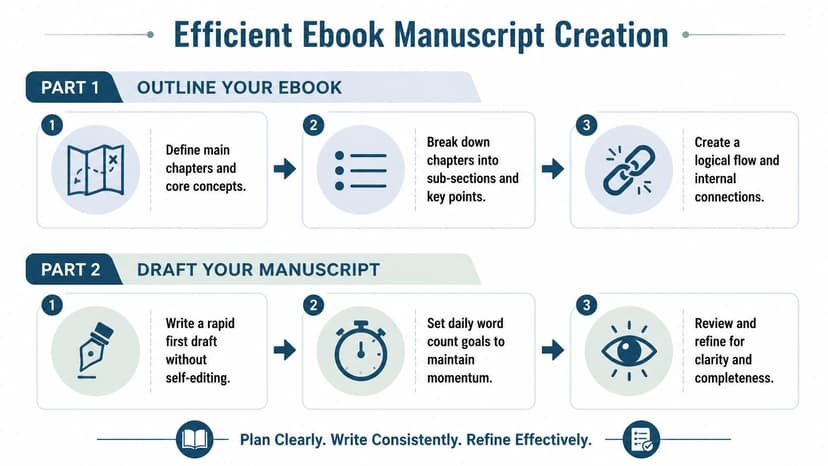
A strong ebook outline is chapter-led and solution-led, not a loose list of things you know about the subject. Hostinger recommends starting with a clear outline, building chapters in logical order from basic concepts to more advanced material, and listing the points each chapter needs to cover (Hostinger). That structure keeps the book moving toward a payoff instead of wandering in circles.
A useful way to think about the outline is this, each chapter should answer the reader's next question. If the reader starts with confusion, the first chapter should orient them. If they already know the basics, the next chapter should move them forward. That's how you create momentum without padding the book.
Build the outline as a reader journey
The outline should include a title for each chapter, plus subheadings or subsections and a list of points to cover (Hostinger). That sounds basic, but it's where most first drafts either become organized or collapse into repetition. If each chapter has a job, the manuscript stays tight.
A good structural rule is to keep the ebook focused on a manageable number of chapters and avoid stuffing every related thought into one project. An outlining framework from Anthony Chatfield recommends grouping the material into roughly 6 to 15 chapters and focusing on about 8 to 10 substantial information units, because too much scope weakens flow and makes editing harder (Anthony Chatfield). The point isn't to hit a magic number, it's to protect clarity.
Draft fast, then revise with intent
Once the outline is set, draft for speed. Don't stop to polish every paragraph while the ideas are still moving. A first draft's job is to exist, not impress anyone.
Use a simple drafting rhythm:
- Write in timed blocks: One focused session beats scattered half-attention.
- Separate drafting from editing: Fixing sentences too early breaks momentum.
- Leave placeholders: If a section needs a stat, story, or smoother transition, mark it and continue.
- End each session mid-thought: It makes the next writing block easier to start.
Write the messy version first. Clean structure matters more than beautiful prose at the draft stage.
If you need a practical comparison point, think of the draft as the raw material and the outline as the blueprint. The blueprint keeps the book coherent, and the draft gives you something real to improve instead of endlessly imagining what the book might become.
Master the Ebook Editing and Proofreading Process
A first draft is not a finished ebook. It's the point where critical quality control begins, and that's where many self-publishers either save money intelligently or create avoidable problems. Editing has layers, and each layer protects a different part of the reader experience.
Edit in the right order
Developmental editing looks at the big picture. Does the book make sense? Does the promise from the topic show up in the chapters? Are some sections too thin while others over-explain the obvious?
Copy editing comes next. That's where sentence flow, word choice, repetition, and consistency get cleaned up. Proofreading is the final pass, and it catches punctuation slips, formatting mistakes, and small errors that still make a book feel unfinished.
A strong self-editing process can save money, but it has to be disciplined. Read the manuscript aloud, because awkward phrasing usually sounds worse than it looks on screen. Step away between passes so you're not reading what you meant to write. And use software tools carefully, since spellcheck can't tell you whether a paragraph is logically weak.

Use beta readers for reality checks
Beta readers are valuable because they read like your future audience, not like your inner editor. They'll spot places where the book drifts, repeats itself, or assumes too much prior knowledge. If you need help building that feedback loop, this beta reader guide gives you a practical way to gather useful responses without turning the process into a guessing game.
Use beta feedback with a filter. Not every comment deserves a rewrite, but repeated confusion is a signal. If three readers stumble over the same chapter, that's not a reader problem, it's a clarity problem.
Best practice: Fix structure before grammar. A perfectly edited chapter still fails if the argument doesn't land.
By the time you reach proofreading, the manuscript should already feel stable. Proofreading is for precision, not rescue work.
Format Your Ebook for KDP and Other Platforms
Formatting isn't a cosmetic step, it's a technical gatekeeper. Designrr recommends running EPUBCheck, fixing every error before publication, testing on multiple devices, and asking other people to review the ebook before release (Designrr). That matters because an ebook that looks fine in a document editor can break in retail systems or display badly on a reader's device.
Hostinger names EPUB, PDF, and MOBI as the main file types and says the format should match the distribution platform and reader habits (Designrr). For broad retail distribution, EPUB is usually the most important format to understand, because it's designed for reflowable reading across different screens. Fixed-layout files can still be useful for certain books, but they're not the default choice for most text-led ebooks.
Follow a clean production workflow
A practical workflow starts in Word or Google Docs, moves into a clean style pass, and then gets exported or converted into the target ebook format. Keep images simple, use consistent heading styles, and build a clickable table of contents so readers can move through the material without frustration. If the book is mostly text, clean structure matters more than decorative formatting.
Before upload, run a device test. Don't trust one preview window. What looks acceptable on a laptop can look cramped on a phone or awkward on a tablet.
If you're comparing tools and selling channels, this guide to top platforms for selling digital goods is useful context because your distribution choices affect how much formatting flexibility you need. For KDP-specific preparation, this formatting guide for Kindle Direct Publishing is worth keeping open while you prep the manuscript.
Validate before you upload
Think of validation as the final quality gate. If EPUBCheck finds errors, fix them. If the ebook behaves oddly on a device, correct the source file before you publish. A clean file doesn't just reduce rejection risk, it also reduces negative reviews caused by broken navigation or display issues.
Good formatting doesn't call attention to itself. It disappears, so the reader can focus on the content.
Create a Sales-Ready Cover and Compelling Metadata
A strong manuscript can still underperform if the package doesn't sell the promise fast enough. Recent publishing guidance emphasizes buyer language, conversion-focused descriptions, reader-intent keywords, and competitive categories because the cover and metadata do the work of getting a reader to stop scrolling (Breaker). That's why cover design isn't decoration, it's part of the sales message.
The cover has to do three jobs at once. It should signal the genre, suggest the book's level of professionalism, and make the promise obvious at thumbnail size. Typography, visual hierarchy, and genre cues matter more than flashy effects. If the design is pretty but unclear, it's failing.
Design for fast recognition
Readers skim. They compare covers side by side. They decide in seconds whether a book looks like it belongs in the category they're browsing.
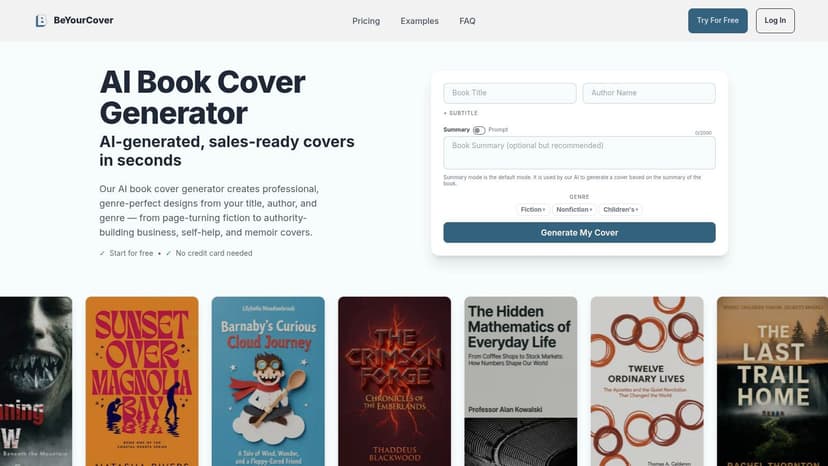
That means the cover needs a clean focal point, readable text, and visual signals that match the market. If you're making multiple concepts, a tool like BeYourCover can generate and test cover directions from a title, genre, and short summary, which is useful when you want to compare options before hiring a designer or refining a brief. Used well, AI helps with iteration, not guesswork.
Write metadata like a salesperson
Your title and subtitle should make the promise clear. Your description should lead with the reader's problem and show the value quickly. Your keywords should match what readers are searching for, not what sounds clever in an author bio.
Use this decision filter:
- Title clarity: Can the reader tell what the book is about without decoding it?
- Subtitle payoff: Does it sharpen the promise or audience?
- Description flow: Does the first paragraph answer “why this book, why now”?
- Keyword fit: Do the keywords reflect reader intent rather than broad subject labels?
- Category choice: Can the book compete where it's listed, instead of disappearing in an oversized category?
A good ebook can still lose if the cover and metadata don't communicate fast enough in a crowded marketplace.
That's the part many first-time authors miss. They think the manuscript is the product, but the market often sees the package first.
Prepare for a Successful Ebook Launch
Publishing day shouldn't be your first marketing day. A low-budget launch works better when the groundwork is already in place, even if the audience is small. You need a simple plan that creates visibility before release and gives readers a reason to act once the book is live.
Start with three basics. Set up an author landing page, collect email addresses from people who already care about the topic, and line up a few places where you can talk about the book without sounding repetitive. That might include a blog post, a short announcement sequence, or a social post series that explains the problem the ebook solves.
Build the launch around a clear budget
Pricing matters because readers use price as part of their decision-making, and launch costs can creep up if you don't plan them. Many ebooks are priced between $2.99 and $29.99, and creators are often advised to reserve 20%–40% of total project spend for promotion plus 10%–20% for contingency costs (Udemy). Those numbers are useful because they remind you that launch spending is part of the product, not an optional extra.
Use this as a simple prelaunch checklist:
- Landing page ready: One page that explains the book and captures interest.
- Email announcement prepared: A short message for launch day and a follow-up.
- Launch pricing decided: A price that fits the category and your promotional plan.
- Review request plan: A polite way to ask early readers for feedback.
- Post-launch follow-up: A plan for sharing the book again after the first announcement.
If you want a broader launch framework, PledgeBox's book launch insights can help you think through timing and audience coordination even if you're not crowdfunding.
Don't treat launch as a one-day event. The books that move tend to get introduced, reminded, and reintroduced in more than one place. Keep the momentum going after release, because early visibility is often the difference between a quiet upload and a book that starts finding its readers.
If you're ready to turn your idea into a market-ready ebook, start with topic validation today, then move through outline, editing, formatting, cover, and launch in that order. Build the book around a real reader need, test the packaging before publishing, and give your release a simple plan you can follow.
Ready to Create Your Own Book Cover?
Turn your story into a visual masterpiece. Fill in the details below to start generating professional covers instantly.
