Create the Perfect Book Review Form: A Guide for Authors
Learn to design a book review form that delivers actionable feedback. This guide covers question design, distribution tactics, and using reviews for marketing.
Posted by
 Pablo Yáñez
Related reading
The Bright Pink Color Code for KDP Book Covers
Find the right bright pink color code for your book cover. This guide covers hex, RGB, and CMYK values, plus KDP print settings and design tips for authors.
Hiring a Book Cover Illustrator: A Practical Guide for 2026
Learn how to find, hire, and manage a professional book cover illustrator. Our step-by-step guide helps indie authors navigate briefs, pricing, and rights.
Photos for Book Covers: A Complete Guide for Authors
Learn how to choose effective photos for book covers. This guide covers composition, sourcing, licensing, and technical specs for KDP-ready designs.
Ready to design your cover?
Use our AI book cover generator to create tailored book cover concepts in minutes.

You've probably seen this happen. You send your manuscript to beta readers or an ARC team, ask for “honest feedback,” and get back a pile of comments that don't help much. One reader says they loved it. Another says the middle dragged. A third writes two sentences you can't use for revision or marketing.
That usually isn't a reader problem. It's a form design problem.
A strong book review form doesn't just collect opinions. It guides readers toward the kind of response you need, whether that's developmental feedback before publication, launch-ready blurbs, or clearer signals about what your audience values. When the form fits the stage of the book, the feedback becomes easier to sort, act on, and reuse.
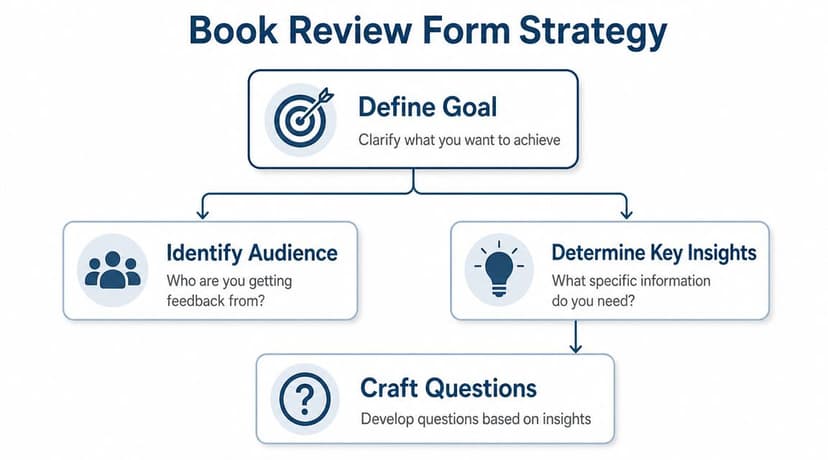
Start with Strategy Not Questions
Most authors start in the wrong place. They open Google Forms, type “What did you think of the book?”, and build from there. That creates vague answers because the form has no job.
Your book review form should start with one decision. What are you trying to get from this reader right now? If you skip that step, you'll mix revision questions, testimonial prompts, and general reactions into one document. The result is cluttered feedback that serves none of those goals well.
Match the form to the publishing stage
A beta reader form should help you fix the manuscript. That means asking about pacing, clarity, character motivation, confusion points, and scenes that felt weak or unnecessary.
An ARC form has a different purpose. You're usually looking for two things: honest launch feedback and language you may later request permission to use in marketing. That form should be shorter, more reader-facing, and focused on emotional response, strongest selling points, and audience fit.
Post-publication feedback sits somewhere else again. At that stage, you're not rebuilding the book. You're trying to understand sentiment patterns, discover how readers describe the reading experience, and identify phrases that belong in ads, blurbs, and retailer copy.
Practical rule: One form, one primary outcome.
That's the same discipline good research teams use when they need to get decision-ready insights for your business. If the form is trying to answer too many questions at once, the answers get muddy.
Use separate forms for separate readers
Different readers notice different things. A fellow writer can often spot structure issues. A genre fan is better at telling you whether the promise lands. A casual early reviewer may give you cleaner testimonial language than either.
Build forms around the reader's role, not around your convenience.
- For beta readers: Ask where they got bored, confused, unconvinced, or emotionally disengaged.
- For ARC readers: Ask what stood out, what they'd tell a friend, and who they'd recommend the book to.
- For street team or launch readers: Ask which phrases, themes, or hooks most describe the book.
If you haven't clarified your positioning yet, sort that out before you write the form. A simple brand strategy template for authors and publishers helps tighten the promise your book is making, which in turn sharpens the questions you ask readers.
Strategy changes tone, length, and structure
A developmental form can be more detailed because the reader knows they're helping improve the manuscript. A testimonial-oriented form should feel lighter and faster. A post-launch sentiment form should reduce friction and focus on reusable insight.
Modern review guidance treats a review as a structured evaluation tool, not just a space for opinions. It also stresses naming the intended audience and being “balanced, fair, and professionally critical,” which is why strong forms usually ask for both strengths and weaknesses rather than a simple thumbs-up or thumbs-down (peer-reviewed guidance on book reviews).
The Anatomy of a High-Impact Review Form
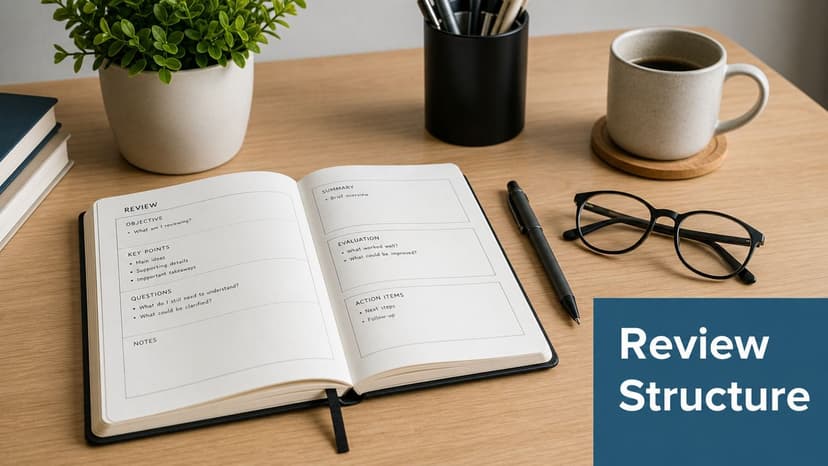
Once the purpose is clear, structure matters. A messy form produces messy feedback. A clean one leads the reader from basic context to sharper judgments.
Start with the essentials
The first block should collect the information you'll need later when you sort responses.
Include:
- Book details: Title, edition or draft version, and format read.
- Reader identity: Name or alias, email if follow-up is needed, and whether you may quote them with attribution.
- Reader context: Genre familiarity, how they received the book, and whether they read the full manuscript.
This looks basic, but it prevents a common problem. Authors often receive useful comments and then can't tell which draft the reader saw or whether the reader is even in the target market.
Academic review models have long treated bibliographic information, argument, organization, style, evaluation, and target audience as core fields in a review framework (Hamilton College's book review guidance). That logic still holds for indie publishing, even when the form is simpler.
Separate reaction from analysis
Don't dump every question into one long list. Group the form by function.
A useful sequence looks like this:
- Overall impression
- What the book is about
- What worked
- What didn't
- Audience fit
- Permission and follow-up
The key move is separating summary from evaluation. Ask readers to briefly describe what they think the book is doing before you ask whether it succeeds. That helps you catch positioning problems. If readers can't clearly explain the premise or promise, your manuscript or packaging may be misfiring.
Readers give better critique when you first orient them, then ask them to judge.
Use quick signals and rich prompts together
A high-impact book review form usually needs two layers. First, fast-response items that help you scan patterns. Second, open-ended prompts that explain the why behind the reaction.
Try this mix:
- Scaled ratings: Overall enjoyment, pacing, clarity, character connection, or usefulness.
- Single-choice questions: Would they recommend it, and to whom?
- Open text fields: Best scene, biggest weakness, strongest takeaway, confusing section.
The ratings help you sort. The comments help you revise.
Keep the review balanced
Formal review guidance is clear on this point. Reviews should include strengths and weaknesses, audience analysis, and quality assessment, not just raw opinion. That's why your form should always include a paired question set.
For example:
- What was strongest about the book?
- Where did the book lose momentum or clarity?
- Who is the right reader for this book?
- Who may not be the right reader?
That paired design gives you better revision notes and cleaner marketing intelligence. It also reduces the all-positive bias that creeps in when readers think you only want praise.
Designing Questions That Generate Usable Feedback
Weak questions create polite noise. Strong questions create evidence.
A reviewer shouldn't have to guess what kind of answer helps you. The form should lead them toward specifics. Good prompts usually ask the reader to identify a moment, reaction, comparison, or reason. Bad prompts ask for a verdict with no support.
A widely used reviewing method follows a three-step process: take structured notes while reading, develop an argument about the book's value, then write an organized assessment. One major pitfall is leaning on plot summary instead of a thesis about whether the book succeeds (USC writing guide on book reviews). Your form should push readers toward that second move.
Good questions versus lazy questions
Compare these:
-
Weak: Did you like the book?
-
Better: What kept you reading, and where did your attention dip?
-
Weak: Was the main character good?
-
Better: Which character felt most convincing, and what made them believable or unconvincing?
-
Weak: Was the ending satisfying?
-
Better: Did the ending feel earned by what came before it? Why or why not?
The second version gives you something to work with. It points to craft, not just opinion.
A usable answer names a reaction and the reason behind it.
If you're building forms for early readers, it helps to study how other feedback systems frame targeted prompts. This guide on how to master student feedback form creation is useful because it shows how better wording pulls out clearer, more actionable responses.
Question types for your book review form
| Question Type | Best For | Example |
|---|---|---|
| Rating scale | Fast pattern spotting | How clear was the opening chapter? |
| Multiple choice | Audience and fit signals | Which element mattered most: plot, character, romance, worldbuilding, practical advice? |
| Short answer | Clean pull quotes and hooks | What's the first phrase you'd use to describe this book? |
| Long answer | Revision guidance | Where did the book lose momentum, and what caused that? |
| Yes or no with follow-up | Simple screening | Would you recommend this book to a friend? Why or why not? |
Tailor prompts to the type of book
The biggest missed opportunity in many book review form templates is generic wording. Genre changes what matters.
For a thriller, ask about pace, suspense, reveal timing, and whether twists felt surprising but credible.
For romance, ask where emotional chemistry felt strongest, whether the central relationship developed convincingly, and whether the ending delivered the expected emotional payoff.
For prescriptive nonfiction, ask whether the core framework was clear, whether the advice felt actionable, and which section the reader would apply first.
A few practical prompts:
- Thriller: At what point did the tension noticeably rise or drop?
- Romance: Which scene most deepened your investment in the central relationship?
- Nonfiction: Which idea felt most useful, and what made it practical?
If you're still recruiting readers, use a process that matches the kind of feedback you need. A broad pool isn't enough. You need the right readers, in the right genre, at the right stage. This guide on how to find beta readers for your book is a solid place to tighten that pipeline.
Ask for evidence, not just reactions
When a reader says, “the middle dragged,” your next question is obvious. Where exactly? What scene, chapter, or shift caused that feeling?
Build that follow-up into the form itself.
- Prompt the moment: Which chapter or section felt slow, confusing, or repetitive?
- Prompt the comparison: Was there a character, chapter, or concept that clearly worked better than the weaker section?
- Prompt the impact: How did that issue affect your desire to keep reading?
That's how you turn “helpful but vague” into revision notes you can use.
Distributing Your Form and Boosting Response Rates
A strong form still fails if the delivery is sloppy. Most response problems start before the reader opens the link.
Make completion feel easy
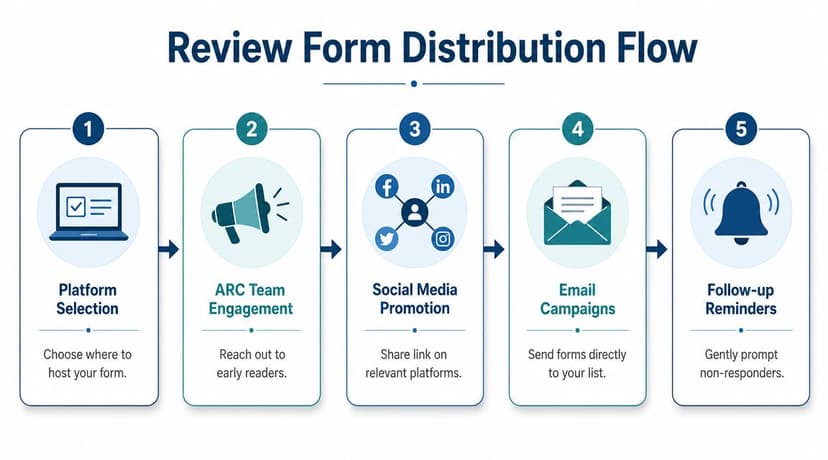
Use a platform your readers already understand. Google Forms works well because it loads fast, feels familiar, and doesn't ask people to learn anything new. Typeform can feel more polished, but some readers prefer the straightforward look of a standard form. If your audience skews older or less tech-comfortable, simpler usually wins.
The outreach message matters as much as the form. Tell readers what kind of feedback you want, how long the form will take, and when you need it back. If you're asking for developmental notes, say so. If you're collecting launch feedback, say that too.
Use a clean follow-up rhythm
Many authors either nag too much or never follow up at all. Neither works.
Try this checklist:
- Set expectations early: Include the deadline in the first message.
- Explain the purpose: Tell readers whether the form supports revision, launch, or audience research.
- Send one reminder: Keep it brief and polite.
- Close the loop: Thank responders and tell them what happens next.
Readers are more likely to respond when they know their time will be used well.
If you want a broader view of how teams think about getting feedback forms in front of people, Formbricks' advice on customer feedback offers useful distribution thinking you can adapt to ARC teams, newsletters, and reader communities.
Incentives need care
You can thank readers for their time. You can't pressure them toward a positive public review.
That distinction matters, especially on retailer platforms. If you offer a bonus, giveaway entry, or thank-you gift related to completing your private form, keep it disconnected from the tone of the feedback. Don't reward praise. Reward participation.
Also make the path clear. If your process asks readers to complete a private form first and post a retailer review separately, explain that these are different actions. Readers appreciate direct instructions when the ask is simple and transparent.
Turning Reader Feedback into Marketing Power
Most authors stop too early. They collect responses, skim them, revise a few pages, and move on. That leaves a lot of value on the table.

Look for repeated language
A good form doesn't just tell you whether readers liked the book. It shows you how they talk about it. That language is often more persuasive than what the author writes alone.
One practical guideline from review writing is that stronger reviews lean heavily toward evaluation rather than summary. A useful summary should stay compact, while the judgments should be supported by 2 to 3 pieces of textual evidence. Guidance summarized in one review format source says reviews are often 500 to 750 words, with many stronger academic reviews devoting 60–70% to evaluation and limiting summary to 15–25% (book review format guidance). That matters for authors because a form built around evidence gives you comments you can trust and reuse.
Turn comments into assets
Go through responses and highlight phrases that appear more than once. You're not counting for vanity. You're identifying message fit.
Look for wording that reveals:
- Core appeal: “fast-paced,” “emotionally intense,” “clear and practical,” “atmospheric”
- Reader identity: “for fans of character-driven fantasy,” “best for new entrepreneurs,” “ideal for busy parents”
- Purchase triggers: “couldn't put it down,” “easy to apply,” “felt cinematic,” “made me rethink”
Then sort those into three buckets.
Blurbs
Short, vivid reactions can become testimonial requests. Don't lift private form responses into public marketing without permission. Instead, follow up and ask whether the reader is comfortable letting you use a cleaned-up version with their name.
Retail copy and ads
If readers consistently mention one benefit or feeling, that language belongs in your Amazon description, subtitle support copy, ad hooks, and social posts.
Cover direction
Feedback can also help you judge whether your cover is promising the right reading experience. If readers call the book dark, literary, eerie, or playful, the packaging should reflect that. This is a sensible place to test visual concepts with an AI design tool. Generate a few cover directions based on reader language, then compare which concept best reflects the tone readers responded to. If you're also building your review pipeline, this guide on how to get book reviews as an indie author helps connect feedback gathering with launch execution.
The best marketing copy often starts as reader language, not author language.
Review Form Pitfalls and Ethical Guidelines
Authors often assume the main risk is getting too little feedback. In practice, the bigger risk is collecting distorted feedback and then treating it as reliable.
The mistakes that quietly ruin the form
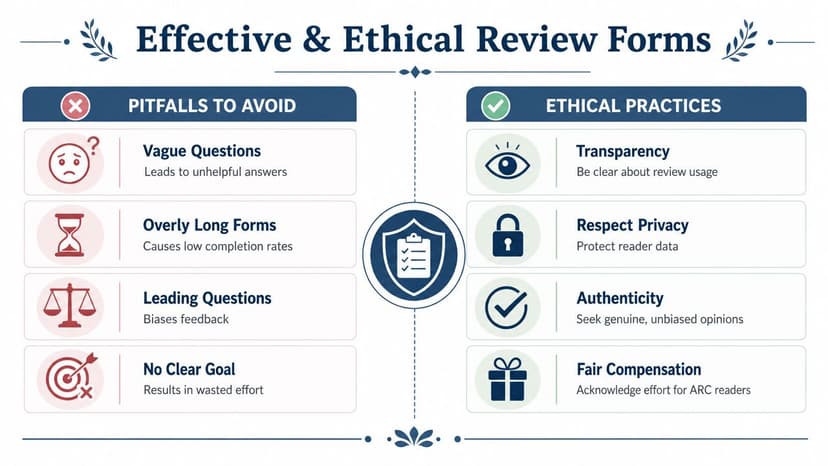
Leading questions are the fastest way to poison your own data. If you ask, “What did you love most about the unforgettable ending?” you've already pushed the answer.
Long forms cause a different problem. Readers start strong, then rush the back half. The final answers turn thin just when you need detail.
Watch for these issues:
- Leading wording: It biases the response before the reader answers.
- Mixed purpose: It combines craft critique, launch reviews, and testimonials in one form.
- Over-collection: It asks for more detail than you'll realistically use.
- Bad interpretation: It treats one loud opinion as a universal truth.
Protect the reader and the process
Be transparent about how you'll use the response. If quotes may be requested for marketing, say that clearly. If the form is private and only for revision, say that too.
Respect privacy. Don't ask for unnecessary personal information. Don't publish names, comments, or screenshots without permission.
One useful way to think about ethics is this: the modern consumer-facing review may be faster than the academic version, but the core fields remain stable across both. Bibliographic data, summary, evaluation, and target readership still anchor the review form as a standardized decision aid (historical review structure from Hamilton College). The speed of online publishing doesn't remove the need for fairness and clarity.
There's also a separate disclosure issue when readers received a free copy. If someone posts a public review after getting an ARC, they should understand the platform and disclosure expectations that apply. You don't need to turn your form into a legal memo, but you do need to run a professional process built on transparency.
A clean book review form does three jobs well. It asks the right reader the right questions at the right time. It gives you feedback you can act on. And it creates a paper trail of trust, which matters just as much as insight.
If you're ready to turn reader insight into stronger packaging, ad assets, or launch visuals, explore the free tools at BeYourCover. You can test cover directions, generate new concepts, and refine visual ideas based on the language real readers use about your book.
Ready to Create Your Own Book Cover?
Turn your story into a visual masterpiece. Fill in the details below to start generating professional covers instantly.
