Traditional Publishing Versus Self Publishing: A 2026 Guide
Deciding between traditional publishing versus self publishing? Our guide compares costs, royalties, timelines, and control to help you choose the best path.
Posted by
 Pablo Yáñez
Related reading
Are Premade Book Covers Worth It? A Practical Guide
Learn when premade book covers are worth buying. Compare speed, exclusivity, customization, series needs, rights, print files, and total cost before you choose.
How to Build a Character Profile for Book Cover Design
Build a visual character profile that keeps cover art accurate and consistent. Define appearance, clothing, references, exclusions, and series continuity.
How to Create Consistent Book Series Covers
Create consistent book series covers with a repeatable visual system. Keep typography, colors, style, and recurring characters recognizable across every title.
Ready to design your cover?
Use our AI book cover generator to create tailored book cover concepts in minutes.

You've finished the manuscript. The hard creative work is done, but the publishing decision in front of you is no longer just artistic. It's operational, financial, and strategic.
Most authors still frame the choice emotionally. Traditional publishing sounds validated. Self publishing sounds independent. That framing is too shallow to be useful. A better way to think about traditional publishing versus self publishing is this: you're choosing between two business models.
One model is a partnership with an established company. That company funds production, controls many decisions, and gives you access to channels that are difficult to build alone. In return, you give up speed, margin, and some control.
The other model is a small business you run yourself. You keep control of rights, timing, packaging, and pricing. You also carry the workload, the execution risk, and the upfront investment.
Neither path is automatically smarter. The right choice depends on what you want the book to do for your career, how fast you need to move, how much control you want, and whether you're willing to operate like a publisher instead of only a writer.
Choosing Your Publishing Business Model
The moment after “The End” is deceptive. It feels like the book is complete, but in commercial terms, the project has barely started. Editing, packaging, pricing, distribution, rights, and launch planning still sit in front of you.

Authors who make good publishing decisions usually stop asking, “Which option feels more legitimate?” and start asking, “Which operating model fits this book and my goals?” That shift changes everything.
Traditional publishing works like a corporate partnership. A publisher takes on the production process, invests in the release, and decides whether your book fits its list. If they say yes, they become the primary operator across editorial, packaging, sales, and distribution. You participate, but you don't control every lever.
Self publishing works like launching an independent venture. You become the publisher. You assemble freelancers, approve edits, choose the cover direction, manage metadata, select retailers, and decide whether to sell only through platforms or build direct sales too. If you're weighing print options, this overview of print on demand publishers helps clarify how the production side differs from the business model itself.
The first decision is not format
Print, ebook, audiobook, hardcover, and direct sales all come later. The first decision is simpler:
- Do you want a gatekeeper to approve the project first
- Do you want someone else to fund the release
- Do you want final say over the finished product
- Do you want to build an author business or contribute to a publisher's list
Practical rule: Don't choose based on status. Choose based on who will own the work, who will fund the work, and who will be responsible when the book has to sell.
That's the true comparison.
The Core Differences at a Glance
If you step back from individual anecdotes, the market has already made one fact very clear. Self publishing is no longer a niche side route. In the U.S. market, self-published books accounted for about 500,000 annual titles in 2023, or roughly 98% of all new U.S. titles, compared with about 10,000 titles from traditional publishers, according to Automateed's self-publishing statistics summary.
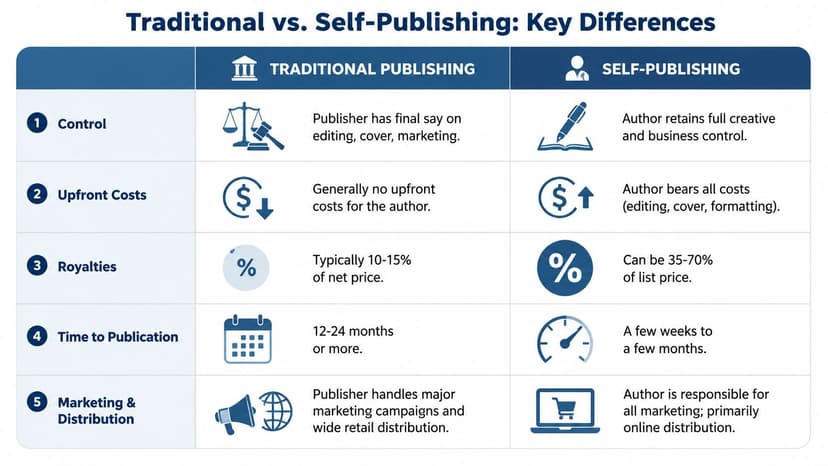
That doesn't mean traditional publishing has become irrelevant. It means the publishing scene altered. Self publishing now dominates title output, while traditional houses still hold many prestige channels, trade relationships, and institutional review pathways.
Side by side comparison
| Factor | Traditional publishing | Self publishing |
|---|---|---|
| Gatekeeping | Requires acceptance by agents and publishers | Open access. The author decides when to publish |
| Time to market | Often slow, with 18 to 24 months commonly cited from deal to release in the source above | Often fast, with 4 to 8 weeks commonly cited in the same source |
| Funding model | Publisher typically absorbs production cost | Author funds editing, cover, formatting, and launch work |
| Control | Publisher usually has final authority over many packaging and publishing decisions | Author keeps final say |
| Royalties | Lower royalty share, with print commonly around 10 to 15% and ebooks around 25% in the source above | Higher royalty share, with ebooks commonly 35 to 70% and print roughly 35 to 60% in the same source |
| Distribution strength | Stronger access to bookstores, libraries, and trade channels | Strongest in online retail and author-controlled channels |
| Risk profile | Lower capital risk for the author | Higher capital risk for the author |
What those differences mean in practice
Traditional publishing is built around selection and support. The publisher chooses fewer projects, invests in them, and manages the route to market. That structure can be valuable if your goals depend on bookstore placement, library access, and institutional credibility.
Self publishing is built around speed and control. You don't wait for approval. You decide when the manuscript is ready, who works on it, what the cover looks like, how it's priced, and where it's sold.
The mistake many authors make is assuming these are only creative differences. They're not. They affect your calendar, your cash flow, your rights, and your day-to-day responsibilities for months or years.
A simple lens for evaluating both
Ask which of these statements sounds more like you:
- I want a company to invest in this project and help carry it into trade channels
- I want to move quickly, keep control, and own the economics
- I'd rather clear a high bar and join an existing system
- I'd rather build my own system and improve it book by book
Traditional publishing filters first and publishes second. Self publishing publishes first and relies on the market to do the filtering.
That distinction drives almost every downstream trade-off.
Creative Control and Production Quality
“Creative control” sounds romantic until you get specific. It isn't just about whether you like your title or cover. It's about who has authority over the final product when market positioning, genre signaling, and production standards are on the line.
What control looks like in traditional publishing
In traditional publishing, you work with professionals whose job is to make the book commercially viable inside their system. That can be useful. Experienced editors, designers, and sales teams know what bookstores, reviewers, and buyers respond to.
It also means your preferences are not always decisive.
A traditional publisher may influence or determine:
- Editorial direction based on the house's list and market strategy
- Cover concept based on category fit rather than the author's personal taste
- Title and subtitle choices if they believe a different package will sell better
- Publication timing based on the publisher's schedule, not your own ideal launch window
For some authors, that feels like relief. For others, it feels like losing the thread of the project.
What control looks like in self publishing
Self publishing gives you final say, but final say is only valuable if you can manage quality. That's where many authors misunderstand the model. Control does not replace expertise. It increases your need to hire or develop it.
If you self-publish, you become the project manager for the book's production. You're responsible for choosing editors, reviewing design drafts, approving typography, checking trim-size assumptions, confirming print-readiness, and making sure the cover communicates the correct genre signal at thumbnail size.
That last point matters more than many new authors expect. A cover is not a decorative reward for finishing the manuscript. It is packaging. It has to help the right reader identify the book quickly.
Production quality is not built into either route
Traditional publishing usually gives you a quality floor because professionals handle the workflow. Self publishing can match that quality, but only when the author treats the book like a professional release instead of a quick upload.
A practical indie quality stack usually includes:
- Developmental or structural editing when the manuscript needs deeper work
- Copyediting and proofreading so the final text reads cleanly
- Professional cover direction that fits the genre and retailer environment
- Interior formatting that works for ebook and print, not just one format
- Metadata discipline so the listing supports discoverability and conversion
If you self-publish, quality is no longer somebody else's department. It's your management job.
Cover decisions are where business judgment shows up fast
The cover process often exposes a core difference between these business models. In traditional publishing, the art department develops the package, and the author typically reacts to it. In self publishing, the author sets the brief.
That's a serious advantage if you understand your category. It's a serious liability if you don't.
A strong indie process usually looks like this:
-
Study your genre shelves on Amazon KDP and other major retailers
Look for recurring visual patterns in typography, composition, color, and image treatment. -
Build several directions before locking one in
A single concept is risky. Multiple concepts help you separate personal preference from market fit. -
Test at thumbnail size
Many covers look good full screen and fail completely in search results. -
Check whether the design communicates the right promise
Readers don't buy covers because they are pretty. They buy when the cover tells them what kind of reading experience to expect.
If you want to explore concepts quickly before committing to a final design, some authors now use AI-based cover workflows to generate and compare genre directions. That can be useful for briefing a designer, narrowing visual strategy, or testing options with beta readers. One option is BeYourCover, which generates cover concepts from a title, genre, and short summary, then lets you iterate on typography, color, and layout. Used well, tools like that don't replace judgment. They speed up the early packaging process and give the author more control over experimentation.
What doesn't work
Two mistakes show up constantly on the self-publishing side:
- Treating creative control as a license to ignore market conventions
- Assuming low budget decisions won't be visible to readers
Readers may not know why a book looks off, but they usually feel it immediately. Amateur typography, weak contrast, vague imagery, and genre-misaligned covers reduce trust before the sample is ever opened.
Traditional publishing has its own failure mode. Sometimes the publisher packages the book for channel logic rather than author fit, and the author has little power to change it. The quality may be professional, but the alignment may still be wrong.
That's why “control” should never be discussed without “responsibility.” In one model you surrender some control to gain infrastructure. In the other you keep control and assume the burden of getting quality right.
The Financial Breakdown Cost Royalties and Income
Money is where the two business models separate most clearly. Traditional publishing reduces the author's upfront financial exposure. Self publishing increases it, but offers much better unit economics if the book sells.
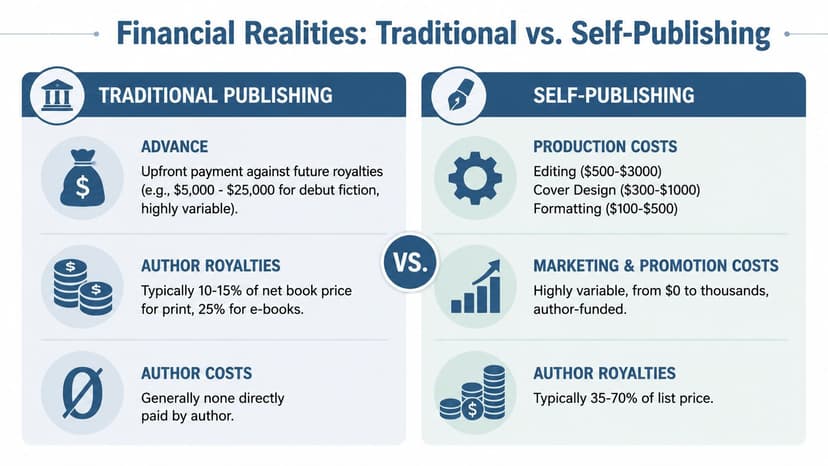
According to Tiffany Hawk's analysis, traditional authors generally receive an advance and royalties in the 8 to 15% range, while self-published authors may keep roughly 35 to 70% depending on format and retail price. The same source notes that producing a professional-quality self-published book can easily cost several thousand dollars once editing, design, and marketing are included, and cites an average of $3,360 per year in royalties for traditionally published book-only earnings in one benchmark figure from the article's discussion of author income realities in this publishing economics analysis.
Traditional publishing finances
Traditional publishing is a lower-capital model for the author. The publisher pays to produce the book. The author typically receives an advance, then earns royalties based on the contract.
That sounds safer because it is safer from a cash-flow standpoint. You don't need to fund editing, cover design, or interior production directly. The trade-off is that your share per sale is smaller, and the publisher keeps most of the economic upside because they funded the operation and control the distribution.
Traditional publishing often works best financially for authors who want:
- Lower upfront risk
- Professional production without self-funding
- A chance at bookstore and library exposure
- A deal structure that pays before sales royalties arrive
Self publishing finances
Self publishing flips that model. There is no built-in advance. You pay for production and launch, or you do some of the work yourself. In exchange, each sale can return a much larger share to you.
That higher royalty rate matters. It gives indie authors more room to build a business around a backlist, series, niche catalog, or direct audience relationship. But higher margin doesn't mean automatic profit. You still have to recover your upfront spend.
The break-even question matters more than royalties
Many authors fixate on royalty percentages and ignore break-even math. That's backwards. The first financial question in self publishing isn't “What's the royalty?” It's “How many sales do I need before I stop recovering costs and start earning profit?”
Your break-even point depends on:
- Total upfront spend
- Per-copy earnings after retailer and print costs
- How much marketing you plan to fund after launch
- Whether the book is a one-off or part of a longer catalog strategy
If you're pricing and modeling your book for Amazon, an Amazon KDP royalty calculator is useful for translating list price into realistic per-sale earnings before you commit to a publishing path.
Financial reality: Traditional publishing lowers the cost of entry. Self publishing raises the cost of entry and can raise the ceiling if the book finds readers.
Which model is more forgiving
Traditional publishing is more forgiving if you can't or won't invest cash upfront. It's also easier on authors who don't want to manage vendors, compare editing quotes, or make pricing decisions.
Self publishing is more forgiving if you can execute well over time. One strong release can underperform and still contribute to a larger catalog strategy later. You retain rights, can repackage, relaunch, adjust pricing, and test new channels.
That flexibility has real business value, even when a single launch starts slowly.
Common financial mistakes
A few patterns cause problems repeatedly.
-
Underbudgeting production
Authors spend heavily on ads while skipping editing or cover quality, then wonder why conversion is weak. -
Confusing revenue with profit
Higher royalties don't mean more money if the book never earns back its production and marketing spend. -
Treating the book as a one-time event
Self publishing tends to work better when the author thinks in assets, rights, and catalog life rather than one launch window.
Traditional publishing has its own blind spot. Some authors assume that getting a deal means the economics are automatically favorable. They aren't always. Lower royalties, slower timelines, and limited control can be acceptable trade-offs, but they are still trade-offs.
Marketing and Distribution Channels
A good book doesn't go anywhere on its own. It moves through channels that someone has to secure, manage, and support.

In this part of the decision, the core question isn't “Will anyone market my book?” It's “Who is responsible for building the path between this book and its readers?”
Nathan Bransford notes that traditional publishing has the strongest built-in route to bookstore and library placement, while self publishing can move much faster but usually lacks that trade infrastructure unless the author builds it independently. He also notes that the timeline from signed deal to retail availability is commonly about two years, and that self-publishing is often a better fit for time-sensitive launches, niche topics, or rapid testing of demand in his comparison of self-publishing and traditional publishing.
Traditional distribution strength
Traditional publishing still has the clearest path into physical retail and library systems. That matters if your definition of success includes bookstore visibility, institutional legitimacy, or the support of established sales teams.
A traditional publisher can coordinate:
- Trade distribution
- Sales representation to retailers
- Library channel access
- Catalog placement and seasonal scheduling
- Some publicity and marketing support
That support is real, but authors should stay realistic. Even in traditional publishing, not every title gets the same level of attention. Being signed is not the same as being heavily pushed.
Self publishing distribution strength
Self publishing is strongest where speed, flexibility, and direct reader access matter. Platforms like Amazon KDP, Apple Books, and Kobo make publication far simpler than the old gatekept model, especially for ebook-first or niche projects.
That simplicity shifts the burden to the author. If you self-publish, you are responsible for most or all of:
- Retail setup and metadata
- Launch planning
- Email list building
- Reader acquisition
- Advertising and promotional testing
- Ongoing category and pricing adjustments
For many indie authors, this is manageable because the channels are accessible. It's still work. You aren't outsourcing marketing. You're building it.
The practical difference in mindset
Traditional publishing asks, “Can this project fit our existing system?”
Self publishing asks, “Can you build a system that consistently sells this project?”
That's a very different career posture. Some authors want to write and collaborate inside a publisher's framework. Others want to own the reader relationship, test offers, control timing, and improve their process with each release.
If you're leaning indie and want a more grounded look at launch responsibilities, this guide on how to market a self-published book is a useful place to map the work before you upload anything.
A bookstore presence is powerful, but so is speed. The right channel strategy depends on whether your book needs institutional reach or entrepreneurial momentum.
What tends to work best for each path
Traditional publishing fits best when:
- Bookstore placement matters a lot
- Library visibility is a priority
- External validation is part of the goal
- The author wants a partner to run core sales-channel operations
Self publishing fits best when:
- The topic is timely
- The audience is niche but clearly reachable
- The author wants to test demand quickly
- The author is willing to learn retail and marketing systems
The distribution choice is really a decision about strategic advantage. Traditional publishing gives you access to established channel influence. Self-publishing gives you direct control over operations if you can build and maintain it yourself.
The Modern Author Defining Success on Your Own Terms
The prestige hierarchy around publishing used to make this decision feel simple. Traditional publishing was treated as the destination, and self publishing was framed as the backup plan. That view doesn't describe the current market very well.
The Alliance of Independent Authors reports that in its 2025 Indie Author Income Survey, the median self-published author income was $13,500, up 6% year over year, while the typical traditionally published author earned about $6,000 to $8,000 and was trending downward. The same fact sheet says fewer than 50% of authors under 45 now want their next book traditionally published, and 30% of authors are already selling direct, with another 30% planning to do so in 2026. Those figures are summarized on the Alliance's independent author facts page.
Success now has more than one shape
That doesn't prove self publishing is better for everyone. It proves authors are evaluating success differently.
For one author, success means seeing the book in stores, landing institutional reviews, and working with an established house. For another, success means keeping rights, controlling release timing, building a direct customer base, and improving lifetime earnings across multiple formats.
Both are valid. Problems start when an author adopts someone else's scorecard.
Ask what you want the career to look like
A clear publishing decision usually comes from answering career questions, not ego questions.
Consider these:
- Do you want to be approved by a gatekeeper, or do you want to control the release yourself
- Do you want a single book deal, or do you want a long-term rights business
- Do you care more about institutional visibility or direct audience ownership
- Do you want to write books, or do you want to run an author enterprise with books at the center
Those answers affect more than print versus digital. They shape whether you pursue direct sales, build email infrastructure, and expand into adjacent formats. If audio is on your roadmap, this guide to AI audiobook narration is useful for understanding one of the newer production options authors are evaluating alongside print and ebook.
The strongest modern advantage in self publishing
The strongest modern advantage isn't only higher control. It's optionality.
When you self-publish, you can revise the package, change pricing, add formats, test direct selling, relaunch older titles, or reposition a series without waiting for corporate approval. That flexibility compounds over time if you treat your books as assets.
Traditional publishing offers a different kind of advantage. It can still deliver a level of validation, trade access, and professional infrastructure that many authors value greatly. For some books, especially those aimed at channels where curation matters, that support may be worth the slower pace and reduced control.
Your best publishing path is the one that matches your definition of a successful author life, not the one that wins the most approval online.
Decision Checklist Which Path Is Right for You
A good decision usually becomes obvious once you stop asking abstract questions and start testing your actual constraints.
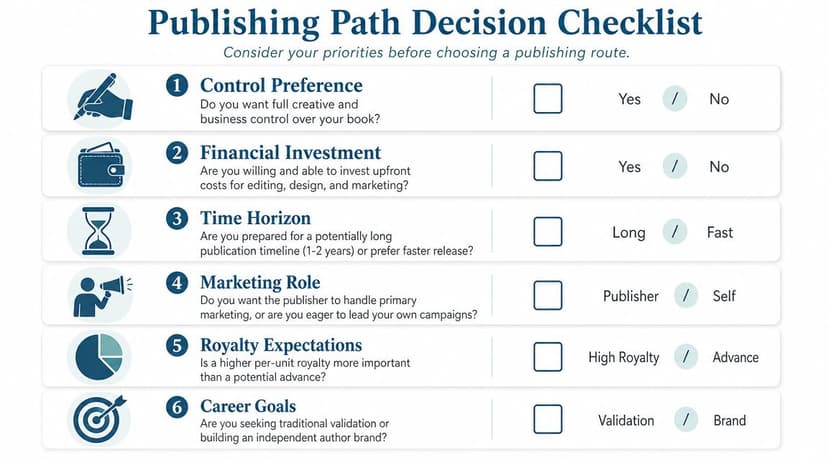
Choose traditional publishing if most of these feel true
-
You want outside validation before the book goes to market
You'd rather clear an acquisitions process and work inside a publisher's framework. -
Bookstore and library presence matter more than release speed
Physical shelf visibility is part of your definition of success. -
You don't want to fund production yourself
You'd rather accept lower margins than carry upfront costs. -
You prefer collaboration even when it means compromise
You're comfortable with other professionals having strong influence over title, cover, schedule, and positioning. -
You don't want to run the publishing operation
You want to focus more on writing than vendor management, retail setup, and launch systems.
Choose self publishing if most of these feel true
-
Speed matters
Your book is timely, niche, seasonal, or part of a release strategy that benefits from moving quickly. -
You want to retain rights and control
You care about packaging, pricing, formats, timing, and long-term flexibility. -
You're willing to invest in professional execution
You understand that indie quality requires budgeting and management. -
You can tolerate business responsibility
Metadata, ads, distribution choices, launch planning, and reader communication don't scare you. -
You're building an author business, not just publishing one book
You want a catalog, direct audience relationship, and the ability to improve systems over time.
A fast self-audit
If you're stuck, answer these in one sitting:
- How important is speed to market for this specific book
- Is upfront investment a deal-breaker
- Do you want final say on the cover and packaging
- Would you rather query agents than hire freelancers
- Is shelf presence in bookstores central to your goal
- Are you willing to learn marketing instead of hoping someone else will handle it
- Do you want an advance more than higher per-copy earnings
- Are you choosing a path for this book only, or for the career you want to build
Your pattern matters more than any single answer.
Immediate next steps for each route
If you choose traditional publishing
- Research agents and imprints carefully based on your genre and category
- Polish the manuscript before querying because gatekeepers evaluate submission quality fast
- Prepare a professional query package that matches industry expectations
- Study contract terms closely if you get interest, especially around rights and control
If you choose self publishing
- Book editing before design and launch work
- Decide your trim size, formats, and distribution setup early
- Create a market-ready cover that fits your category, works at thumbnail size, and supports retail conversion
- Format the interior professionally
- Build your metadata and launch plan before uploading
- Use a free planning tool if you need help organizing the packaging stage. A practical place to start is BeYourCover's free tool, especially if you want to generate and compare early cover directions before committing to a final concept
The simplest final filter
Ask one last question: Do you want a publisher, or do you want to become one?
That question usually cuts through the noise. Traditional publishing rewards patience, selectivity, and collaboration inside an established structure. Self publishing rewards initiative, execution, and business ownership.
Neither path guarantees success. Both can work. The best choice is the one whose responsibilities you want to carry.
If you're moving toward self publishing, treat the cover, metadata, and launch plan as part of the product, not as finishing touches. Those details often determine whether a good book gets noticed.
Ready to Create Your Own Book Cover?
Turn your story into a visual masterpiece. Fill in the details below to start generating professional covers instantly.