How to Manage Multiple Projects Simultaneously Without Burnout
Learn how to manage multiple projects simultaneously with proven strategies for authors. Turn creative chaos into a streamlined workflow and avoid burnout.
Posted by
 Pablo Yáñez
Related reading
Letter of Transmittal Templates: Free Downloads 2026
Find the best letter of transmittal templates for any project. Get free, downloadable Word, PDF, & Google Docs files for business & authors.
Your Guide to the Perfect Book Cover Design Format
Master the book cover design format for KDP ebooks and print. Learn file types, dimensions, and color modes to publish your book with confidence.
How to Increase Book Sales on Amazon: An Author's Practical Guide
Learn how to increase book sales on Amazon with actionable strategies for metadata, pricing, ads, and cover design to amplify your KDP success.
Ready to design your cover?
Use our AI book cover generator to create tailored book cover concepts in minutes.


Juggling writing, editing, cover design, and marketing for a single book is tough. Doing it for several books at once can lead to creative chaos. To effectively manage multiple projects simultaneously, you need to move beyond a simple to-do list and build a repeatable system. The secret isn't working harder—it's working smarter by being strategic about what you do and when.
The Indie Author's Dilemma: Juggling Multiple Projects
For indie authors, this challenge is magnified. You're not just a writer; you're a project manager, marketer, and designer, often for several books at different stages. One book might be in the first draft, another with an editor, and a third needing a full marketing launch. It's a web of deadlines that can lead to burnout if not properly managed.
Common pain points for authors include:
- Launch dates being pushed back due to planning issues.
- Feeling constantly overwhelmed by a never-ending task list.
- Making rushed decisions on crucial elements, like your book cover.
- Losing momentum on major projects while dealing with small, urgent tasks.
When you're stuck in this cycle, it's nearly impossible to know how to maintain work-life balance and avoid creative exhaustion. A solid system provides structure not just for your work, but for your sanity.
The goal is to turn this chaos into a well-oiled creative machine. This requires a shift from a reactive mindset—handling whatever is loudest—to a proactive one, where you strategically decide where to invest your time and energy.
This guide will serve as your playbook for making that shift. We'll cover everything from defining your projects and smart prioritization to executing work efficiently with the right tools. For instance, instead of designing a single cover, you can batch-create initial concepts for several projects at once—like a new set of romance book covers—by blocking out dedicated time.
By building a system, you replace the constant stress of juggling with the quiet confidence of knowing exactly what to work on next, and why.
If you're juggling multiple books, the chaos of half-finished manuscripts, scattered cover ideas, and looming deadlines can feel overwhelming. The key is to turn that chaos into a calm, predictable system by treating your author career like the business it is. The first step? Formally defining each book as a project.
For every book in your pipeline—whether it's a new idea or heading to an editor—create a "Project Brief." This doesn't need to be a complex corporate document; a simple one-pager is sufficient. This document becomes the north star for that specific book.
Think of a Project Brief as the blueprint for your book. It’s a simple document that prevents ‘scope creep’—the enemy of focused work—and ensures you have a clear plan before you invest your time and energy.
Your brief should outline the essentials:
- Key Deliverables: What are you actually creating? Go beyond just the manuscript. List the ebook cover, print cover, any audiobook assets, and promotional graphics you'll need.
- High-Level Timelines: You don't need a minute-by-minute schedule yet. Just map out the major milestones: first draft complete, edits finished, final cover approved.
- Genre and Market Specifics: What is the book's primary genre? Who is the target audience? What tropes or market expectations will guide your creative choices?
Once you have these simple briefs for each project, you're ready to integrate them into a system that works for creative professionals.
Adopting a Hybrid Management Approach
Rigid, long-term plans rarely survive the creative process. Ideas change, and new opportunities arise. That's why a hybrid approach, which blends big-picture planning with agile, short-term sprints, is highly effective for authors.
This approach is about moving from scattered tasks to a structured, successful workflow.
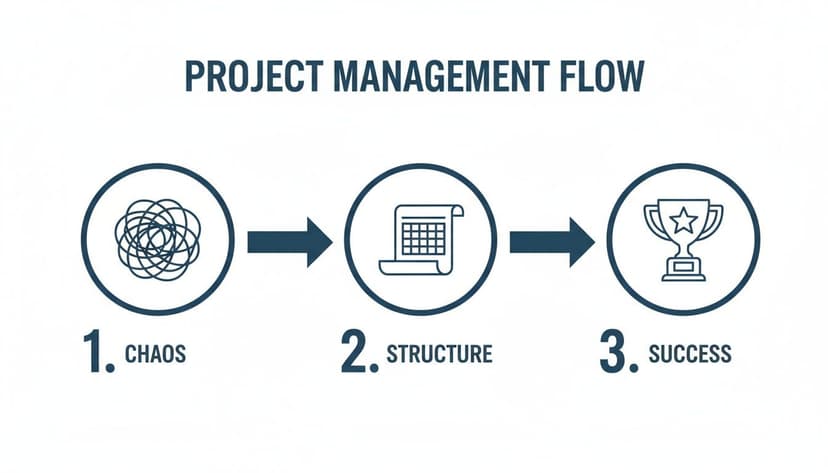
The flow is simple: you build a system that organizes the chaos without stifling creativity. It's about creating a clear path forward, even when working on multiple books at once.
Data supports this approach. According to ApolloTechnical.com, 58% of organizations now use a hybrid project management methodology. This adaptability is a significant advantage when managing multiple creative pipelines.
How a Hybrid Framework Works for Authors
So, what does this look like in practice?
It means you have a high-level plan for the year (traditional planning), but you break down the actual work into short, two-week "sprints" (Agile cycles). During each sprint, you tackle a small, curated batch of high-priority tasks from across all your projects.
A two-week sprint might look like this:
- Write three chapters of your new sci-fi manuscript.
- Review the copyedits for the romance novel that's almost ready.
- Generate five initial concepts for your new thriller book covers. This can be done efficiently using an AI tool to explore different visual directions.
- Schedule the social media posts for next month's launch.
This method allows you to make steady, visible progress on all fronts without feeling overwhelmed. You have the structure to handle everything from drafting to designing and testing multiple cover variations. By mixing long-term vision with short-term, focused execution, you build a reliable machine for your entire creative business.
Prioritizing Your Projects with Proven Frameworks
With multiple projects on your plate, the real challenge isn't just doing the work—it's deciding what to work on first. If you simply tackle whatever feels most urgent, you'll spend your days reacting to problems rather than making progress. To get ahead, you need an objective system for prioritization.
A good framework acts as a filter, helping you see where your energy will have the greatest impact.
Using the Eisenhower Matrix
One of the most effective methods is the Eisenhower Matrix. It sorts tasks based on two questions: Is it urgent? And is it important? The key is understanding that these two qualities are not always the same.
Your tasks will fall into one of four quadrants:
- Do First (Urgent & Important): These are time-sensitive, high-stakes tasks. Think finalizing a cover for a book that launches next week or implementing critical editor feedback on a tight deadline.
- Schedule (Important & Not Urgent): This is where your long-term career is built. Writing new chapters, outlining your next book, or developing your author brand reside here. You must schedule dedicated time for these, or the "urgent" tasks will always take over.
- Delegate (Urgent & Not Important): These are tasks that create noise but add little value, such as minor administrative work. If you can't delegate them, batch them into a short, contained time slot to minimize disruption.
- Eliminate (Not Urgent & Not Important): Be ruthless here. This includes mindless social media scrolling, obsessing over minor details no reader will notice, or falling down unproductive research rabbit holes.
By consistently filtering your to-do list through this matrix, you train yourself to focus on what truly moves your career forward. It ensures your most important work—like building a solid author brand—gets the attention it deserves. For more on this, check out our guide on creating a brand strategy template.
Scoping with Value vs. Effort
Another excellent tool, especially for comparing different types of tasks, is the Value vs. Effort analysis. It helps you identify the biggest wins for the least amount of pain.
The process is simple: for every task, score its potential value and required effort from 1 to 5.
- Value: How much does this task contribute to your goals? High-value tasks include finishing a first draft, approving a market-ready cover, or launching a profitable ad campaign.
- Effort: How much time, energy, and money will this take? Writing a chapter is high effort. Generating initial cover mockups with an AI tool can be low effort.
Once scored, your priorities become clear:
- Quick Wins (High Value, Low Effort): Do these immediately. This is your low-hanging fruit, like testing a new ad creative or generating fresh cover concepts.
- Major Projects (High Value, High Effort): This is your core work, like writing the manuscript. Break them into smaller chunks and schedule them as "Important & Not Urgent" tasks.
- Fill-in Tasks (Low Value, Low effort): Handle these during small gaps in your day, but don't let them interrupt your deep work.
- Thankless Tasks (Low Value, High Effort): Avoid these. They drain resources for minimal return. Re-evaluate if they're truly necessary.
To see this in action, here’s a quick example of how an author might prioritize tasks across different books.
Project Prioritization Matrix for Authors
| Project Task | Book Title | Value Score (1-5) | Effort Score (1-5) | Priority Quadrant |
|---|---|---|---|---|
| Write Chapter 10 | Chronicles of the Void | 5 | 5 | Major Project |
| Finalize Cover Design | Whispers in the Mist | 5 | 2 | Quick Win |
| Research Historical Details | Chronicles of the Void | 3 | 4 | Major Project (Lower) |
| Outline Book 2 | Whispers in the Mist | 4 | 3 | Major Project |
| Update Author Website | General Admin | 2 | 2 | Fill-in Task |
| Brainstorm Cover Ideas | Untitled Book 3 | 4 | 1 | Quick Win |
| Respond to All Social Media Comments | General Admin | 1 | 3 | Thankless Task |
Using a simple table like this gives you a bird's-eye view, making it obvious that finalizing the cover for Whispers in the Mist is a much smarter move than getting lost in historical research right now.
Ultimately, these frameworks help you shift from asking, "What should I do next?" to the much more powerful question: "What is the most valuable use of my time right now?" That strategic mindset is the key to managing a full pipeline of creative projects without feeling overwhelmed.
With your priorities set, the next step is execution. The biggest enemy of productivity is context switching—jumping from drafting a chapter to tweaking a cover design to answering emails. This approach demolishes your focus and creative energy.
To combat this, you need to run your day, not let your day run you. Two powerful techniques for this are time blocking and task batching.

Think of these methods as guardrails for your attention. Instead of being pulled in a dozen directions, you assign a specific job to every part of your day. This is the foundation for learning how to manage multiple projects simultaneously without constant overwhelm.
Protect Your Focus with Dedicated Time Blocks
Time blocking involves scheduling specific, non-negotiable appointments with your work. Your vague to-do list becomes a concrete plan on your calendar. Most people have only about four hours of peak creative focus per day; time blocking helps you defend that precious window.
Here's how it might look for an author juggling multiple projects:
- Deep Work Block (9 AM - 11 AM): This is sacred time for your most demanding task—usually writing. All notifications are off. You are doing nothing but drafting new chapters.
- Creative Block (1 PM - 2 PM): This slot is for more visual or conceptual work, like brainstorming book cover ideas or outlining. It uses a different part of your brain than writing, so it gets its own dedicated block.
- Admin Block (4 PM - 5 PM): Corral all the "shallow" work here: answering emails, updating your project board, and scheduling social media posts.
When you work this way, you become intentional. You're not just "working on the book"; you're committing a protected period to a specific part of the process. The mental cost of switching gears drops, making it easier to achieve a state of flow.
Get More Done with Task Batching
If time blocking tells you when to work, task batching tells you how. It’s a simple strategy: group similar tasks together and do them all in one focused session. A great example of this is batch content creation, a method you can easily adapt to your author workflow.
Instead of designing one cover, then writing a bit, then doing some marketing, you’d hold a single session dedicated to all your design work across multiple books.
By grouping similar activities, you stay in the same mental "mode." This cuts down on the warm-up time needed for each task and lets you build incredible momentum. You’re not constantly starting and stopping; you’re on a roll.
Here's how an author can apply this:
- Cover Design Batch: Set aside a "cover session." You could generate dozens of initial concepts for three different books in under an hour. You can use an AI tool to create a project for each, input your briefs, and get a library of genre-appropriate starting points for your upcoming social media marketing for authors. Schedule another block later to refine your top picks.
- Marketing Batch: Dedicate one afternoon a week to all things marketing. This is when you write your newsletter, schedule a month of social media posts, and check your ad performance. Everything is done at once.
- Research Batch: If multiple books require research, block out a solid chunk of time to do it all at once. Your brain will already be in an analytical, fact-finding mode, making the process more efficient.
When you combine time blocking with task batching, you create a system built for execution. You have dedicated slots for specific work, and within those slots, you're efficiently tackling similar tasks for all your projects. This is how you make real, tangible progress on every front.
Building Your Project Management Tech Stack
A great system needs the right tools to function effectively. For an author juggling multiple books, a solid tech stack is a necessity, not a luxury. It acts as a force multiplier for your efforts.

A practical toolkit for a busy author should cover three core functions: project management, asset management, and creative generation.
Your Project Management Hub
To get a bird's-eye view of all your books, a visual project management tool is essential. Kanban-style boards from tools like Trello, Asana, or Notion are perfect for this. Create a master board for your author business with columns like "Idea," "Outlining," "Drafting," "Editing," "Cover Design," and "Published."
Each book becomes a "card" that you drag across the board as it hits new milestones. This visual flow provides an instant status update, ensuring nothing falls through the cracks. According to research compiled by The Digital Project Manager, organizations using formal project management methods are more likely to achieve their goals.
Mastering Your Asset Management
As you manage multiple books, you'll accumulate a large number of digital files: manuscripts, cover images, ad graphics, and source files. Good asset management comes down to two simple habits.
- Centralize with Cloud Storage: Use a service like Google Drive or Dropbox to keep every file in one place. This prevents the frustrating search for a specific file across different devices.
- Use Clear Naming Conventions: A consistent file naming system is a lifesaver. A logical format saves a surprising amount of time and prevents costly mistakes.
A simple but powerful naming system looks like this:
BookTitle_AssetType_Format_v#.ext. For example, a file namedWhispersInTheMist_Cover_Ebook_v3.jpgtells you everything instantly. It's the third version of the ebook cover for Whispers in the Mist.
This discipline means you can find any asset in seconds. This organization is a key part of increasing operational efficiency and reducing the administrative burden on your creative time.
Using AI as a Management Asset
AI cover generators can be more than just creative tools; they can be project management assets. Instead of managing a messy folder of JPEGs from a designer, an AI tool can keep all your cover iterations organized.
Modern AI platforms allow you to create a distinct project for each book. Within that project, you can generate and save dozens of cover variations, keeping them contained and easy to compare. You can have one project for your new fantasy series, another for your nonfiction guide, and a third for your upcoming collection of romance book covers.
This capability helps streamline one of the most asset-heavy parts of publishing, freeing you up to focus on creative decisions rather than file organization.
Common Questions About Managing Multiple Projects
Even with a strong system, juggling multiple book projects can be challenging. Here are answers to common questions that arise.
What Is the First Step if I Feel Completely Overwhelmed?
Feeling overwhelmed is often a symptom of a lack of clarity, not a lack of ability. The first step is a "brain dump." Write down every task, idea, and deadline that's on your mind. Don't organize it; just get it all out. This externalizes the chaos so you can deal with it objectively.
Once it's all written down, pick just one or two projects that are most important right now. For those, define the absolute single next action you need to take.
It doesn’t have to be a big move. It could be as small as:
- "Outline Chapter 1 for the new fantasy book."
- "Generate ten initial concepts for my new romance book covers."
- "Draft the email to my editor confirming the timeline."
This is how you break the paralysis. By narrowing your focus to one or two small, concrete wins, you turn that overwhelming feeling into momentum. It’s the fastest way to get back in control.
How Should I Handle Unexpected Delays or New Opportunities?
No project plan is perfect. An editor might get sick, or a new marketing opportunity may arise. A rigid system will break; a flexible one will bend.
When the unexpected happens, use your prioritization framework. Run the new task or opportunity through your Eisenhower Matrix or Value vs. Effort grid. Ask yourself:
- Is this new thing genuinely more valuable than what I had planned?
- Does this delay create a domino effect that I need to address now?
The goal is to pivot with purpose. If a high-value opportunity appears, consciously adjust your time blocks. If a project is delayed, update your project board and re-evaluate your priorities for the day. Your system is there to help you make these decisions confidently.
Are AI Tools Effective for Managing Multiple Book Covers at Once?
Yes, this is one of the significant workflow advantages of using AI for cover design. The traditional process is linear: you commission one cover, wait for revisions, approve it, and then start over for the next book.
AI allows you to work in parallel. Instead of tackling covers one by one, you can run a "cover batching" session. For example, you can generate dozens of initial concepts for your next three books in under an hour. With a tool like BeYourCover, you can create a separate project for each title, provide a unique brief, and let the AI generate genre-specific starting points for all of them at once.
This transforms cover design from a bottleneck into a streamlined, organized part of your production schedule, saving a massive amount of time.
How Often Should I Review and Adjust My Project Plan?
A weekly review is non-negotiable for managing multiple projects. It's the meeting that holds your author business together and prevents small issues from escalating.
Set aside 30-60 minutes at the same time each week, such as Friday afternoons or Monday mornings.
During your weekly review:
- Review the Past Week: What did you accomplish? Move completed tasks to "Done." What was delayed, and why?
- Update Your Boards: Adjust timelines based on new information. Add any new tasks that have come up.
- Plan the Week Ahead: Look at your priorities and schedule your non-negotiable time blocks. This ensures that "Important, Not Urgent" tasks—the ones that truly move your career forward—get done.
Think of this as the CEO meeting for your author business. It provides the foresight needed to steer all your projects toward the finish line without burning out.
Ready to Create Your Own Book Cover?
Turn your story into a visual masterpiece. Fill in the details below to start generating professional covers instantly.
