The 2026 Indie Author Report: What 9,210 Authors Write, and What Readers Search For
Who indie authors are in 2026 and what they write, set against what readers search for on Amazon and Google: dragons, spice, dark fantasy and sapphic romance.
Posted by
 Pablo Yáñez
Related reading
9 Best Book Marketing Tools for Indie Authors (2026)
Compare nine book marketing tools for indie authors, from market research and cover design to reader delivery, email, promotion, and ad tracking.
6 Best Book Brush Alternatives for Indie Authors (2026)
Looking for a Book Brush alternative? Six tools for indie authors compared — AI cover generators, mockup makers, and free options — with real pricing.
6 Best Canva Alternatives for Book Cover Design (2026)
The best Canva alternatives for book cover design: AI cover generators, free pro design apps, and author-specific tools — compared with honest pros and cons.
Ready to design your cover?
Use our AI book cover generator to create tailored book cover concepts in minutes.
Who are indie authors in 2026, and are they writing what readers look for? We counted what 9,210 authors told us about their books when they made a cover on BeYourCover this year: their genre, their title, their story. Then we set it against what readers type into Amazon and Google.
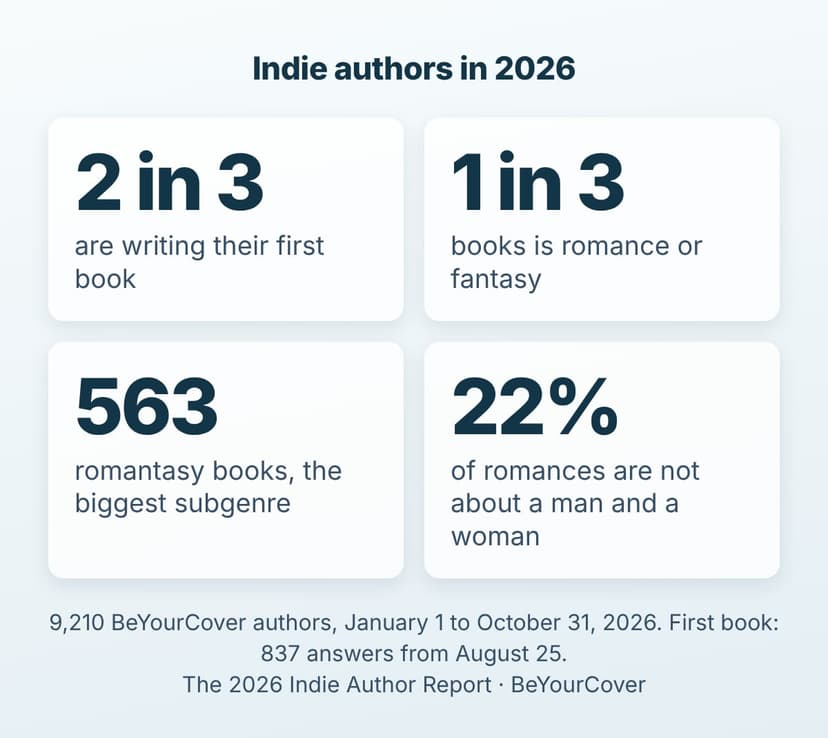
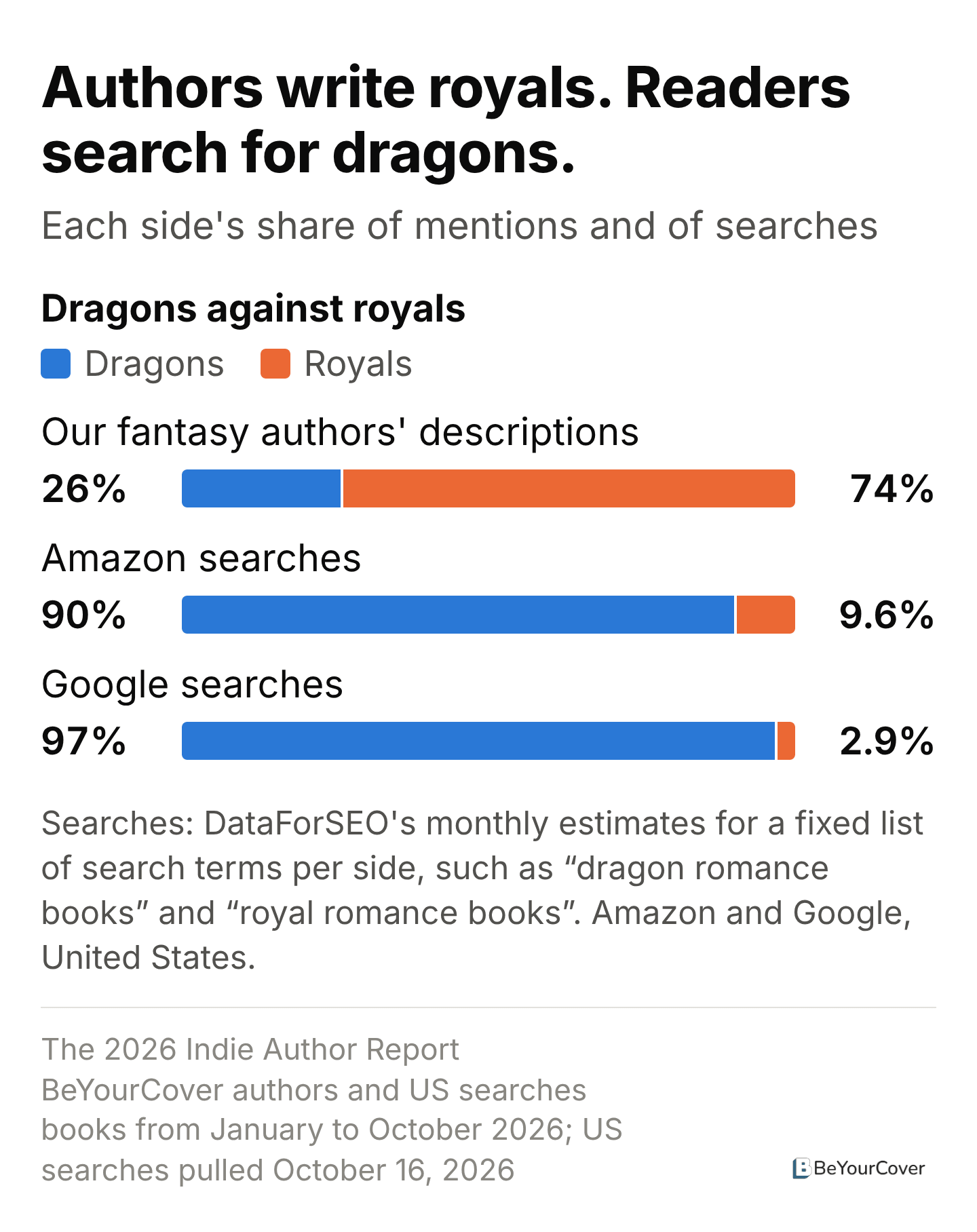
Most indie authors are new: 2 in 3 are writing their first book, and most write romance or fantasy. Readers, for their part, search for more dragons, more heat and darker stories than authors write. In our fantasy authors' book descriptions, royals outnumber dragons 3 to 1. On Amazon, 9 in 10 searches for dragon or royal books are for dragons.
This report describes BeYourCover authors, not the whole book market, and search counts are not sales. Together they show where indie writing and reader interest meet, and where they part.
Indie authors in 2026: the short version
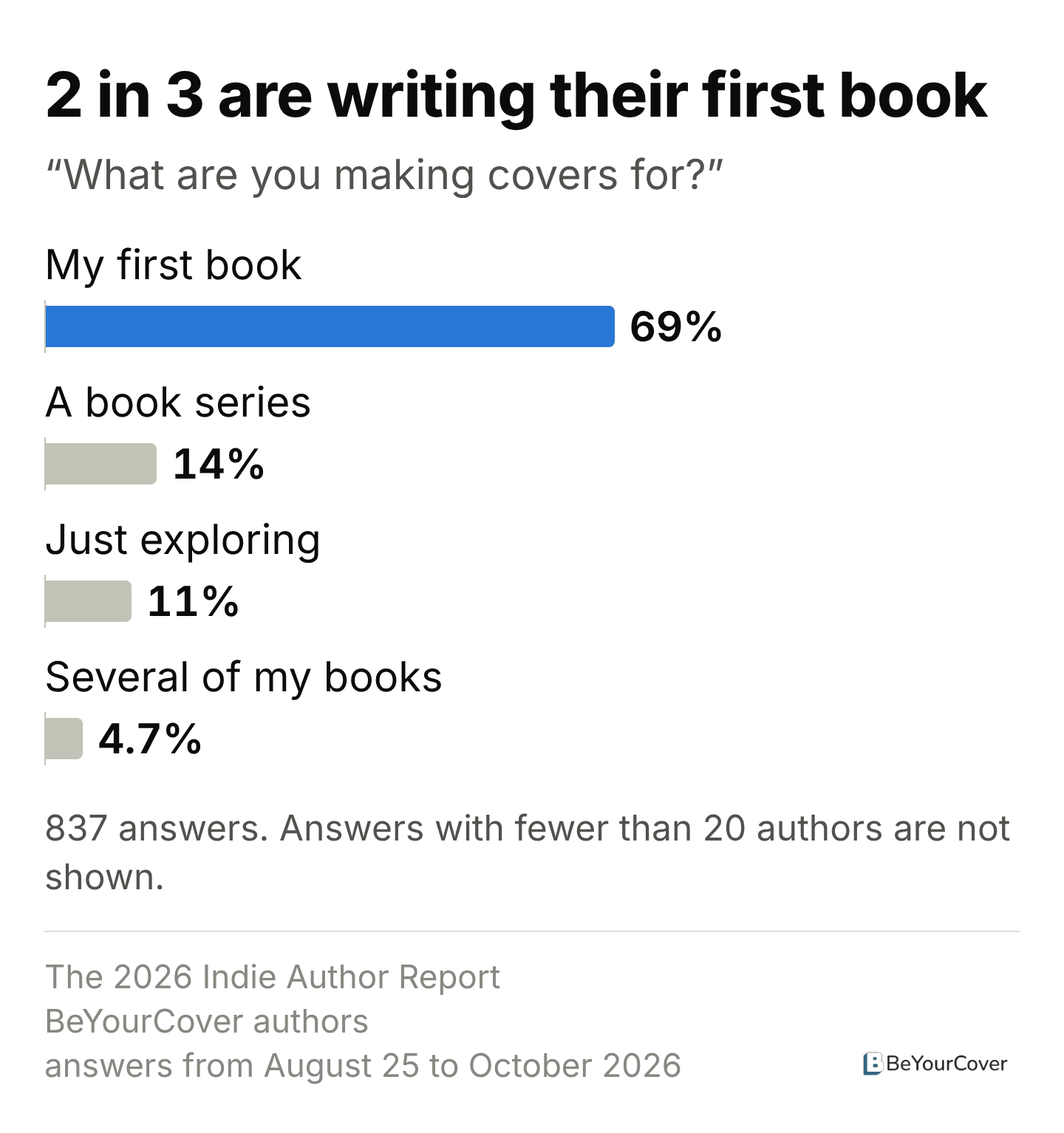
- 2 in 3 are writing their first book, and 96% made covers for one book with us this year.
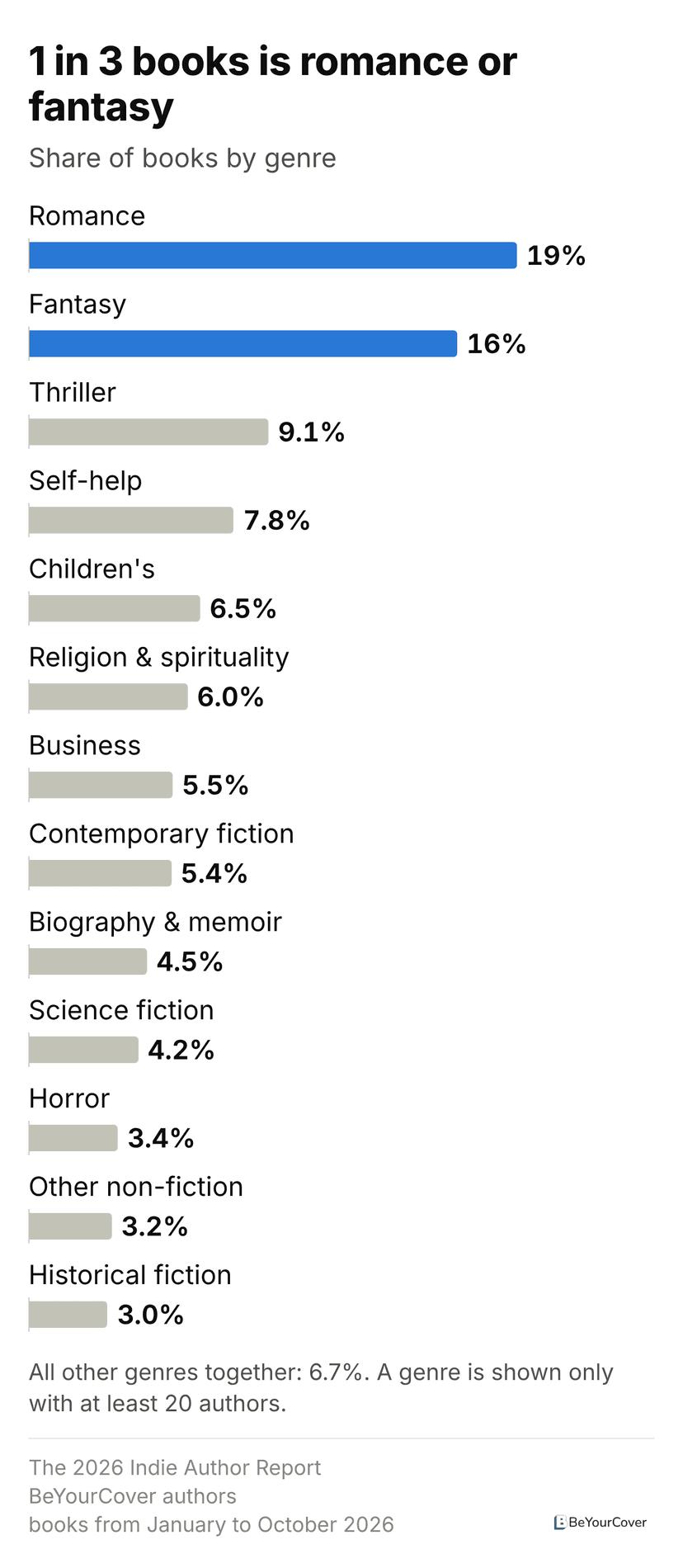
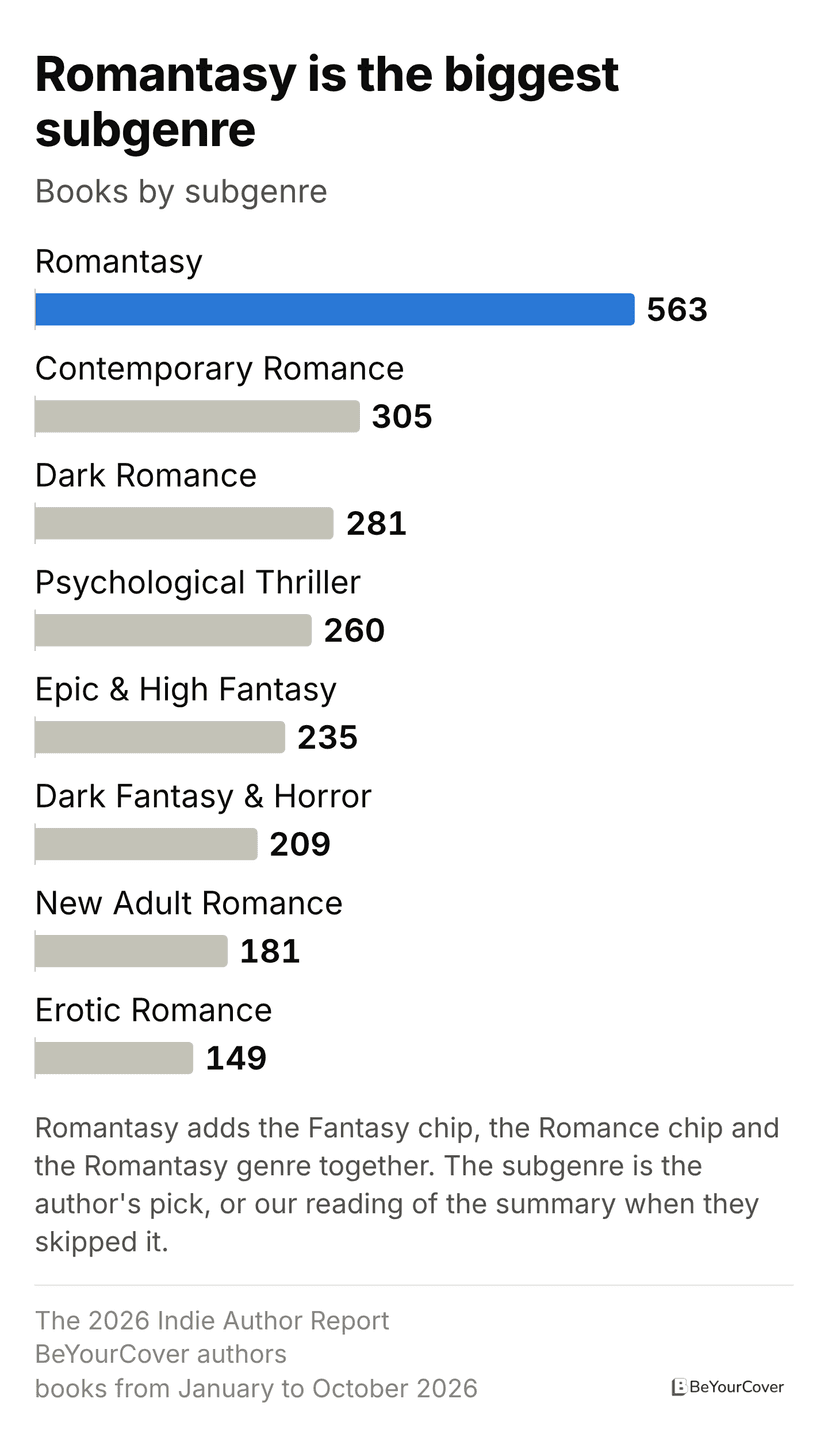
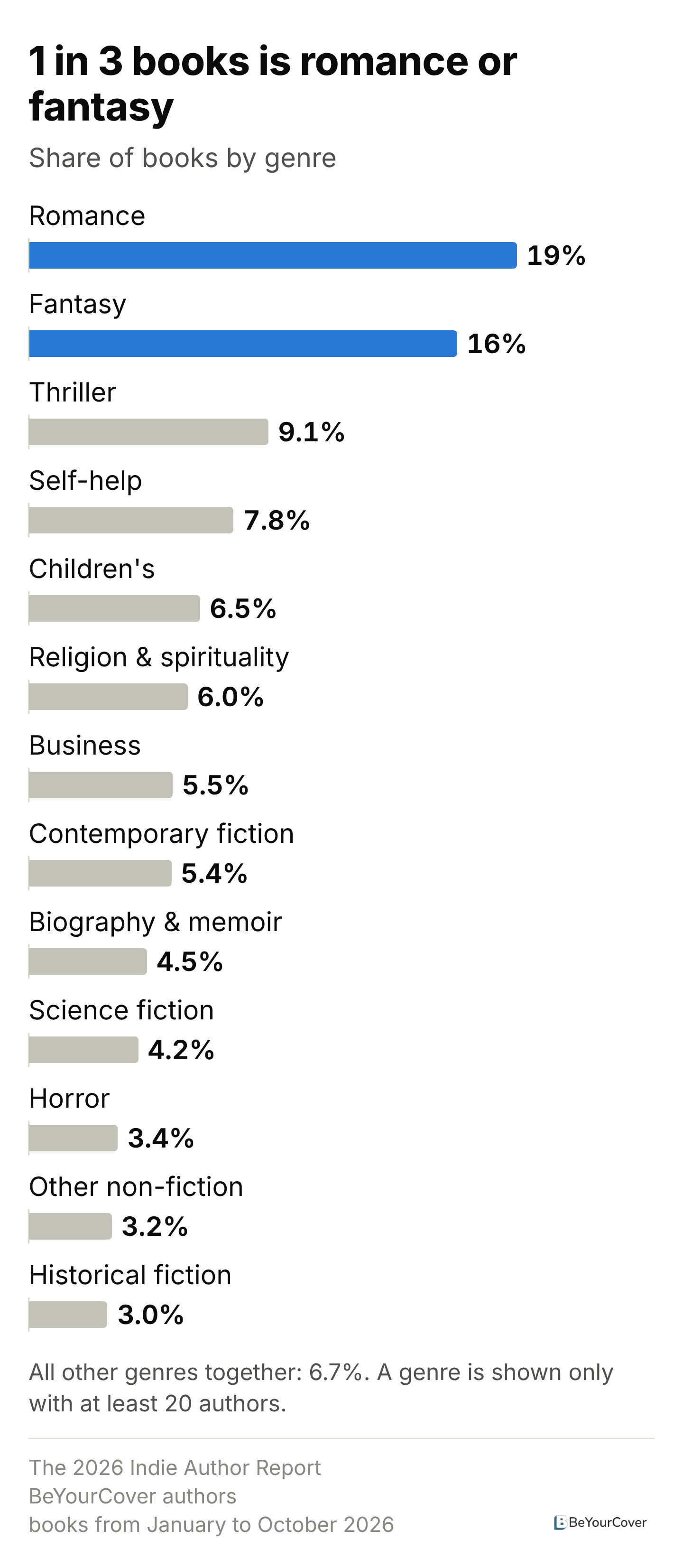
- 1 in 3 books is romance or fantasy. Romantasy is the biggest subgenre, with 563 books.
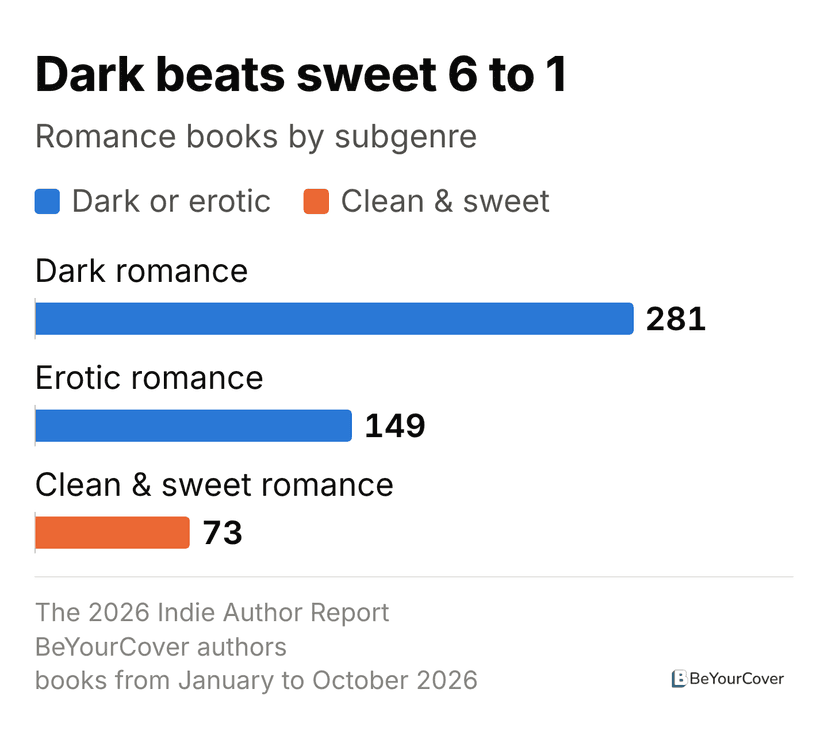
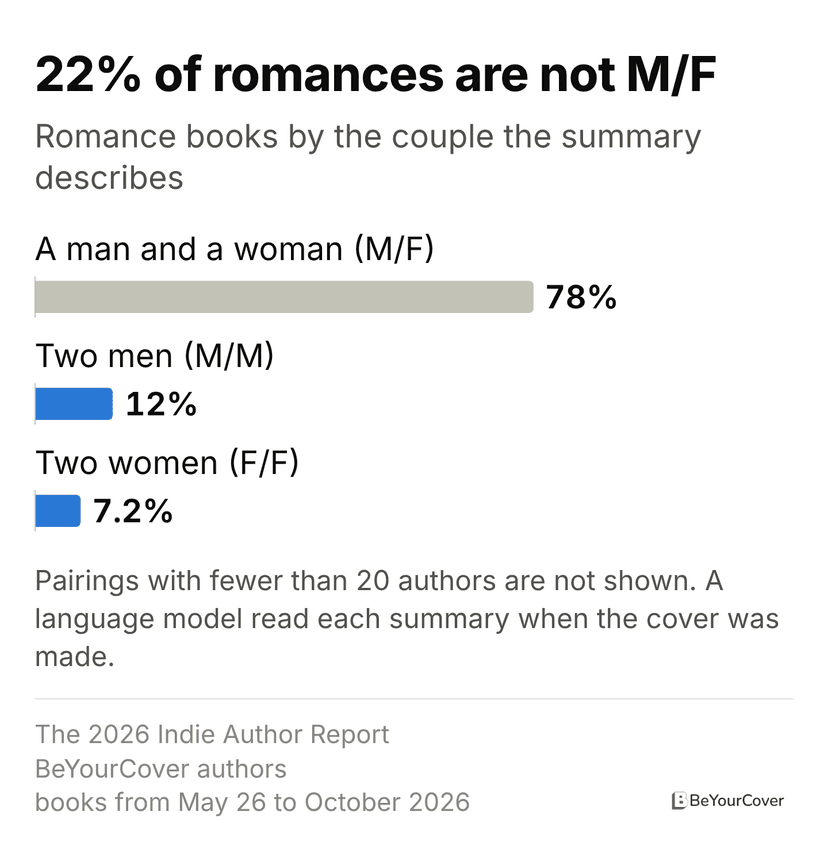
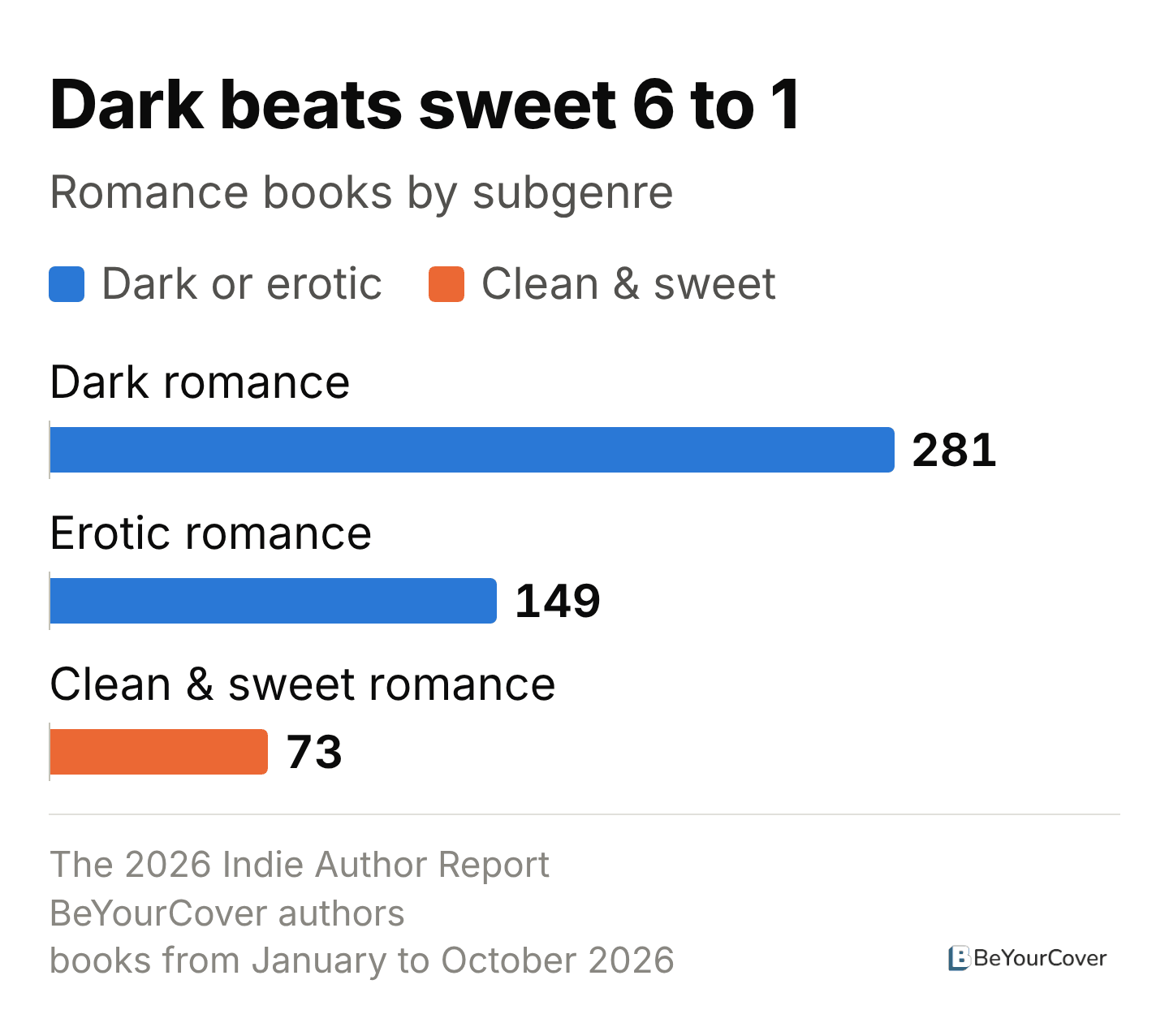
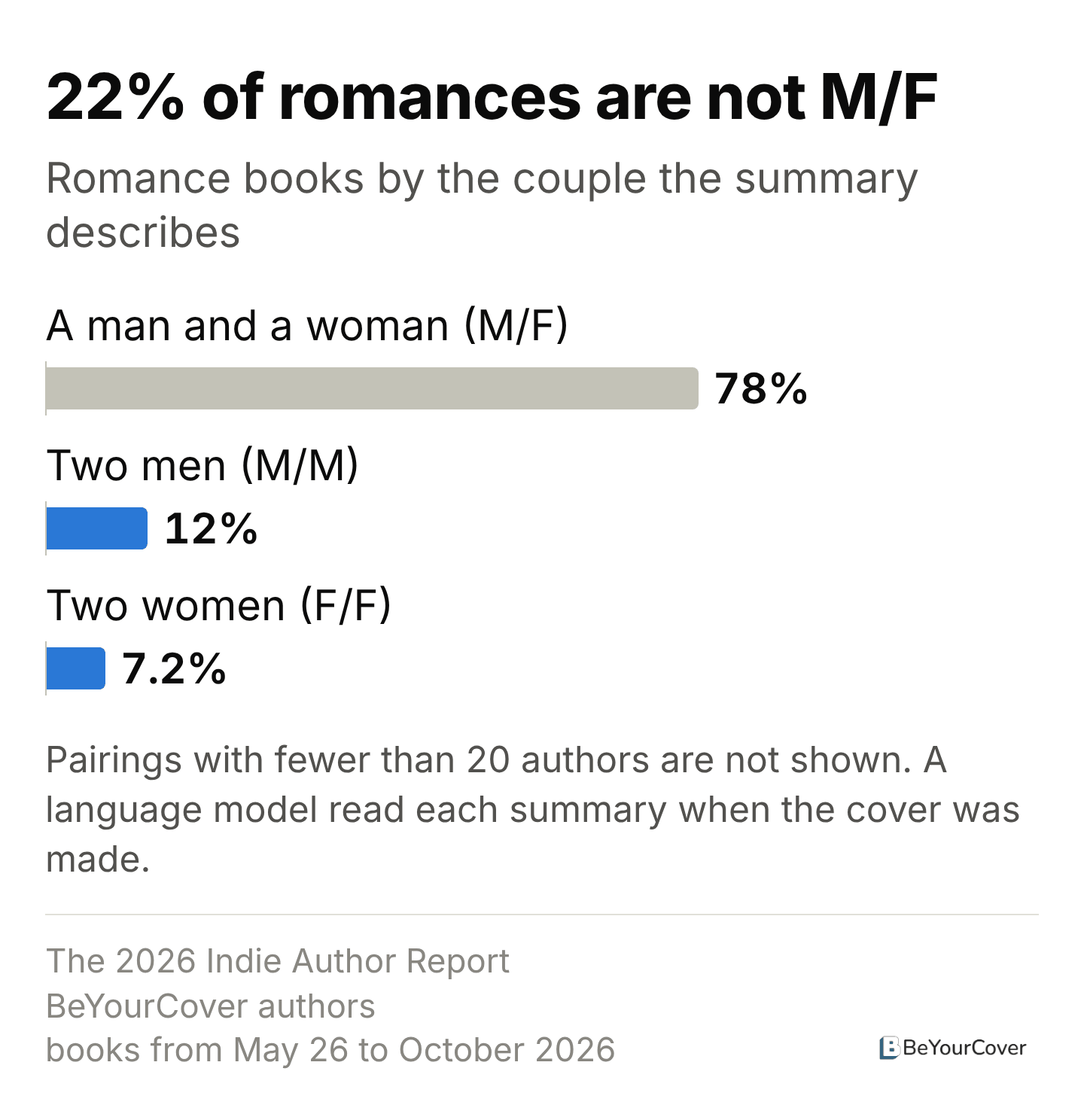
- Dark beats sweet 6 to 1 among romance subgenres, and 1 in 5 romances is not about a man and a woman.
- Readers search for dragons, authors write royals. On Amazon, 9 in 10 searches for dragon or royal books are for dragons.
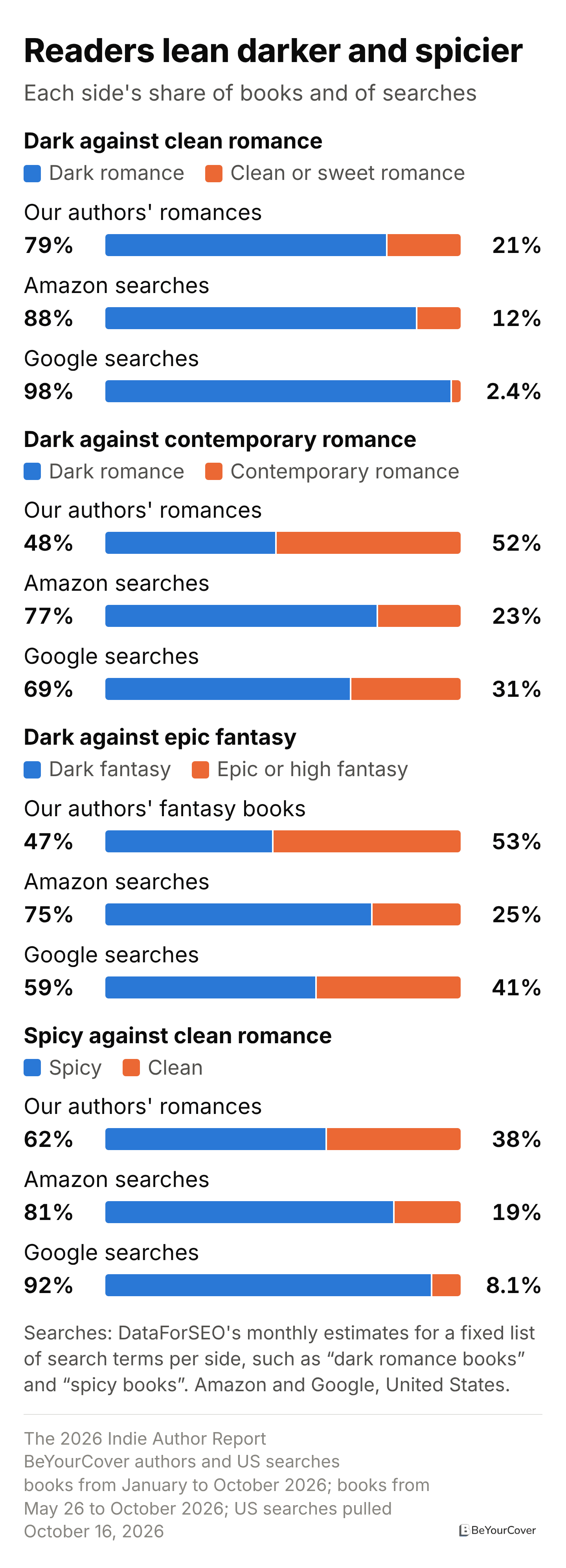
- Readers lean darker. Our authors wrote dark romance over clean romance 4 to 1. Readers searched for it more: nearly 9 in 10 of the Amazon searches for the two.
- And spicier. Our romance authors wrote spicy books over clean ones 2 to 1. Amazon searches ran 4 to 1.
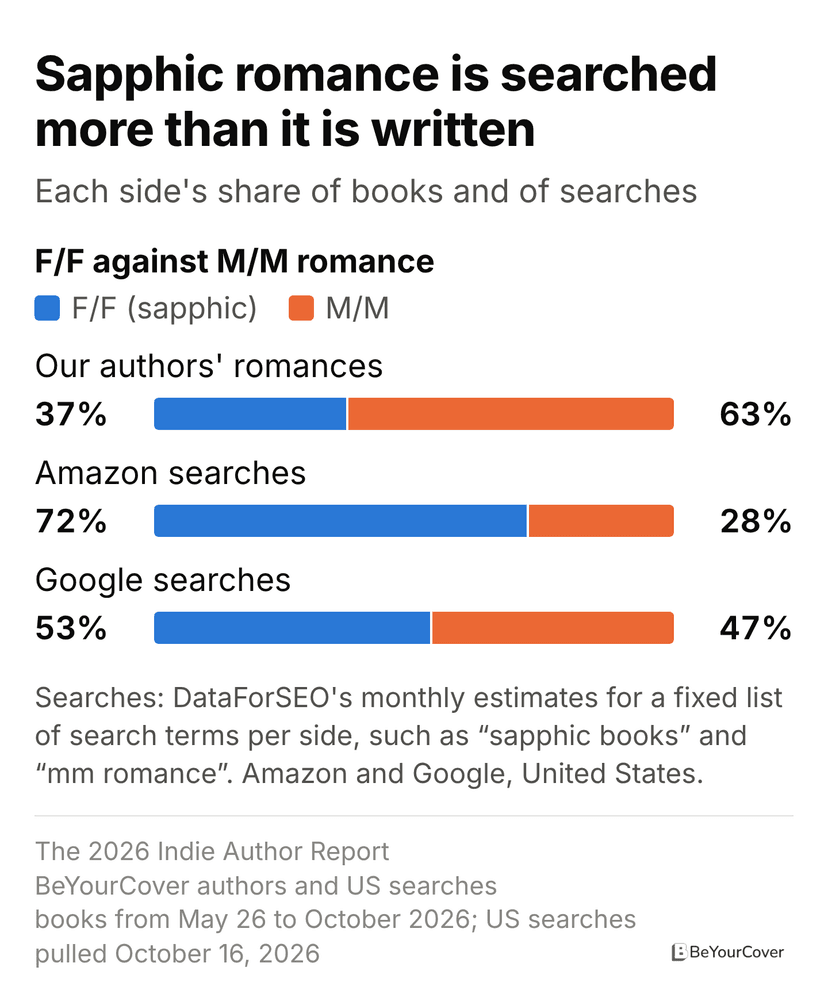
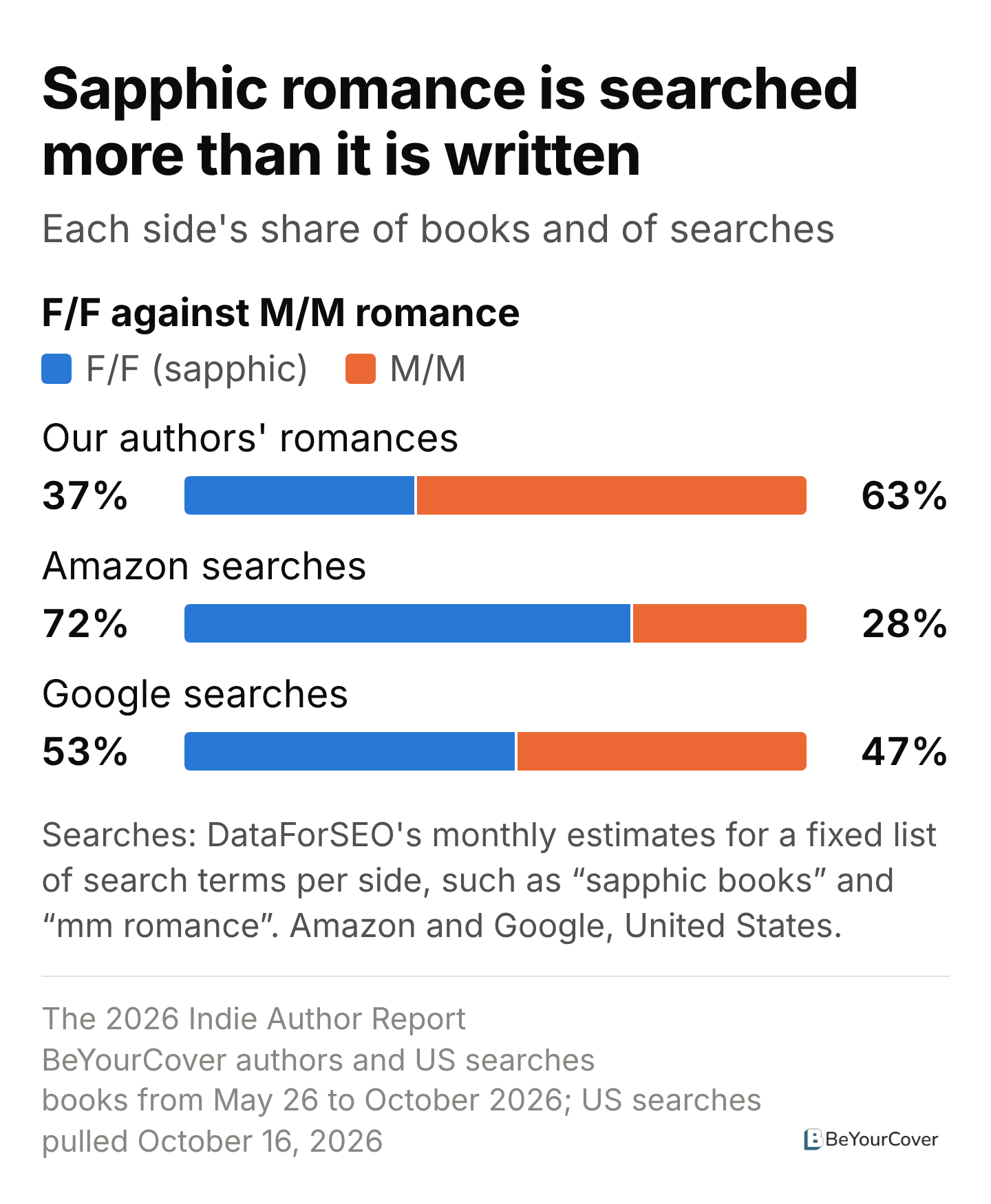
- Sapphic romance is searched more than it is written: 72% of the Amazon searches for F/F or M/M romance, against 37% of our authors' books.
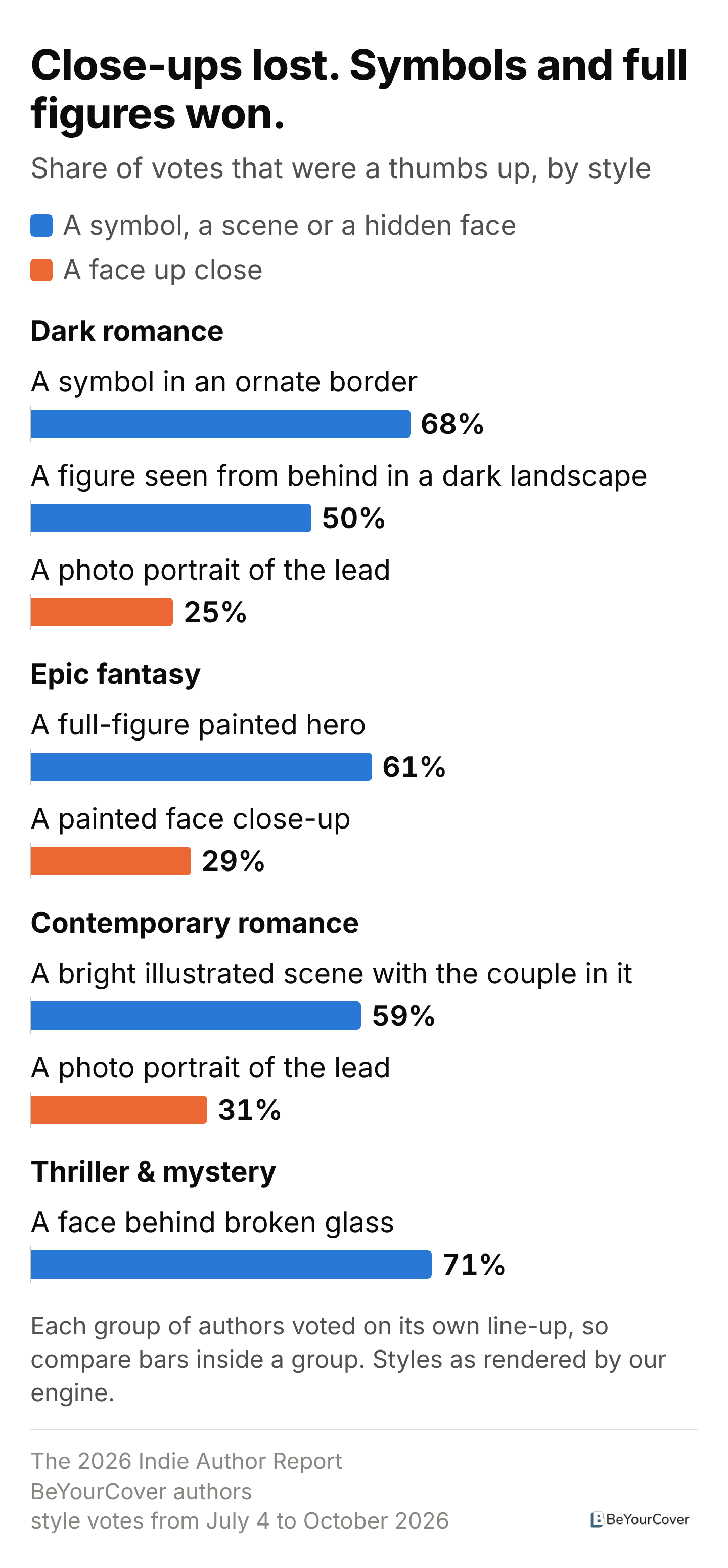
- On covers, close-ups lost. A photo portrait of the lead got a thumbs up in 25% of dark romance votes, against 40% for all styles.
How to read the numbers
- Our authors: what 9,210 authors typed or picked on BeYourCover between January 1 and October 31, 2026. A number appears only when at least 20 authors stand behind it.
- Reader searches: DataForSEO's estimates of monthly searches in the United States, on Amazon and on Google, pulled on October 16, 2026. They show what readers type, not what they buy.
- Fixed word lists: before the full pull, we fixed the search terms for each idea: every common way to say it ("clean", "sweet" and "closed door" romance), in five forms ("dark romance", "dark romance books" and so on).
- Only clear gaps: we report a gap between authors and readers only when Amazon and Google point the same way and the Amazon gap is larger than chance. All seven of our comparisons passed.
Who indie authors are in 2026
2 in 3 are writing their first book
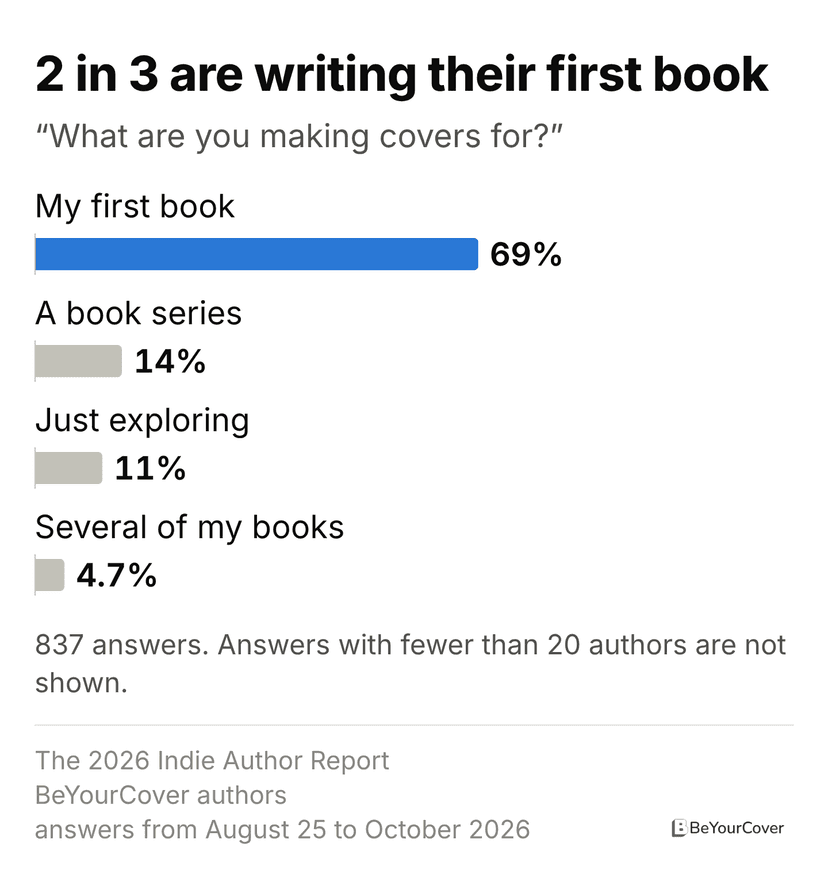
When an author starts on BeYourCover, we ask what they are making covers for. Of the 837 authors who answered since August 25, 69% said their first book. A book series came next (14%), then just exploring (11%). Across the whole year, 96% of our authors made covers for a single book.
1 in 3 books is romance or fantasy
Romance (19% of books) and fantasy (16%) lead, then thriller (9.1%), self-help (7.8%) and children's books (6.5%).
Romantasy is the biggest subgenre
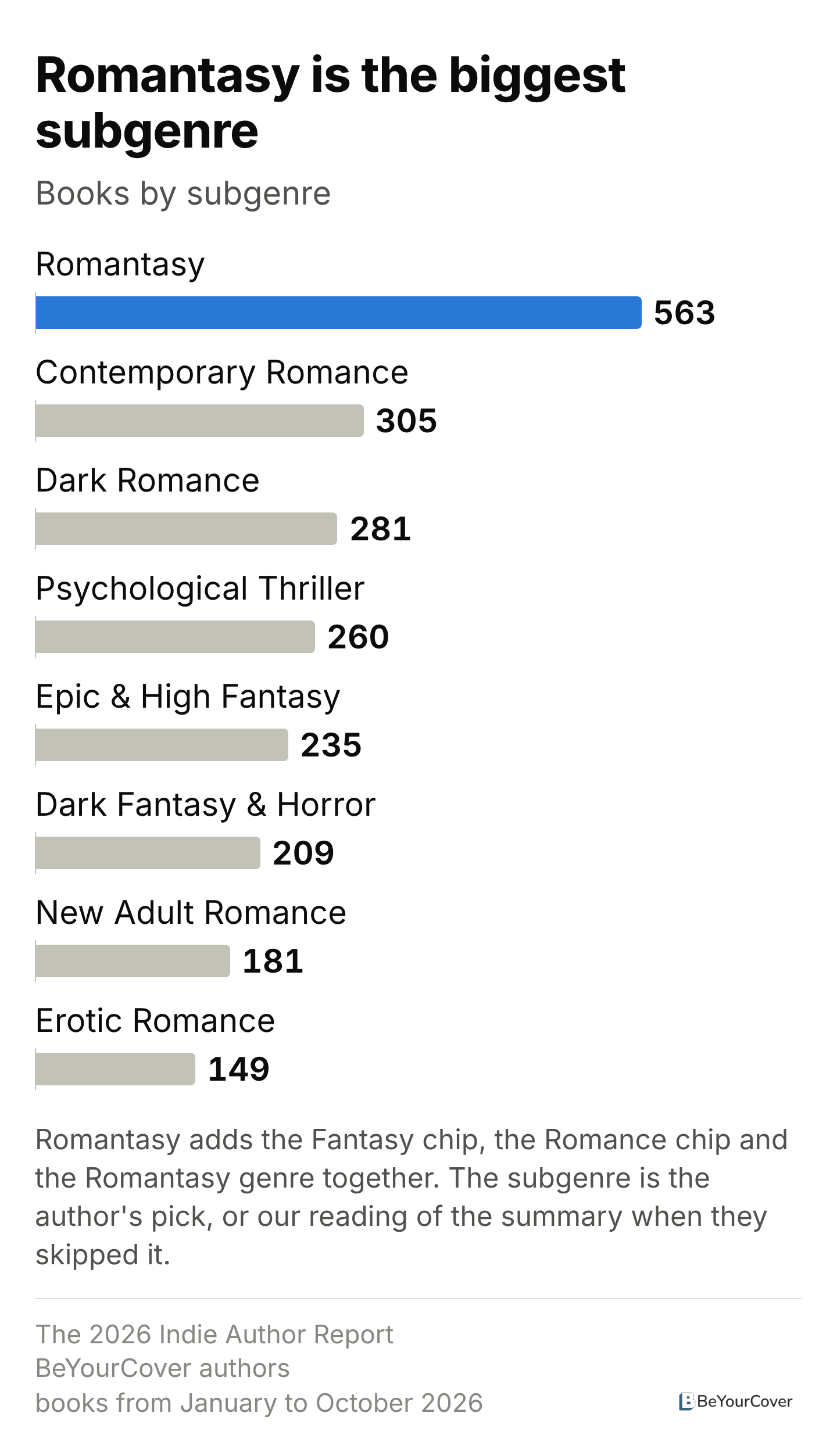
Romantasy, with 563 books, is the biggest subgenre, ahead of contemporary romance (305) and dark romance (281). Authors do not agree where it belongs: 340 filed it under fantasy, 187 under romance and 36 under its own genre.
Dark beats sweet 6 to 1
Dark romance (281 books) and erotic romance (149) together outnumber clean & sweet romance (73) 6 to 1.
1 in 5 romances is not M/F
Of the 514 romances whose summary names the couple, 78% are a man and a woman, 12% two men and 7.2% two women, so 22% are not M/F. 61% of romances are told from two points of view, while 84% of thrillers stay with one. And 34% of romances read as spicy or explicit.
Fantasy: crowns, shadows and royals
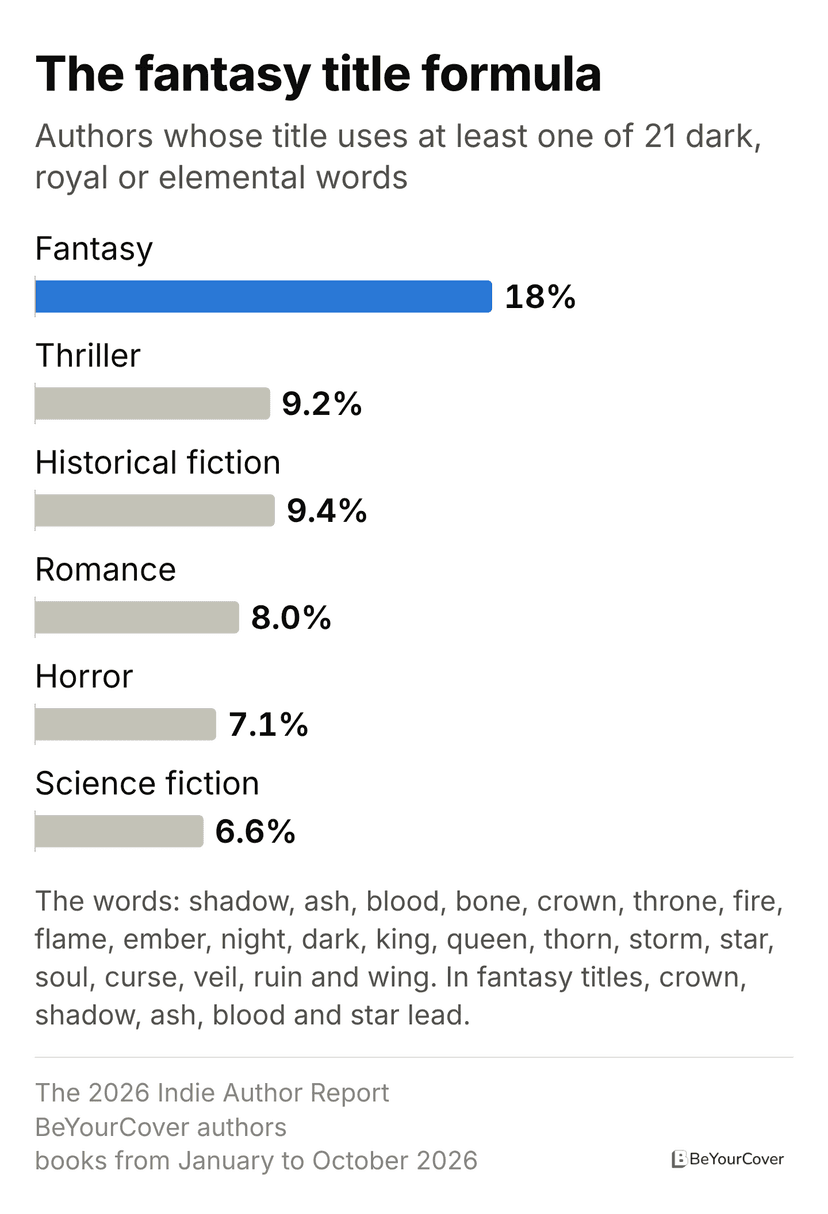
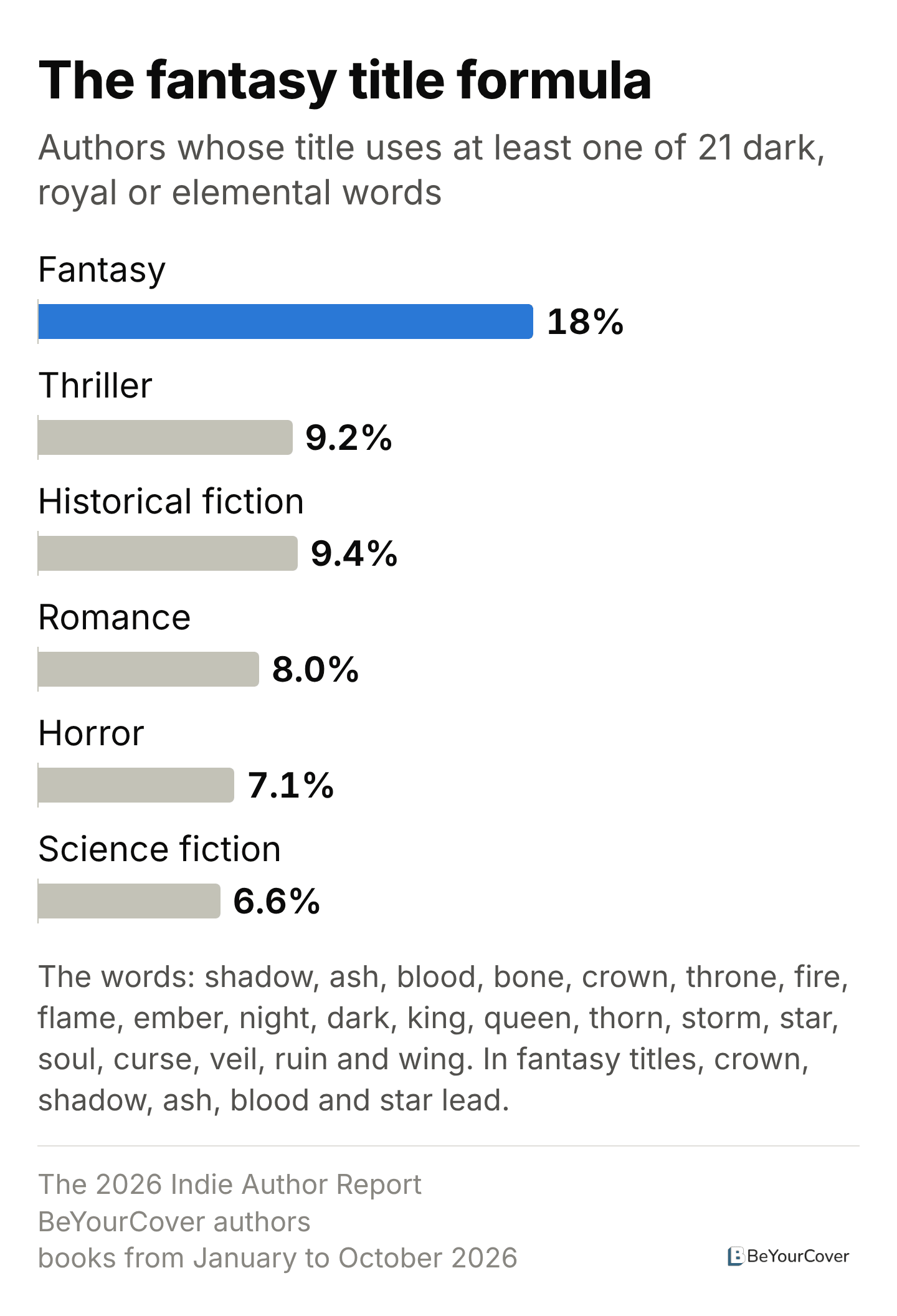
18% of fantasy authors used at least one of 21 dark, royal or elemental words in their title, against 9.2% of thriller authors. Crown leads (2.8% of fantasy authors), then shadow (2.2%), ash (2.1%) and blood (1.9%). And 18% of fantasy titles open with "The X of" or "A X of".
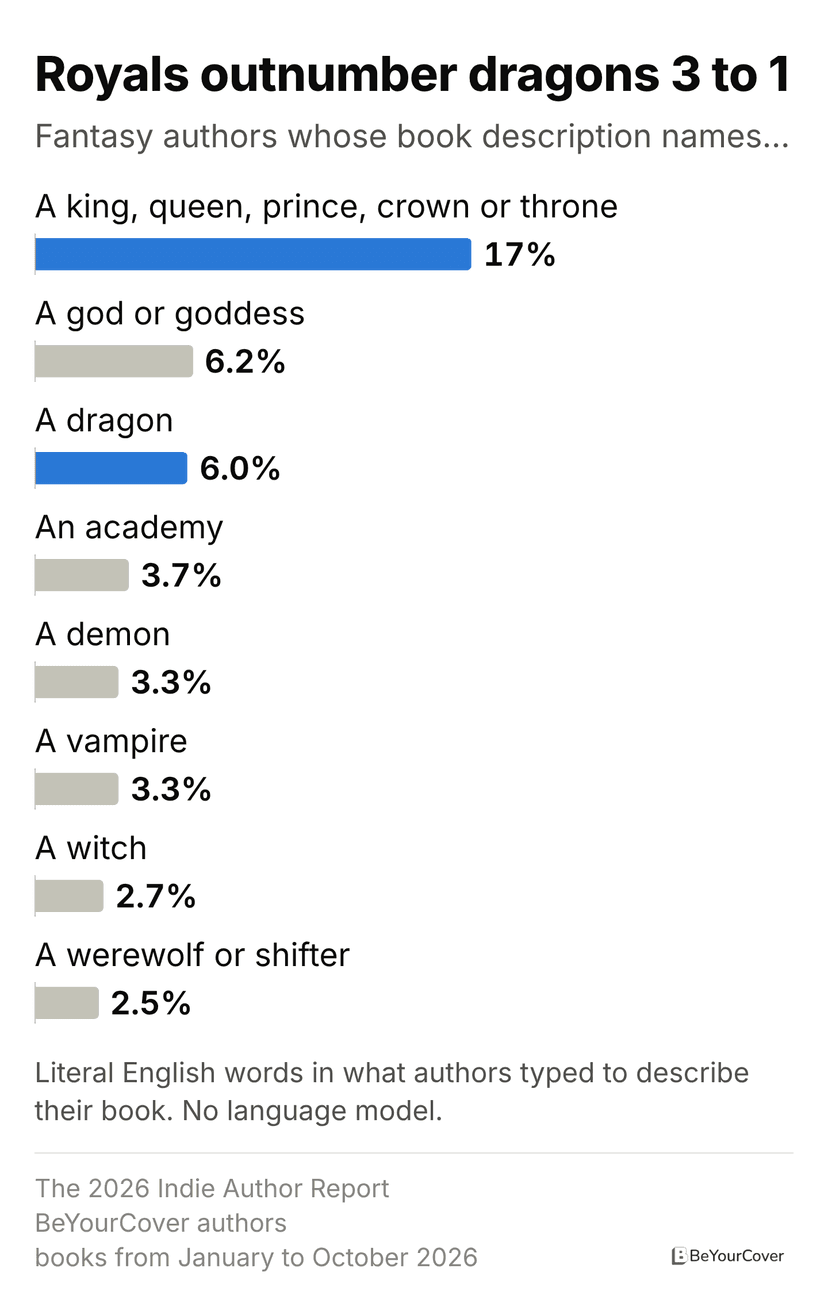
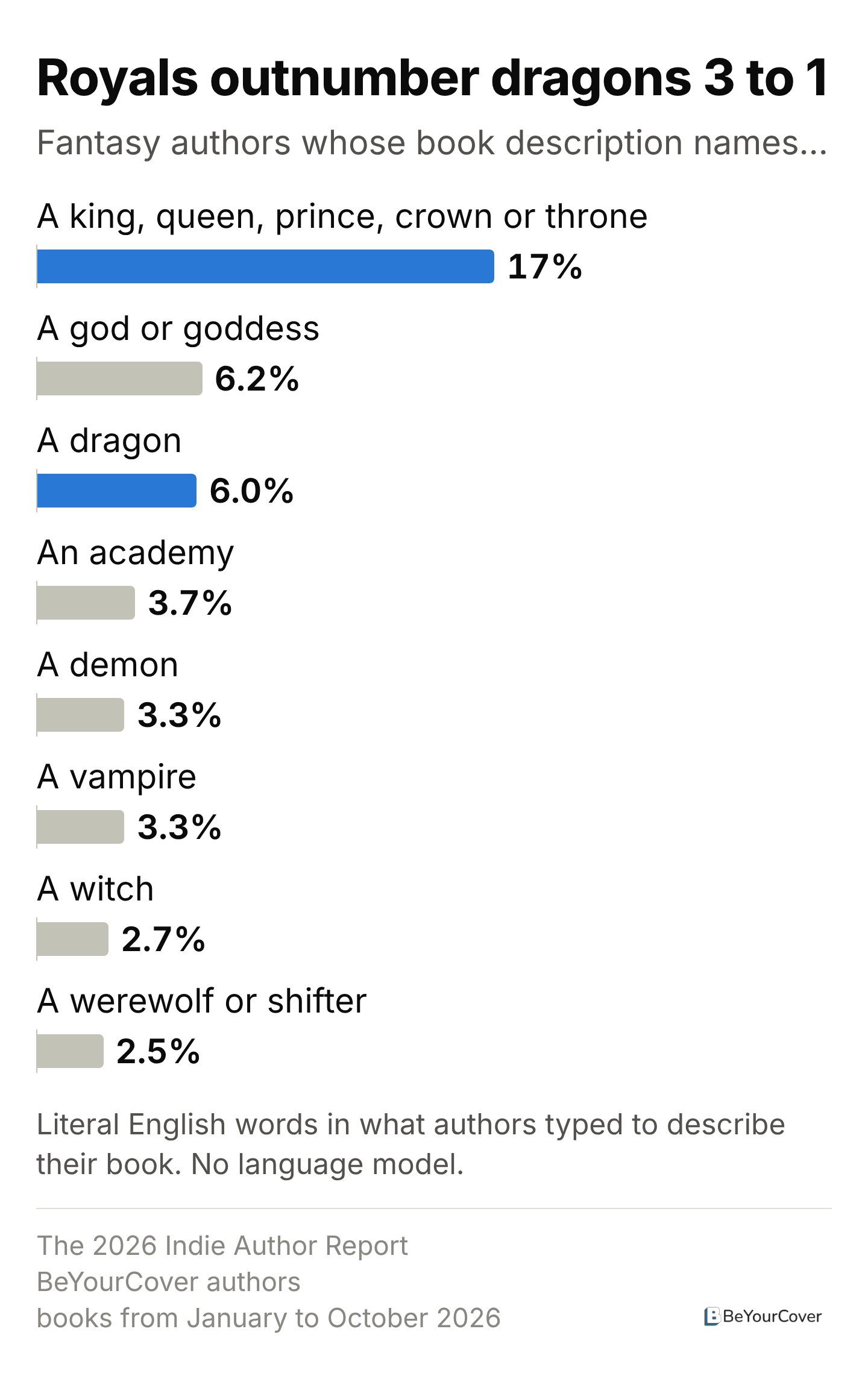
In their book descriptions, fantasy authors named a king, queen, prince or throne (17%) more than anything else on our list, ahead of gods (6.2%) and dragons (6.0%).
What readers search for
Authors decide what to write; readers decide what to look for. To compare the two, we fixed lists of search terms for seven pairs of ideas, such as "dragon romance books" against "royal romance books", and checked how often people in the US search for each on Amazon and on Google. Then we set each pair against what our authors wrote.
Authors write royals. Readers search for dragons.
Our fantasy authors named a royal over a dragon 3 to 1. Readers go the other way: 9 in 10 Amazon searches for dragon or royal books are for dragons, and 97% on Google.
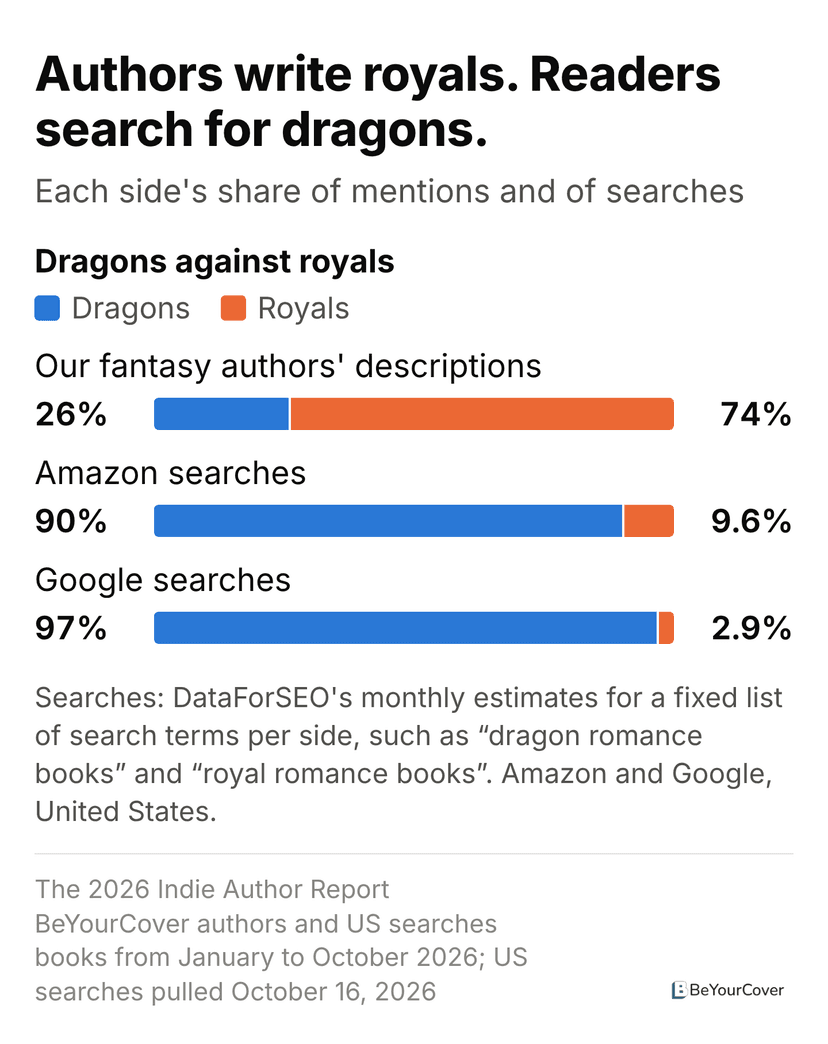
Try this: if your fantasy has dragons, say so in your subtitle, your blurb and your Amazon keywords. Readers type "dragon". Few type "royal".
Readers lean darker, and spicier
Our authors wrote dark romance over clean or sweet romance 4 to 1. Readers lean darker still: dark romance got nearly 9 in 10 of the Amazon searches for the two, and 98% on Google.
Our authors wrote contemporary romance (305 books) and dark romance (281) about equally. Readers did not: dark romance got 3 in 4 of the Amazon searches for the two, and 69% on Google.
Fantasy leans the same way. Our authors wrote a few more epic or high fantasies (235) than dark fantasies (209), but dark fantasy got 3 in 4 of the Amazon searches for the two, and 59% on Google.
Heat follows. Our romance authors wrote spicy or explicit books over clean ones 2 to 1. Searches for spicy, steamy or smut romance beat searches for clean or sweet romance 4 to 1 on Amazon and 11 to 1 on Google.
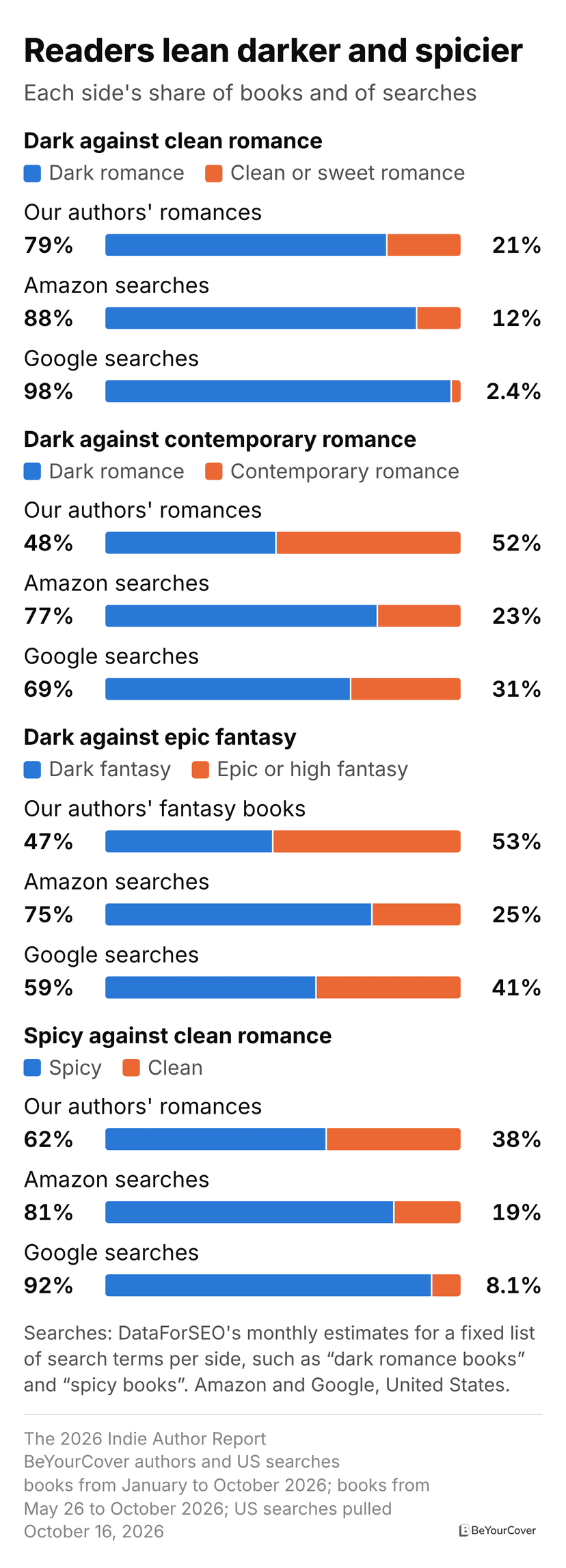
Try this: use the words readers type. If your book is dark or spicy, put "dark romance", "dark fantasy" or "spicy" in your keywords and your blurb, not only the shelf name.
Sapphic romance is searched more than it is written
F/F is 37% of our authors' F/F and M/M romances. In searches, it leads: sapphic, wlw, lesbian and F/F terms got 72% of the Amazon searches for the two, and 53% on Google.
Try this: if you write F/F romance, use all three words readers search with: "sapphic", "wlw" and "lesbian romance".
Romantasy is even bigger in searches
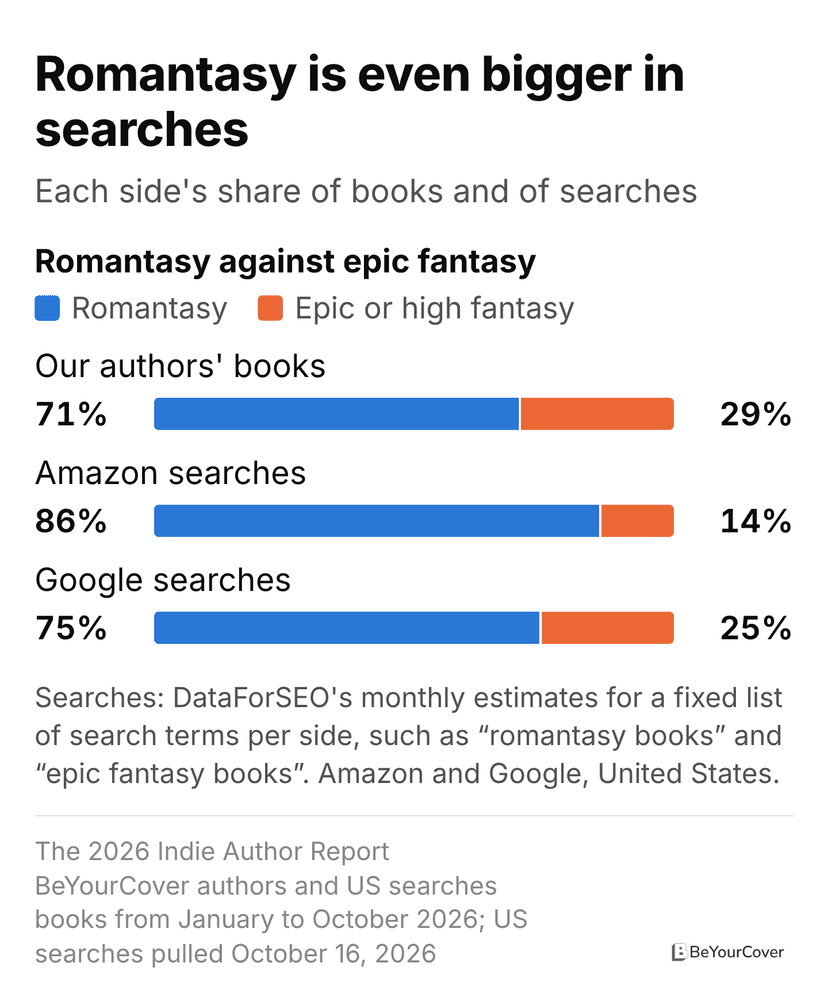
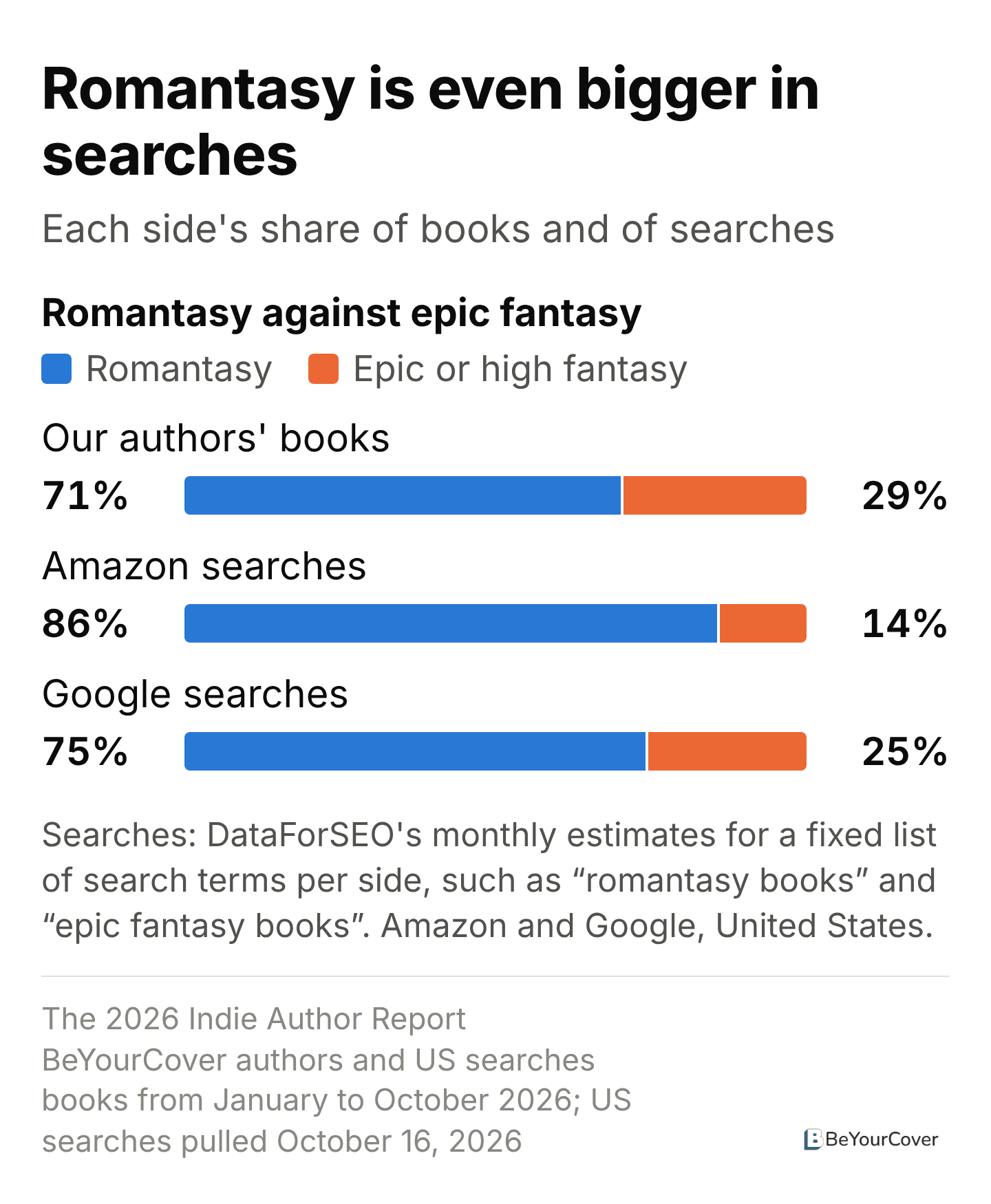
Our authors wrote romantasy over epic or high fantasy 2 to 1. Readers searched for it 6 to 1 on Amazon and 3 to 1 on Google.
What authors picked for their covers
Before an author gets their first covers, we show them up to 8 cover styles made for their own book and ask: thumbs up or thumbs down? This year, 1,454 authors answered 10,756 times. Across all styles, 40% of the votes were a thumbs up.
Close-ups lost
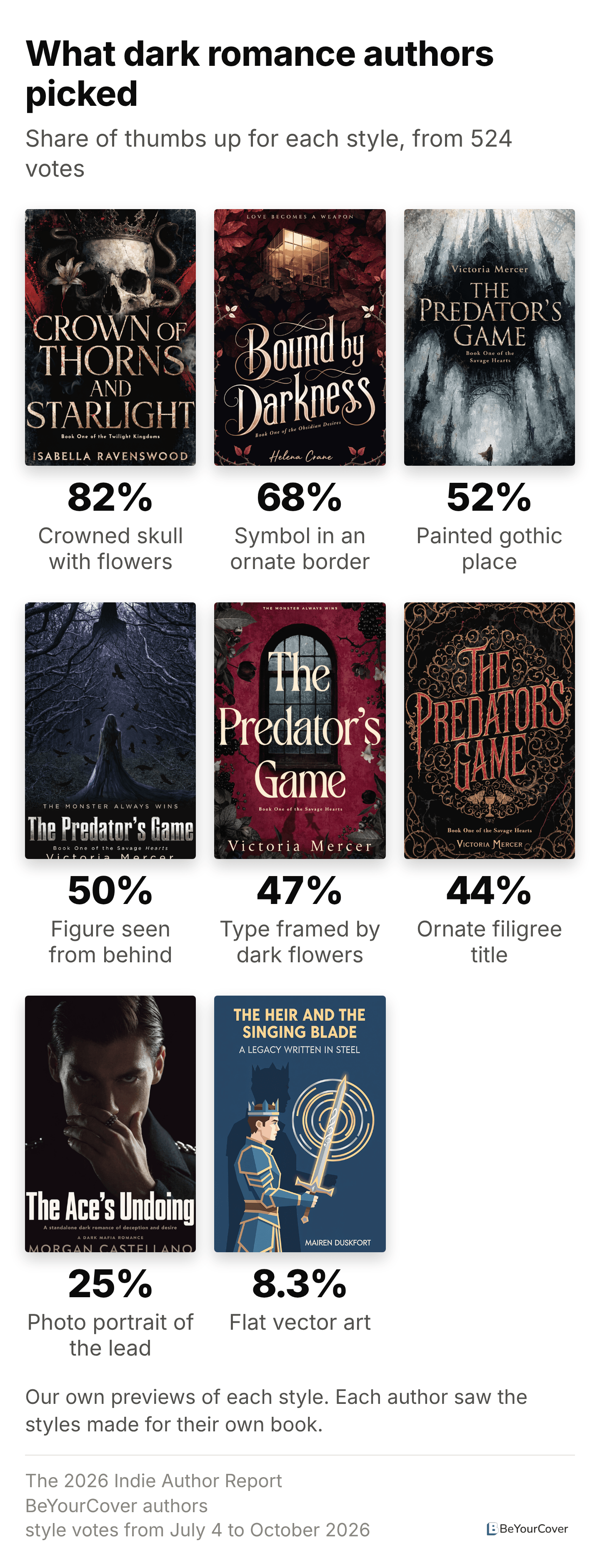
Dark romance authors gave a symbol in an ornate border a thumbs up in 68% of 68 votes, and a photo portrait of the lead 25% of 67 votes. People did well when they were part of a scene: epic fantasy authors gave a full-figure painted hero 61% and a painted face close-up 29%, and contemporary romance authors gave a bright illustrated scene with the couple in it 59% and a photo portrait of the lead 31%.
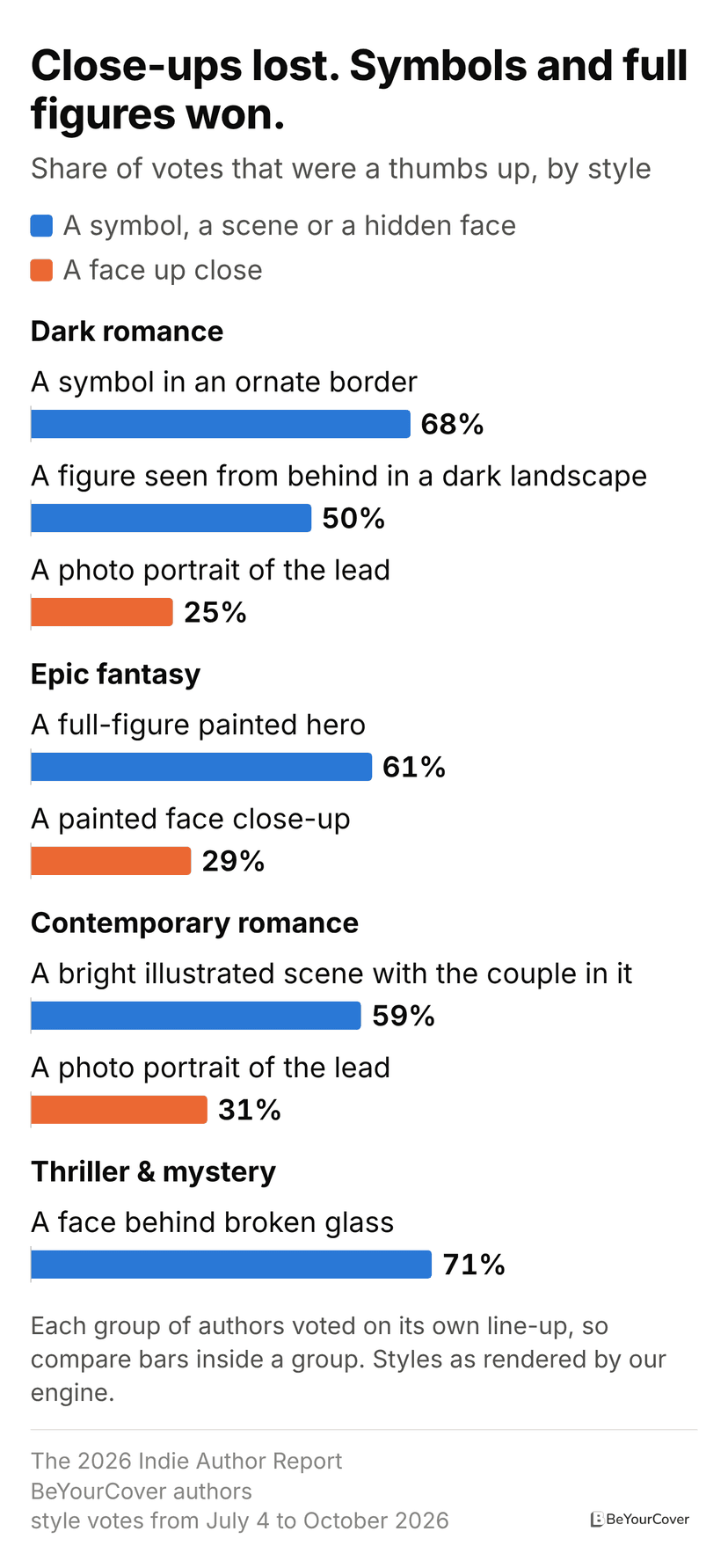
Try this: if your main character has to be on the cover, show them whole and in their world, or partly hidden. In our data, the tight close-up was the weakest way to show a person.
Dark romance: dark, ornate and symbolic
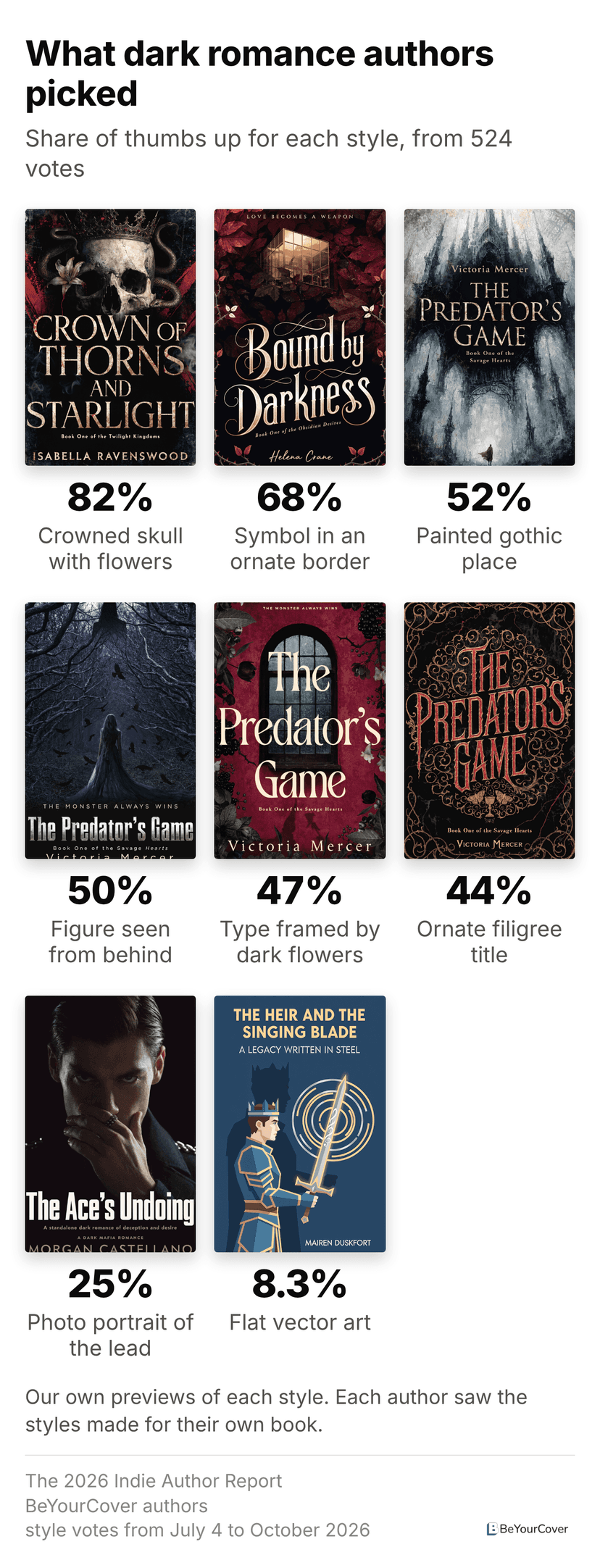
In 524 votes from dark romance authors, a crowned skull with flowers got a thumbs up in 82%, the highest score of any style in this report. Flat vector art got 8.3%.
Your genre cheat sheet
The styles each group of authors liked most and least, with the share of thumbs up each got:
- Dark romance. Liked most: a crowned skull with flowers (82%), a symbol in an ornate border (68%). Liked least: flat vector art (8.3%), a photo portrait of the lead (25%).
- Romantasy. Liked most: a crowned creature (69%), a gothic landscape with filigree corners (60%). Liked least: a figure seen from behind in a dark landscape (27%).
- Contemporary romance. Liked most: a bright illustrated scene with the couple in it (59%), a painterly scene (46%). Liked least: big type around an object (20%), big type over a crowd of figures (19%).
- Erotic romance. Liked most: a cropped body photo with no face (52%). Liked least: script type on a marbled texture (15%).
- Epic fantasy. Liked most: a painted landscape of the world (63%), a full-figure painted hero (61%). Liked least: flat vector art (11%), big type over the elements (21%).
- Thriller & mystery. Liked most: a face behind broken glass (71%), a place seen from above (65%). Liked least: a photographed object on a plain color background (24%), flat vector art (25%).
- Horror. Liked most: a haunted building (50%). Liked least: flat vector art (19%).
- Literary & historical. Liked most: a painterly scene (58%). Liked least: hand-cut lettering that fills the cover (13%).
- Self-help. Liked most: classic serif type with an engraving (47%). Liked least: big bold type with a small symbol (27%).
- Business. Liked most: an illustrated object on a plain color background (67%). Liked least: a big-type manifesto (29%).
- Religion & spirituality. Liked most: a misty photographed landscape (60%), an illustrated emblem (59%). Liked least: big type with a small symbol (32%).
- Biography & memoir. Liked most: a loose illustrated motif (48%). Liked least: big type with a small symbol (24%).
- Children's. Liked most: a character front and center (43%), an adventure scene (41%). Liked least: a pattern with the title in a badge (19%).
Each line compares styles shown to the same group of authors. Styles are our engine's versions, made for each author's book.
How we made this report
Who is in it. Every author who made at least one cover with BeYourCover between January 1 and October 31, 2026: 9,210 authors and 10,290 books. 96% of the authors made one book here. We left out our own team's accounts and books made for a client or a project in an agency workspace.
The windows. Books and titles from January 1. The engine's reading of each description from May 26, when it started. Style votes from July 4, when the line-up started. The question "What are you making covers for?" from August 25. All windows end on October 31, 2026.
Authors, not books. Some accounts made many books, so title and word counts count each author once per genre.
What a language model read. The subgenre, when the author did not pick one, and the pairing, heat and point of view of each book, read from its description when the cover was made (an author's own correction wins). We also tried to measure tropes. A model (Google Gemini, a provider our service already uses) coded 2,868 romance, fantasy and thriller descriptions against a fixed list of about 30 tropes per genre, with no examples. A check of 100 random books agreed on 78% of trope labels, under the 85% we set before the run, so this report has no trope numbers. The same check found that about 1 in 4 descriptions describe the cover the author wants, not the story. The word counts above include both.
Reader searches. DataForSEO's estimates of monthly searches in the United States, pulled on October 16, 2026: Amazon from its Amazon keyword data, Google from its keyword data adjusted with clickstream data. Every Amazon figure is a whole number times 37.4, so we read each one as a count from a sample and give each Amazon share a 95% range. For each idea, we fixed the search terms before the full pull, after a small test the same day: every common way to say it, in five forms. A gap between authors and readers is reported only when the Amazon range does not overlap our authors' range and Google points the same way. All seven comparisons passed. The narrowest was dark against clean romance: on our first pull, two weeks before the cut-off, its Amazon range still overlapped our authors' range, so it did not pass then. The CSV lists every term, count and range.
The votes. Each author saw up to eight styles for their subgenre, one at a time, each made by our engine for their own book. The first slot got a thumbs up 46% of the time and the eighth 29%, whatever it showed, so we checked every result against what each style's place in the line-up predicts. Every difference this report points out holds after that check. Because some groups of authors vote more generously than others, we compare styles only within one group.
Privacy floors. We show a number only when it comes from at least 20 authors, or from at least 40 votes by at least 20 voters. We publish counts and shares only. No author's title, description, name or cover appears here, and the covers shown are our own style previews. Our Terms and privacy policy allow aggregated, de-identified statistics like these. We do not use authors' books or covers to train AI models.
What we left out, and why.
- Genre against genre searches: a search for "romance books" shows how readers of a genre search, not how much they read. Romance readers search by subgenre and trope.
- Search trends over time: the yearly changes of close terms contradict each other.
- The old "elements to avoid" box: its placeholder suggested the answer.
- Print sizes and page counts: they mostly show our editor's defaults.
- Covers per book: the free tier decides it.
- Colors, palettes, motifs and the templates our engine chose: they describe our engine, not authors.
- Month-to-month growth: one year is too short to call a trend.
For journalists
You can use every chart and number here with a link to this page.
Charts (PNG):
- 2 in 3 are writing their first book
- 1 in 3 books is romance or fantasy
- Romantasy is the biggest subgenre
- Dark beats sweet 6 to 1
- 22% of romances are not M/F
- The fantasy title formula
- Royals outnumber dragons 3 to 1
- Authors write royals. Readers search for dragons
- Readers lean darker and spicier
- Sapphic romance is searched more than it is written
- Romantasy is even bigger in searches
- Close-ups lost. Symbols and full figures won
- What dark romance authors picked
Data: every published number as a CSV, with its count, base and window, and every search term. Cells under our privacy floors are not in it.
Cite this report: The 2026 Indie Author Report, BeYourCover, November 2026. Data from 9,210 BeYourCover authors, January 1 to October 31, 2026, and US search estimates from DataForSEO, October 16, 2026. beyourcover.com/blog/indie-author-report-2026
Questions: Pablo Yáñez, founder of BeYourCover, through our contact page.
Ready to Create Your Own Book Cover?
Turn your story into a visual masterpiece. Fill in the details below to start generating professional covers instantly.