Mastering Balancing Elements in Photography for Striking Book Covers
Learn balancing elements photography to create compelling, professional book covers. Get practical tips for indie authors to attract readers on KDP.
Posted by
 Pablo Yáñez
Related reading
How to Write an Ebook in 2026: A Step-by-Step Guide
Learn how to write an ebook that sells. Our practical guide covers topic validation, drafting, editing, formatting, cover design, and launching on KDP.
Children Book Illustration: From Concept to KDP
Learn the essentials of children book illustration in our complete guide for indie authors. Covers styles, hiring illustrators, budgets, and KDP print specs.
The Bright Pink Color Code for KDP Book Covers
Find the right bright pink color code for your book cover. This guide covers hex, RGB, and CMYK values, plus KDP print settings and design tips for authors.
Ready to design your cover?
Use our AI book cover generator to create tailored book cover concepts in minutes.


When you look at a photograph that just works, what you're often feeling is the power of good balance. It’s the art of arranging everything in the frame to create a sense of visual harmony. Think of it as distributing the visual weight of your subjects, colors, and even empty space, so no single part of the image feels like it's about to tip over.
This skill is what separates a quick snapshot from a truly compelling, professional image—a crucial distinction when that image becomes your book cover.
From Camera to Cover: How Balance Shapes Reader Perception
The difference between a book cover that gets clicked and one that gets scrolled past on Amazon KDP often comes down to balance. This isn't just art theory—it's a core part of visual communication that directly affects how readers perceive your book in a crowded digital bookstore.
A well-balanced cover instantly feels professional. It sends a subconscious signal that you've invested care into your product, which suggests the story inside is just as well-crafted. That first impression can be the deciding factor for an indie author.
Guiding the Reader's Eye
The principles of photographic balance translate perfectly to designing covers that grab a reader's attention. A balanced composition creates a clear path for the eye, guiding it naturally from your main image to the most important information—your title and author name. The goal is a smooth visual journey, not a chaotic one.
Think of it like this:
- A stable, symmetrical balance can create a feeling of calm, order, and authority. It’s a strong choice for a non-fiction guide or a sweeping historical biography.
- A dynamic, asymmetrical balance can build tension and excitement, making it an ideal choice for a thriller or an action-packed fantasy novel.
A cover’s balance does more than just look good; it sets a specific emotional tone. It’s your first and best chance to tell a reader what kind of experience your book offers before they’ve even read the blurb.
Applying Photography Principles to Cover Design
Even if you’re not a photographer, understanding these concepts is vital for creating a strong cover. Whether you're using stock photography, commissioning custom art, or generating ideas with an AI tool, you are the director of that final image. You decide where to place text, which colors to use, and how to frame the entire scene.
These principles give you the power to make informed decisions. For example, knowing that a small, bright object can balance a large, dark mass helps you place your title strategically. This is a foundational piece of the puzzle, closely related to the principles of visual hierarchy in graphic design.
Ultimately, this guide will provide the practical knowledge you need to turn your vision into a cover that connects with readers, no matter what genre you write.
The Hidden Force of Your Cover Image's Visual Weight

Ever look at a photo and feel like certain parts just grab your attention? That invisible pull is what designers call visual weight. It’s the perceived “heaviness” of an element in your composition. Mastering it is the first step toward creating a powerful book cover.
This has nothing to do with how much something actually weighs. It’s all about how much attention an element demands from the viewer. Think of your cover as a scale where you strategically place objects to control exactly where a reader looks first.
What Creates Visual Weight?
Several key factors give an element its visual weight. Once you learn to spot them, you can use them to build a powerful focal point. The main ones are:
- Size: Larger objects feel heavier and draw the eye more than smaller ones.
- Color: Bright, warm, and saturated colors (like a fiery red) carry more weight than cool, muted ones (like a pale blue).
- Focus & Contrast: An object in sharp focus will always feel heavier than a blurry background. High-contrast areas where light and dark tones meet also demand attention.
By learning to see these elements, you can make conscious choices about where to place "heavy" items to guide the eye, rather than confusing it.
Applying Visual Weight to Your Cover
This is an incredibly practical concept for an author. Let’s say you have a striking photo for your new thriller. If your main character is standing on the left side of the image, that side now carries significant visual weight. To create balance, you could place your large, bold title on the right.
Or, if you’re writing a romance, you might use a high-contrast image of the main couple to give them maximum weight, making them the undeniable center of attention. For a deeper dive into how professionals select their shots, check out our guide on choosing the right book cover photos. Experimenting with different image and text placements is the best way to get a feel for how visual weight shifts with every adjustment.
Understanding visual weight is a cornerstone of effective design. If you want more great insights, don’t miss these 8 Essential Book Cover Design Tips. Learning to control this hidden force is what separates a forgettable cover from one that feels intentional, professional, and impossible for readers to ignore.
Choosing Your Mood With Symmetrical and Asymmetrical Balance
So, you’ve learned how to spot visual weight. Now it's time to arrange it. The way you balance elements in an image isn't just a technical exercise; it's how you set the entire mood of your book cover.
Your two main tools here are symmetry and asymmetry. The choice between them sends a powerful signal to potential readers before they've even read the title.
Symmetrical balance, where everything mirrors itself across a central line, feels stable, formal, and peaceful. It’s orderly and intentional. This makes it a fantastic choice for a historical biography, a serious non-fiction guide, or even a stately epic fantasy where tradition and order are central themes.
Asymmetrical balance, on the other hand, creates energy, tension, and a sense of movement. It feels dynamic, more natural, and less staged. This is exactly what you want for a fast-paced thriller, an unpredictable sci-fi adventure, or any story that needs to feel alive and in motion.
Symmetry for Stability and Formality
There's a reason symmetrical designs feel so professional and trustworthy. This isn't just a gut feeling; it’s a time-tested principle. Symmetrical compositions are often easier to process visually, which can make a cover feel more authoritative and well-put-together.
For indie authors, this can be a strategic advantage. When a reader is scrolling quickly, a cover with strong symmetrical balance can appear visually stable and easy to comprehend, even as a tiny thumbnail. If your book falls into a genre that benefits from an air of authority—like business or self-help—symmetry is a powerful and reliable choice.
Asymmetry for Energy and Interest
While symmetry is stable, it can also feel static. Asymmetrical balance is how you break out of that box and inject life into your cover. This is where you’ll often lean on the Rule of Thirds, placing your key elements off-center to guide the eye on a more engaging journey across the image.
Picture it: your lone hero stands on the far right of the cover, looking out over a vast, empty landscape that fills the other two-thirds of the frame. That asymmetrical layout instantly creates a feeling of isolation and immense scale, adding a layer of narrative before the book is even opened. It's a go-to technique for genres like dystopian fiction, grand adventure stories, and even many compelling romance book covers.
Choosing between symmetry and asymmetry isn't just an artistic decision—it's a strategic one tied directly to genre conventions and reader expectations. The right balance makes your book feel like it belongs on the shelf with other bestsellers in its category.
To refine your cover’s emotional impact, it pays to also explore how different color palettes affect mood and behavior. A helpful way to test these ideas is to use an AI tool to generate a few concepts—one symmetrical and one asymmetrical—and see which one best captures the spirit of your story.
Your Toolkit for Essential Balancing Techniques
Let's move from theory to action. These are the core techniques photographers and designers use to control where a viewer's eye goes. Mastering them is what separates an amateur cover from one that looks polished and intentional.
First up is the undisputed classic: the Rule of Thirds. It's a principle that has stood the test of time for a reason. The idea is simple: imagine your cover is split into a 3x3 grid. Instead of dead-centering your subject, you place key elements—your protagonist, a crucial object, or the title—along those lines or where they intersect. This simple shift forces the eye to move around the image, creating a sense of energy that a static, centered design often lacks.
Balancing With Color and Tone
Balance isn't just about positioning. It’s also about visual weight, and color and tone have plenty of it. A tiny splash of a bright, warm color (like a vibrant red) can easily hold its own against a much larger patch of a dark, muted color.
Think about a thriller cover with a dark, moody cityscape. By placing a small but brilliant white title on the opposite side, you create a dynamic tension that pulls the viewer in. The contrast creates equilibrium, preventing the design from feeling lopsided.
The Power of Negative Space
One of the most underrated tools in a designer's kit is negative space. This isn't "empty" or "wasted" space; it's an active compositional element that you can use to make a powerful statement.
You can use a vast field of negative space to perfectly balance a single, compelling subject. Picture a lone figure on the far left of your cover, with the remaining two-thirds filled by an empty, dramatic sky. The emptiness itself has weight. This is a go-to technique for evoking feelings of isolation, peace, or epic scale. If you want a deeper dive, our guide on what white space in design is will give you a complete rundown.
This quick visual guide shows you how the choice between a symmetrical and an asymmetrical layout will fundamentally shape your cover's feel.
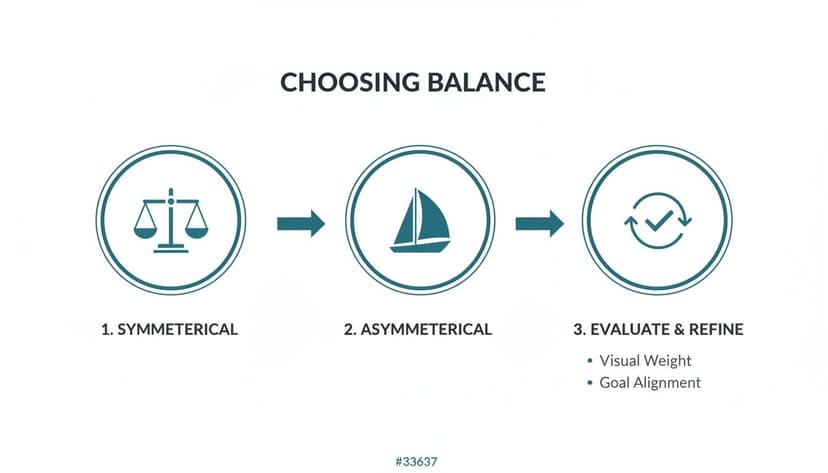
As you can see, your choice directly feeds into the mood your cover projects, so it’s critical to align it with your story’s genre.
To help you choose the right approach, here's a quick-reference table breaking down the most common balancing techniques and their effects on a book cover.
Core Balancing Techniques and Their Effects
| Technique | Description | Best For (Mood/Genre) |
|---|---|---|
| Symmetrical Balance | Elements are mirrored or centered, creating a sense of stability and order. | Non-Fiction (authority), Historical (formality), Epic Fantasy (grandeur). |
| Asymmetrical Balance | Elements are arranged unevenly but still feel balanced due to visual weight. | Thrillers (tension), Contemporary Fiction (energy), Romance (movement). |
| Radial Balance | Elements radiate outward from a central point, drawing the eye inward. | Fantasy (magic portals), Sci-Fi (vortexes), Psychological Thrillers (obsession). |
| Rule of Thirds | Key elements are placed on a 3x3 grid, creating a natural, engaging flow. | Almost all genres. It's the most versatile and reliable starting point for any cover. |
Use this table to quickly gut-check if your chosen compositional style matches the emotional tone you're aiming for. It's a simple way to align your design with reader expectations for a specific genre.
Self-Critique Checklist for Balance: When reviewing your cover design, ask yourself these questions:
- Where does my eye go first? Does it lead to the title?
- Does one side of the cover feel significantly "heavier" than the other?
- Does the overall composition feel anchored and stable, or dynamic and off-kilter?
- Is the feeling created by the balance appropriate for my book's genre?
Don't be afraid to experiment. This is where generating concepts with an AI tool can be helpful. You can create variations in minutes, shifting elements around to test different balances and see what truly clicks for your story before committing.
Common Balance Pitfalls for Indie Authors (and How to Fix Them)
It’s one thing to know the theory, but another to spot when your own cover has gone off the rails. Most unbalanced covers suffer from a few easily fixable mistakes that reduce their professional impact. Here’s a quick troubleshooting guide to help you identify and correct them.
One of the most common traps is the 'dead center' composition. It feels safe to plant your protagonist or a key object right in the middle, but it often kills the energy. The result is a static, often amateur-looking cover that gives the reader’s eye nowhere to go.
Another frequent issue is the cluttered, 'everything-is-important' design. When the character, the background, the title, and the subtitle are all screaming for attention, nothing gets it. This visual chaos confuses potential readers, making it hard for them to grasp your book’s genre or vibe at a glance.
Practical Fixes for Unbalanced Covers
The good news? You don't necessarily need a new image. Most unbalanced covers can be salvaged with a few simple adjustments, using your other design elements to bring back a sense of order.
Here are a few go-to solutions:
- The Lopsided Image Fix: Got an image where the main subject makes one side feel too heavy? Don't toss it. Add your title to the opposite, "lighter" side. A strong, bold typeface carries significant visual weight and can serve as the perfect counterweight, creating a far more dynamic asymmetrical balance.
- The Busy Background Fix: If a distracting background is stealing the spotlight, you need to create depth. Apply a subtle blur or slightly darken the background image. This simple tweak pushes it back, allowing your focal point and title to pop forward.
- The Floating Elements Fix: Does your character or text look like it’s floating aimlessly? Give it an anchor. You can do this by positioning your character so their feet touch the bottom of the frame or by placing your text on a solid color block. This gives the elements a "ground" to stand on, making the whole composition feel more stable.
A well-balanced cover intentionally guides the reader's eye. If your design feels like a visual free-for-all, step back and ask: what is the single most important element? Then, use these balance techniques to make sure it gets the attention it deserves.
Experimenting with these fixes is the best way to develop your eye. You can mock up different layouts quickly using an AI cover creation tool to see exactly how moving one element impacts the entire design. For instance, a great thriller book cover almost always uses asymmetrical balance to build tension—a principle you can easily borrow to fix a static, centered design.
Balancing Elements Q&A for Authors
Here are some practical answers to common questions authors face when trying to balance their cover designs.
How do I balance text with an image on my cover?
Start thinking of your text as another object in the scene. It has mass and weight, just like a character or a building.
A big, chunky title isn't just words; it’s a heavy visual block that can perfectly counterbalance a main subject on the opposite side of the image. Your font choice is a key tool here—a thicker, bolder font adds immediate visual weight. The easiest win is to find the natural empty space in your image and place your text there. This is a classic designer move that keeps your cover from feeling cluttered.
Can a book cover be 'too balanced'?
Absolutely. This happens most often with perfect, rigid symmetry. While a symmetrical design can look clean and professional, it can also be incredibly static—even boring. If you're writing a thriller or a fast-paced sci-fi novel, a perfectly stable cover can kill the sense of energy your story needs.
A cover that feels 'too balanced' often fails to create the visual tension needed to hook a reader. Your goal is to match the type of balance to your book's genre and the feeling you want to evoke. This is exactly why asymmetrical balance is so powerful; it creates a composition that feels alive and dynamic.
My cover photo feels unbalanced but I can't change it. What do I do?
Don't panic. If you're stuck with a lopsided photo, you can use your other design elements to fix it by adding counterweights.
- Use Typography as Your Counterweight: This is the most common fix. Drop your title, subtitle, or a tagline into the "lighter" or emptier part of the image. The text adds the necessary mass to restore equilibrium.
- Add Graphic Elements: Banners, award seals, or even subtle color overlays can add weight where you need it. They can anchor a subject that seems to be floating off the edge or fill a void.
- Adjust Tones: In an editing program, you can selectively brighten or darken parts of the image. Brightening a section makes it feel heavier and pulls more attention, while darkening an area can help it recede.
You can rapidly test different text placements or graphic additions using an AI tool to see precisely how they affect the cover's balance before you commit.
Is one type of balance better for Amazon KDP thumbnails?
For those tiny thumbnails, clarity is everything. You need an immediate impact. While any type of balance can work, the composition has to be bold and simple to be effective when it's the size of a postage stamp.
Symmetrical designs often hold up well because their structure is stable and easy to "read" at a glance. However, a strong asymmetrical design using the Rule of Thirds can also be incredibly effective, guiding the eye directly to a character's face or a key object, even in a tiny format.
The main pitfall to avoid is a busy, overly complex composition that just turns into a muddy mess when shrunk down. Always test your cover by squinting at it or shrinking it down on your screen. You’re aiming for a design that is instantly readable and clearly communicates its genre, just like the best romance book covers manage to do in a crowded marketplace.
Ready to Create Your Own Book Cover?
Turn your story into a visual masterpiece. Fill in the details below to start generating professional covers instantly.
