Novella Length: How Many Words Is a Novella? (17,500–40,000)
A novella is 17,500–40,000 words, or roughly 70–160 pages. See word-count ranges by genre, how novellas compare to novels, and how to price short fiction.
Posted by
 Pablo Yáñez
Related reading
9 Best Book Marketing Tools for Indie Authors (2026)
Compare nine book marketing tools for indie authors, from market research and cover design to reader delivery, email, promotion, and ad tracking.
How to Build a Character Profile for Book Cover Design
Build a visual character profile that keeps cover art accurate and consistent. Define appearance, clothing, references, exclusions, and series continuity.
How to Repurpose One Book Cover for Print, Audio, and Ads
Turn one approved front cover into a print wrap, audiobook square, text-free artwork, mockups, ads, and social assets without rebuilding the design.
Ready to design your cover?
Use our AI book cover generator to create tailored book cover concepts in minutes.
A novella is 17,500 to 40,000 words — roughly 70 to 160 printed pages. Anything from 7,500 to 17,500 words is a novelette, and past 40,000 words you're into novel territory. The boundaries come from the SFWA guidelines, the unofficial industry standard that KDP categories and literary awards follow.
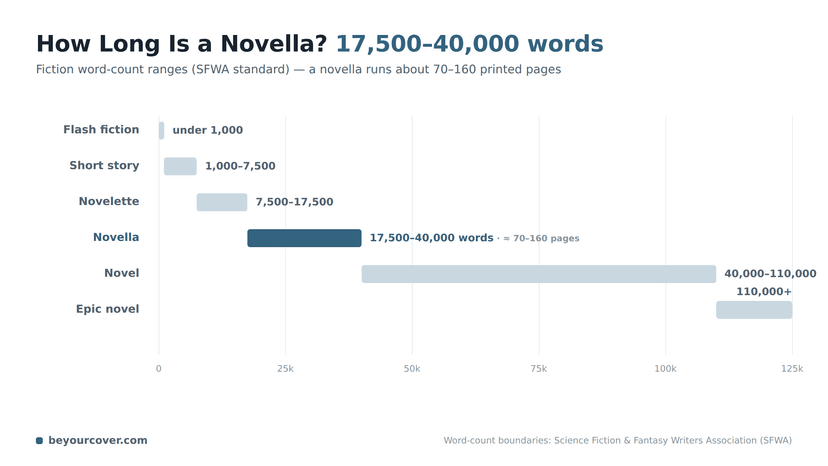
That range isn't a random number; it's the strategic sweet spot for indie authors publishing on Amazon KDP. Hitting this target means publishing a story that's both concise and impactful, perfectly suited for today's readers — big enough to satisfy, short enough to finish in an evening.
Defining the Novella Sweet Spot
For an indie author, word count isn't just a creative choice—it's a business decision. The lines separating a short story, novelette, novella, and a full-blown novel are drawn almost entirely by their length. Nailing this affects everything from reader expectations and genre conventions to how you price your book on KDP.
From a reader's perspective, a short story is a quick snack and an epic novel is a ten-course meal. The novella is the perfect, satisfying dinner that can be enjoyed in a single evening. It offers a deep, focused narrative without demanding a massive time commitment.
The Word Count Spectrum
The Science Fiction and Fantasy Writers of America (SFWA) established widely accepted guidelines that have become an unofficial industry standard. They place the novella squarely in that 17,500 to 40,000-word range, which usually translates to between 70 and 160 pages.
As you map out your story, remember that a shorter format doesn't mean less structure. In fact, mastering the art of structure in writing is even more critical to make sure your story feels complete and satisfying within its tighter container.
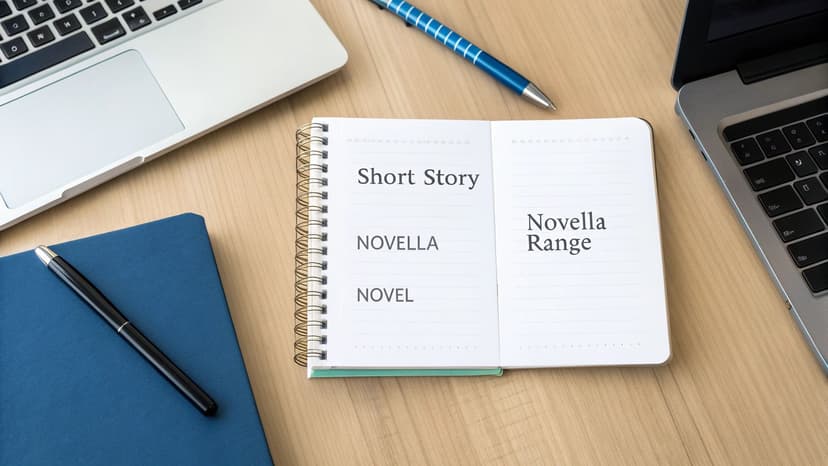
To give you a clearer picture, here’s how the different fiction formats stack up against each other.
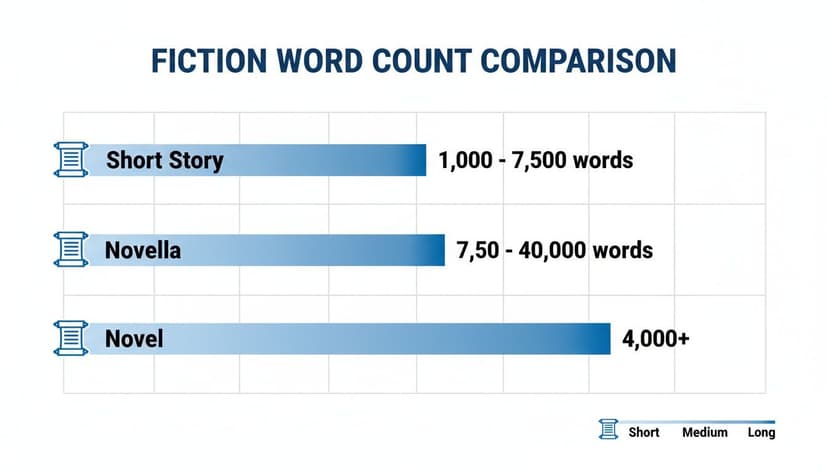
This visual drives home how the novella occupies a perfect middle ground—more substance than a short story, but tighter and more focused than a novel. Understanding this from the start helps you position your book correctly in the market.
Fiction Word Count Cheat Sheet
To make things even easier, here's a quick reference table. It’s a handy guide for figuring out exactly where your story fits.
| Format | Word Count Range | Typical Page Count |
|---|---|---|
| Flash Fiction | Under 1,000 words | 1–3 pages |
| Short Story | 1,000 – 7,500 words | 3–30 pages |
| Novelette | 7,500 – 17,500 words | 30–70 pages |
| Novella | 17,500 – 40,000 words | 70–160 pages |
| Novel | 40,000 – 110,000 words | 160–450 pages |
| Epic Novel | Over 110,000 words | 450+ pages |
Keep this cheat sheet handy. It’s a simple but powerful tool for ensuring your story aligns with what readers and publishers are looking for.
Why Word Count Is a Game Changer on KDP
For indie authors publishing on Amazon KDP, your novella's word count is a critical business decision. The length of your manuscript directly shapes its commercial viability, touching everything from royalty rates and pricing strategy to reader psychology and your book's visibility in the Kindle store.
Thinking strategically about your manuscript's length is one of the most important first steps you can take. Getting a handle on these implications before you publish can be the difference between a book that finds its audience and one that gets lost on the digital shelves.
Pricing and Royalty Implications
One of the biggest factors is KDP's royalty structure. To qualify for the coveted 70% royalty rate, you must price your ebook between $2.99 and $9.99. Any book priced below or above that range automatically drops to a 35% royalty.
This creates a challenge for novella writers. Readers are often hesitant to pay novel-level prices for a shorter work. A $4.99 price tag on a 25,000-word novella might feel steep to a potential buyer, but pricing it at $1.99 cuts your earnings in half.
The novella length hits a sweet spot, allowing you to price competitively at $2.99. This maximizes your profit margin while still offering readers a fantastic deal.
Gaining Visibility in Niche Categories
The Amazon marketplace is vast, and getting noticed can feel like an uphill battle. Fortunately, KDP has specific categories for shorter works called Kindle Short Reads. These are organized by estimated reading time, like "30-minute reads" or "90-minute reads."
This is where a novella gives you a serious edge:
- Less Competition: The fight for top spots in these niche categories is often far less intense than in broader categories like "Thrillers" or "Romance."
- A Targeted Audience: You connect directly with readers who are actively looking for a quick, satisfying story they can finish in one sitting.
- Better Discoverability: Ranking high in a Short Reads category can give your book the momentum it needs to be noticed by Amazon's algorithm.
By writing to a specific novella length word count, you can strategically place your book in these less-crowded, highly targeted digital aisles.
The Psychology of Reader Completion
Amazon’s algorithm tends to favor books with high reader engagement, and a huge part of that is completion rate. When a reader finishes your book, it sends a powerful positive signal to Amazon that the book is satisfying and worth recommending.
Because novellas are shorter, readers are far more likely to finish them, often in a single session. This high completion rate can potentially boost your book's visibility in "Also Boughts" and other algorithmic recommendations, creating a powerful organic marketing loop.
A reader who finishes your novella is also more likely to leave a review and see what else you've written. That feeling of accomplishment makes them more invested in you as an author.
Building Author Momentum and a Backlist
Finally, novellas are an incredible tool for building a career. Their shorter length means you can have a much faster production cycle compared to a sprawling 100,000-word novel.
This allows you to publish more frequently, keeping your current audience engaged while constantly bringing new readers into your world. A strong backlist of novellas creates multiple entry points for people to discover your work.
Furthermore, a faster writing process gives you room to experiment. You can test different genre tropes, play with a new narrative voice, or try a different marketing angle without sinking a year into a single project. That flexibility is key to figuring out what resonates with your audience and building a sustainable author platform.
Matching Your Novella Length to Genre Expectations
A 30,000-word story might feel just right for a whirlwind romance, but it could leave an epic fantasy reader feeling short-changed. The "right" length for a novella isn't a hard-and-fast rule. It's shaped by the unwritten agreements between authors and readers in any given genre.
Nailing this is one of the secrets to success. When you understand these conventions before you start writing, you’re not just hitting a word count target; you're crafting an experience that feels satisfying and complete to the very people you want to reach.

Why Genre Conventions Dictate Length
Every genre is its own ecosystem, with expectations that have evolved over thousands of books. These aren't arbitrary numbers; they're a direct result of the story's needs. A sprawling fantasy saga needs pages for world-building, while a taut psychological thriller must be lean to keep the pages turning.
Get the length right, and readers feel you've delivered on your promise. Get it wrong, and you’ll see reviews complaining about a "rushed ending" or "underdeveloped characters." Go too long, and they’ll call it "padded" or "slow." Aligning your word count with genre norms is your first, best chance to manage reader expectations.
Romance And Thrillers: The Need For Speed
In genres like Romance and Thrillers, pacing is king. Readers grab these books expecting a shot of adrenaline—a story that moves with purpose, high stakes, and a plot that yanks them forward.
- Romance: Most romance novellas clock in between 20,000 and 40,000 words. This is the sweet spot for focusing on the core relationship. It gives you just enough room to build tension, hit the emotional beats, and deliver a satisfying "happily ever after" (HEA) without getting tangled in subplots.
- Thrillers/Suspense: A thriller novella usually lands in the 25,000 to 40,000-word zone. This shorter format is a feature, not a bug. It helps you crank up the tension and keep the reader guessing, creating that "just one more chapter" feeling that makes a thriller impossible to put down.
For these fast-paced categories, the novella delivers a concentrated hit of passion or peril, which is exactly what the reader signed up for. You can see this philosophy reflected in the visual language of the genre, such as in these popular fast-paced romance covers, where every element signals a specific, focused emotional journey.
Sci-Fi And Fantasy: A Little More Breathing Room
Readers of Science Fiction and Fantasy are often used to doorstopper epics and intricate worlds, so while they enjoy novellas, their expectations for length are a bit higher.
The big difference-maker here is world-building. Sci-Fi and Fantasy stories have a heavier lift. They have to establish unique settings, complex magic systems, or futuristic technologies from scratch. To make that world feel real and immersive, you simply need more words.
As a result, a successful SFF novella usually falls in the 30,000 to 40,000-word range. That gives you enough runway to introduce a fascinating new world and tell a tight, self-contained story without committing to a 150,000-word epic.
Market data backs this up. While the average fantasy novel is massive, novellas that top out around 40,000 words consistently perform well. They're the perfect gateway for readers who are intrigued by a world but intimidated by a huge time commitment. If you're curious how these numbers stack up, you can explore average novel word counts across the board and see just where novellas fit in.
Knowing the typical word count for your genre helps you meet reader expectations from the first page to the last. Here’s a quick breakdown of common novella lengths across some of the most popular fiction categories.
Novella Word Count by Popular Genre
| Genre | Typical Novella Word Count | Key Considerations |
|---|---|---|
| Romance | 20,000 – 40,000 | Focus on a single, compelling relationship arc. Pacing is critical to maintain emotional tension. |
| Thriller/Suspense | 25,000 – 40,000 | The tight word count helps maintain suspense and a fast pace. Avoid unnecessary subplots. |
| Science Fiction | 30,000 – 40,000 | Needs enough room for essential world-building without overwhelming a focused plot. |
| Fantasy | 30,000 – 40,000 | Similar to Sci-Fi; must establish magic systems or unique settings efficiently. |
| Mystery/Crime | 20,000 – 40,000 | Perfect for a single, intricate case. The focus is on clues, deduction, and resolution. |
| Horror | 15,000 – 35,000 | Often shorter to build atmospheric dread and deliver a powerful, concentrated scare. |
| Young Adult (YA) | 20,000 – 40,000 | Tends to mirror adult genres but with a focus on teen protagonists and themes. |
This table is a great starting point, but always remember to research the top-selling novellas in your specific subgenre to get the most accurate feel for what’s currently working with readers.
Using an AI Tool To Test Genre Signals
Once your manuscript is polished, your book cover becomes the single most important signal of genre and tone. The right typography, imagery, and color palette have to communicate "this is the kind of story you love" to your target reader.
This is where an AI cover generator can be a useful tool for testing concepts. You can generate different visual ideas for your story in minutes. Does your thriller look better with a stark, high-contrast design or a moody, atmospheric one? An AI tool lets you visualize different options to help you make a smart, market-aware decision before you publish.
Smart Marketing Strategies for Your Novella
A shorter book demands a smarter marketing plan. Because novellas have that distinct, in-between word count, you can’t just treat them like a shrunken novel. You have to lean into their brevity, turning what some might see as a weakness into your single greatest selling point.
The secret is to frame your novella as the perfect antidote to the modern reader’s time-crunched life. Your marketing copy should sing its praises as a "fast-paced read for a busy afternoon," a "complete story you can devour on your commute," or a "quick escape you won't be able to put down." This immediately sets expectations and attracts readers who are actively looking for a quick, satisfying story.
To connect with those readers, you have to master the art of writing compelling product descriptions. Think of your Amazon description as your most important sales pitch—make every word count.
The Novella as a Reader Magnet
One of the most powerful ways to leverage a novella is to turn it into a reader magnet. This is a free book you offer people for signing up for your author newsletter. For an indie author, building an email list is the foundation of a sustainable career, and a fantastic novella is an incredibly high-value hook.
Here’s why this strategy works so well:
- It’s a substantial introduction. A novella gives readers a much deeper, more immersive taste of your writing, your characters, and your world than a simple short story ever could.
- It builds trust. When someone loves your free novella, they're not just a reader anymore; they're a fan who is far more likely to buy your next book.
- It gives you a direct line to your audience. An email list lets you talk directly to your fans without having to shout over social media algorithms. You can announce new releases, share behind-the-scenes tidbits, and build a real community.
A prequel novella that sets the stage for your main series is a classic for a reason—it’s an incredibly effective reader magnet. It gets readers invested in your world and leaves them hungry for the first full-length novel.
Bundling and Box Sets for Bigger Paydays
While a standalone novella priced at $2.99 can be a nice, steady earner, the real money often comes from bundling. Once you’ve written a few novellas or have a mix of novellas and novels in a series, you can package them into a digital box set.
Box sets offer huge value to readers and can seriously boost your income. A collection of three novellas, for instance, can easily be priced at $5.99 or more. You earn more from a single sale, and the reader gets a fantastic deal.
This approach is a goldmine in genres like Romance and Urban Fantasy, where binge-readers rule. They love having the next book ready to go and will happily pay a premium for the convenience of a collected edition. Professional cover design is critical here; your box set cover must look slick and cohesive, and fantasy novella cover examples show how a series can hold a consistent look across every volume.
Serializing Your Story on Platforms Like Kindle Vella
For authors who enjoy writing in smaller, punchier installments, serializing a novella can be a brilliant move. Platforms like Kindle Vella let you release your story one episode at a time, building an audience as you write.
The benefits here are compelling:
- Build early buzz: You can generate excitement and get valuable reader feedback long before the story is even finished.
- Get paid while you write: Readers use "tokens" to unlock new episodes, which means you can have an income stream during the drafting process.
- Create a second product: Once your serialized novella is complete, you can bundle all the episodes and publish it as a standard ebook on KDP, creating two products from one project.
This method is perfect for plot-driven stories with killer chapter hooks that keep readers clicking "next episode." It's a modern, dynamic way to connect with an audience and turn one novella-length project into multiple streams of income.
Designing a Cover That Shouts "Novella" and Whispers "Genre"
Novellas live and die by the impulse buy. When a reader is scrolling through Amazon, your cover is the only thing you have to stop their thumb. It's a tiny thumbnail fighting for attention, and it has to do two jobs in a split second: scream the story's genre and signal its shorter, binge-worthy length.
A professional, genre-perfect cover isn't just a pretty picture. It’s a crucial part of your sales pitch. It manages reader expectations before they even click, promising them a tight, satisfying story that won't demand a massive time commitment.
Visual Cues That Say "Quick Read"
Readers have a built-in visual library for what books should look like, and that includes shorter fiction. While you must stick to your genre's established look, you can add subtle layers that hint at brevity. It’s visual shorthand for "fast-paced and focused."
Here are a few techniques that work wonders:
- Minimalist Imagery: Forget the sprawling, epic scene. Go for a single, powerful symbol or a clean, striking character portrait. This tells the reader the story is direct, zeroed in on one core idea or conflict.
- Bold Typography: Big, clean, in-your-face title fonts feel immediate and punchy. They grab the eye and project confidence, just like a short, impactful story.
- High Contrast: Strong color palettes are your best friend. A bright, vibrant color popping against a dark, moody background makes a thumbnail leap off the screen. That visual "snap" perfectly mirrors the quick, engaging nature of a novella.
When these elements come together, they create a design that feels both professional and perfectly tailored for a shorter format.
Typography and Layout That Just Works
Beyond your main image, the fonts and layout you choose are doing heavy lifting. The wrong font can make your gritty thriller look like a sweet romance, instantly confusing the exact readers you want to attract.
Your cover's typography is the visual equivalent of your authorial voice. A serif font might whisper of literary depth or historical settings, while a sharp, modern sans-serif font screams thriller or sci-fi. Consistency with genre is key.
Here are a couple of layout tips to nail it:
- Make the Title the Hero: For a novella, the title is often the main event. Make it the biggest, boldest thing on the cover to catch that scrolling eye.
- Use Subtitles Smartly: There's no shame in being direct. A simple subtitle like "A Sci-Fi Novella" or "A Standalone Romance" is a brutally effective way to set expectations about the story's format and novella length word count.
- Do the Thumbnail Test: Before you fall in love with a design, shrink it. Make it the size of a postage stamp, just like it’ll appear on a Kindle store page. If the title turns to mush or the details blur, that cover isn't pulling its weight.
Using AI to Nail Your Cover Design
Trying to perfectly balance genre signals with hints of brevity can feel like walking a tightrope. This is where a smart AI tool becomes a useful asset for an indie author. Instead of agonizing over one concept, you can generate a dozen high-quality, KDP-ready cover ideas in minutes.
This lets you test your assumptions. Is a character-focused cover better for your mystery novella, or does a symbolic one create more intrigue? You can generate both, show them to your readers on social media, and see which one gets a better reaction. It’s a fast, affordable way to make a data-driven decision instead of just guessing. For a deeper dive into creating fantastic digital covers, our guide on designing a book cover for an ebook is packed with more practical advice.
Common Novella Publishing Mistakes to Avoid
Publishing your novella is a huge thrill, but a few common missteps can easily trip up even the sharpest indie authors. To ensure your story finds its readers and earns the glowing reviews it deserves, you need to sidestep these classic blunders. Think of this as your field guide to avoiding the most frequent publishing traps.

Mistake 1: Padding the Word Count
It’s tempting. You have a punchy 15,000-word novelette, and you think, "If I just add a little here and there, I can hit 20,000 words and call it a novella." This is one of the most common rookie mistakes, and it almost always backfires.
Readers can spot filler from a mile away. Long, unnecessary descriptions, repetitive inner monologues, and subplots that go nowhere don't just add words; they kill your pacing and water down your story's impact. You end up with a book that feels sluggish and unsatisfying, and the reviews will reflect that.
The Fix: Let your story be the length it needs to be. A tight, powerful 15,000-word novelette is infinitely better than a bloated 20,000-word novella. Your only job is to tell a complete, concise story with a sharp beginning, middle, and end.
Mistake 2: Pricing It Like a Novel
Your novella might be a work of art, but readers are incredibly price-sensitive, especially with ebooks. Slapping a $5.99 price tag on a 30,000-word story—a price point many full-length novels occupy—creates a huge mismatch in perceived value. It’s a sales killer.
Book buyers simply expect shorter works to cost less. Overpricing doesn't just scare away impulse buyers; it actively invites bad reviews. People who feel they overpaid will often complain about the length, regardless of how good the story is.
Quick Pricing Sanity Check:
- Is it priced over $3.99? For a new or mid-list author's novella, this is almost always too high. The sweet spot is usually $2.99.
- Are you dropping below the 70% royalty rate? On KDP, pricing at $0.99 or $1.99 cuts your earnings dramatically. Hitting that $2.99 mark is key to maximizing your income.
- Have you checked your competition? See what other successful authors in your genre charge for their novellas. Market research is your best friend here.
Mistake 3: Miscategorizing on Amazon
This is the silent killer of visibility. Too many authors finish their KDP setup by dumping their novella into massive, hyper-competitive categories like "Fantasy" or "Romance." In there, your lean, focused story is trying to shout over 100,000-word epics.
You're missing a massive opportunity. Amazon has dedicated Kindle Short Reads categories specifically for shorter fiction. Placing your book here puts it directly in front of readers who are actively looking for a quick, satisfying read—exactly what you wrote.
Take the time to dig into these categories during your KDP setup. For instance, a romance author should study which niche categories are working for other authors in their genre. A book that’s properly categorized and has a genre-perfect cover is a book that gets discovered. Seeing what works for other well-branded romance covers can also provide clues about successful categorization strategies.
Your Novella Publishing Questions, Answered
Let's tackle some of the most common questions indie authors have when they’re figuring out the novella format and how to publish one on KDP.
Is a 15,000-Word Story a Novella?
Not quite. A story that's 15,000 words long sits firmly in the novelette category, which generally covers anything from 7,500 to 17,500 words.
While it might feel like splitting hairs, using the right term matters. Mislabeling your work can throw readers off and confuse their expectations. Your best bet is to market it as a "long short story" or a novelette to keep everyone on the same page.
Is 50,000 Words a Novella or a Novel?
A 50,000-word manuscript is a short novel, not a novella. The novella range tops out around 40,000 words, and the novel category runs from roughly 40,000 to 110,000 words. NaNoWriMo's famous 50k target, in other words, produces a short novel — position and price it as one.
What's the Best Price for a Novella on KDP?
For most indie authors, $2.99 is the magic number for a novella on KDP. It’s the sweet spot.
This price is high enough to qualify you for the coveted 70% royalty rate, but it's also low enough to feel like an absolute steal for readers. It encourages those impulse buys from people looking for a quick, affordable escape. Go much higher, and you risk losing that casual browser.
Are Novellas Harder to Sell Than Novels?
They aren't harder to sell, but you have to sell them differently. A novella's strength is its brevity.
Think of them as low-cost entry points into your author world, perfect reader magnets to build your email list, or fantastic additions to a multi-author box set. They're a perfect fit for readers who are short on time but still crave a full, satisfying story arc.
The trick is to market its shortness as a feature, not a flaw. You can frame it as a "quick, thrilling read" or "the perfect story to devour in a single evening." That’s how you hook the right audience.
Do I Need a Different Kind of Cover for a Novella?
Your cover's number one job is still the same: it must scream "this is a [Your Genre] book!" just like a novel's cover would.
But you can use design to give readers subtle clues about its length. Things like bold, in-your-face typography or clean, minimalist imagery can signal a faster pace and a more focused story. This is a great place to experiment with an AI tool, which can help you generate different visual concepts fast. You can see right away which style best communicates "quick, punchy read" to someone scrolling through the Kindle store.
Relevant Free Tools
Keep going with the right generator
These tools match the topic of this article and give readers a direct next step.
Book Title Generators
Book Title Generator
Generate compelling book titles with AI. Get 10 unique, commercially viable title ideas for your book in seconds. Free, no signup required.
Open tool
Book Blurb Generators
Book Blurb Generator
Generate compelling book blurbs with AI. Create back-cover copy, retailer descriptions, and launch-ready blurbs in seconds for any genre.
Open tool
Ready to Create Your Own Book Cover?
Turn your story into a visual masterpiece. Fill in the details below to start generating professional covers instantly.