How to Publish Short Stories: A Guide for Indie Authors
Learn how to publish short stories in 2026. This guide covers traditional journals and self-publishing on Amazon KDP to help you reach readers.
Posted by
 Pablo Yáñez
Related reading
Letter of Transmittal Templates: Free Downloads 2026
Find the best letter of transmittal templates for any project. Get free, downloadable Word, PDF, & Google Docs files for business & authors.
Your Guide to the Perfect Book Cover Design Format
Master the book cover design format for KDP ebooks and print. Learn file types, dimensions, and color modes to publish your book with confidence.
How to Increase Book Sales on Amazon: An Author's Practical Guide
Learn how to increase book sales on Amazon with actionable strategies for metadata, pricing, ads, and cover design to amplify your KDP success.
Ready to design your cover?
Use our AI book cover generator to create tailored book cover concepts in minutes.

So, you’ve polished your short story. What now? The road to publication splits into two main avenues: the traditional route of literary journals and anthologies, or the indie path of self-publishing.
There’s no right or wrong answer here. The best choice depends entirely on what you want out of your writing career. Are you chasing the prestige of being published in a well-regarded journal, or do you crave total creative control and a direct line to your readers?
Choosing Your Path to Publication
Let's break down what each path really means for you as a writer.
The Traditional Route: Prestige and Validation
The traditional path is the one you’ve probably heard about most often. It involves sending your work to literary magazines, journals, and anthologies, hoping an editor will love it enough to publish it.
For many writers, the big draw here isn't the money—which is often just a small honorarium or a contributor's copy. It's about validation. An acceptance from a respected publication is a powerful credential. It signals to agents, publishers, and other writers that your work has met a professional standard.
This path is a marathon, not a sprint. The prestige is real, but it comes at the cost of time and patience. An acceptance from a top-tier journal can be a huge career boost, but you'll likely collect a mountain of rejections to get there.
Be prepared for a long waiting game. Submission windows can be brief, and it can take months—sometimes over a year—to get a response. You also hand over a lot of control. The journal decides on the final edits, layout, and any accompanying artwork.
The Indie Route: Control and Speed
Self-publishing flips the script entirely. Using platforms like Amazon KDP and other ebook distributors, you become the publisher. This route gives you 100% creative and financial control.
You call all the shots: the cover art, the price, the release date, and how you market it. If you're exploring this option, you might want to look into the top print-on-demand publishers for indie authors to see what services are available.
This flowchart gives you a quick visual of how your goals point you down one path or the other.
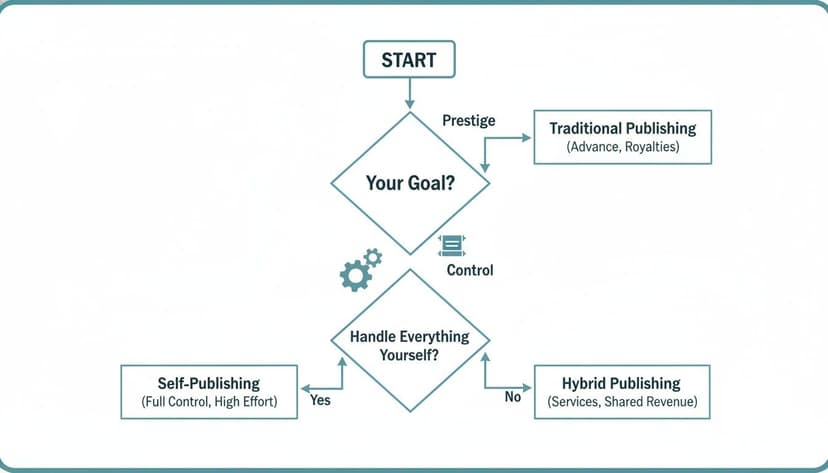
As you can see, the decision really boils down to what matters most to you right now: industry recognition or entrepreneurial freedom.
The biggest advantage of going indie is speed. You can get a polished story from your desktop to a global marketplace in just a few days. The trade-off? You're responsible for everything. That means professional editing, formatting, cover design, and all the marketing. It’s a lot of hats to wear.
This path is perfect for writers with an entrepreneurial spirit who are excited to build their own brand and connect directly with an audience.
Publishing Routes Compared: Traditional vs Self-Publishing
To make the choice clearer, let's put the two main routes for short story writers side-by-side.
| Factor | Traditional Publishing (Journals & Anthologies) | Self-Publishing (KDP, Direct Sales) |
|---|---|---|
| Control | Low. Editors have the final say on edits, titles, and presentation. | High. You have 100% creative control over the final product. |
| Speed to Market | Slow. 6-18 months from submission to publication is common. | Fast. You can publish within days or weeks of finishing the story. |
| Upfront Cost | None. You may pay small submission fees for some journals. | Varies. Costs for editing, cover design, and marketing can range from $0 to $1,000+. |
| Royalties/Payment | Low. Typically a small flat fee ($25-$500) or contributor copies. | High. You can earn 35%-70% royalties on platforms like KDP. |
| Prestige/Validation | High. A publication credit acts as a strong professional credential. | Low. Credibility is built over time through sales and reader reviews. |
| Rights | You grant temporary rights (e.g., First Serial Rights) for a set period. | You retain all rights to your work, always. |
| Discoverability | Built-in. The publication has an existing audience and distribution. | Your responsibility. Success depends entirely on your marketing efforts. |
Ultimately, many authors end up doing both. You might submit your more "literary" stories to journals while self-publishing genre fiction to build a commercial audience. Neither path cancels the other out; they're just different tools for building the writing life you want.
Polishing Your Manuscript for Publication

Before your story ever hits an editor’s inbox or a reader’s Kindle, it needs to be immaculate. A polished manuscript is your handshake—it signals professionalism and shows you respect the reader’s time.
A rushed manuscript is the fastest way to earn a rejection from an editor or a one-star review from a reader. The journey from a raw first draft to a truly publishable manuscript is all about refinement. It’s a process of stepping back, gaining perspective, and methodically elevating your work.
The Crucial Layers of Editing
Editing isn't just one task; it’s a multi-stage process. Each layer serves a specific purpose, taking you from the big-picture story down to the tiniest comma. Rushing this critical part is a common pitfall that can sabotage an otherwise great story.
Here’s how to break down the process:
- Developmental Editing: This is the deep structural work. Does your plot actually hold together? Are the characters compelling and consistent? Is the pacing dragging in the middle? This is about the what of your story.
- Line Editing: Now we zoom in to the sentence level. This is where you focus on the how. You’ll scrutinize your prose, sharpening your voice, improving flow, and making sure every single sentence pulls its weight. It's about making the language sing.
- Copyediting & Proofreading: These are the final, critical passes for correctness. Copyediting hunts down grammatical mistakes, punctuation errors, and inconsistencies. Proofreading is that last-chance look for any sneaky typos or formatting glitches that have survived.
As an indie author, self-editing is your first line of defense. A helpful practice is to let your story sit for at least a week—two is better. Then, come back with fresh eyes and tackle each of these layers one by one.
The Power of Outside Feedback
You can only get a story so far on your own. Eventually, you become blind to its flaws. You know the characters too well, you know what’s supposed to happen, and you can’t see where a new reader might get lost.
This is where an outside perspective becomes invaluable.
Beta readers are trusted individuals who read your manuscript and give you honest feedback from a true audience point of view. They’ll tell you if the plot dragged, which character they fell in love with, and whether that twist ending actually landed. Finding the right people for this is crucial, and you can check out our guide on how to find beta readers for some practical tips.
If you’re serious about self-publishing or aiming for the most competitive journals, hiring a professional freelance editor is a game-changing investment. A good editor brings an expert, impartial eye that will elevate your work to a truly publishable standard.
Standard Manuscript Formatting
Whether you’re submitting to a literary journal or uploading to Amazon, your manuscript needs to follow industry-standard formatting. This isn't about being nitpicky; it's about making your story clean and easy to read. Ignoring these norms signals "amateur" to editors and reviewers.
Adhering to standard manuscript format is a non-verbal signal to editors that you understand the professional conventions of the publishing world. It’s a simple way to make a good first impression before they’ve even read your first sentence.
Here’s a quick formatting checklist:
- Font: 12-point Times New Roman is the gold standard. Courier New is also acceptable.
- Spacing: Double-space the entire document.
- Margins: Set them to one inch on all four sides.
- Paragraphs: Indent the first line of every paragraph by 0.5 inches. Do not add an extra line break between paragraphs.
- Header: In the top right corner of every page, include your last name, a shortened story title, and the page number.
- Title Page: Your first page should have your name and contact info (email, phone number), the story title, and the approximate word count. Place this in the top left corner or centered on the page.
Sticking to these guidelines removes any distraction and lets your writing speak for itself. It’s a simple but crucial step.
Navigating the Traditional Publishing Route

Going the traditional route with short stories is a game of patience, precision, and strategy. This path—getting your work into literary magazines, journals, and anthologies—is incredibly rewarding. It offers validation and puts your writing in front of an audience that's already looking for great fiction.
However, you must impress a series of gatekeepers—the editors and first readers who are buried under a mountain of submissions. Your story has to be polished to a shine, and your submission has to be flawless.
Researching the Right Markets
Sending your quiet literary drama to a sci-fi magazine is the fastest way to get a rejection. Your first job is to become a detective. You need to hunt down the journals that are a genuine fit for your voice, your style, and your story.
Websites like Duotrope and The Submission Grinder are invaluable tools for writers. These databases let you filter publications by genre, pay rates, response times, and more. They’ll save you countless hours and dramatically boost your odds of finding the perfect home for your work.
As you vet potential markets, keep these points in mind:
- Genre and Tone: Read a few recent pieces from the journal. Does your story’s mood and style actually feel at home there?
- Word Count Limits: This is non-negotiable. If they only accept flash fiction under 1,000 words, don't send them your 7,000-word epic.
- Submission Windows: Many journals only open for submissions during specific "reading periods." Mark those dates on your calendar.
- Submission Fees: Some places charge a small reading fee, usually around $3-$5. Decide if you're okay with that or if you want to stick to markets that are free to submit to.
Your goal isn't just to find any publication; it's to find the right one. One targeted submission to a journal that loves your kind of story is worth ten sent out blindly.
Crafting a Professional Submission Package
Once you’ve got a shortlist of journals, it’s time to prepare your submission. This usually consists of a cover letter and your formatted manuscript. A clean, professional package signals to editors that you respect their time and take your own work seriously.
Keep the cover letter short and professional.
Here’s a checklist for your cover letter:
- A polite, formal greeting (e.g., "Dear [Editor's Name]," or "Dear Fiction Editor," if you can't find a name).
- The title and exact word count of your story.
- A quick, one-sentence personalization. Mentioning a story you admired from a recent issue shows you’ve done your research.
- A short bio of about 50-75 words. List a few previous publications or relevant credentials. If you have none, that's fine—just say you're an emerging writer.
- A polite closing with your contact information.
This isn't the place to summarize the plot or explain what your story really means. Let the work speak for itself.
Understanding Rights and Payments
Getting that acceptance email is a thrill, but it’s also a business transaction. You need to know what you’re signing. Most literary magazines will ask for First Serial Rights. This simply means they get to be the very first to publish your story in a serial format (like a magazine or online journal).
After a set period of time, usually 3 to 12 months, the rights almost always revert back to you. This frees you up to include the story in a future collection or submit it to a "reprint" anthology. Just be sure to always credit the original publisher.
As for payment, it varies widely. Some highly respected journals pay only in contributor copies, while others might offer a token fee of $25-$100. Professional rates, as defined by groups like the Science Fiction & Fantasy Writers of America (SFWA), are considered 8 cents per word or higher, but this is more common in genre fiction than in the literary world.
Even if the pay is modest, a publication credit from a good journal is a major asset. Publishers are actively looking for new talent; watch a detailed breakdown of debut author market trends to see just how committed publishers are to finding fresh voices.
Taking the Indie Route: Mastering Self-Publishing
For authors who crave total creative control, self-publishing is an excellent path. It's the entrepreneurial route to getting your short stories into the world. Going indie, especially through a powerhouse like Amazon's Kindle Direct Publishing (KDP), puts you squarely in the driver's seat. You control the cover, price, marketing, and release schedule.
That freedom is exhilarating, but it also means you’re responsible for every step. From formatting a clean ebook to marketing, success is on your shoulders. The payoff, however, is higher royalties and a direct connection with your readers.
The Single Story vs. the Collection
One of the first strategic decisions you'll make is whether to publish one story at a time or bundle several into a collection.
Publishing a single story, often priced at $0.99 or even offered for free, is a brilliant low-risk way to get started. Authors use this tactic for a few key reasons:
- As a Reader Magnet: Offer a free story to anyone who signs up for your author newsletter. This is one of the most powerful ways to build an audience.
- To Test the Waters: Curious about a new genre? A single story lets you gauge reader interest without the time investment of a whole novel.
- To Build Momentum: Releasing single stories on a regular cadence keeps your name in front of readers and builds a backlist that can generate steady income over time.
On the other hand, putting together a collection creates a more substantial product. A collection feels like a "real book" to many readers, which can justify a higher price (e.g., $2.99 and up). The key to a good collection is cohesion. The stories should feel like they belong together, linked by a common theme, a shared world, or recurring characters.
Prepping Your Book for the Digital Shelf
Once you have a strategy, it's time to get your manuscript and product page ready for KDP or other platforms.
First, your manuscript needs to be properly formatted. While you can upload a Word document, using a tool like Kindle Create or professional formatting software will provide a cleaner, more professional reader experience. Knowing how to upload your ebook to different distributors is a fundamental skill for the modern indie author.
Next up is your product page—your digital storefront. Three elements are absolutely critical:
- The Book Description: This is your sales pitch. Start with a killer hook that grabs attention, summarize the story's core conflict or question, and finish with a clear call to action. Use basic HTML like bold and italics to make the text easy to scan.
- Keywords: KDP gives you seven keyword slots. Think like a reader. What phrases would they actually type into the search bar? Try things like "short sci-fi stories with a twist" or "cozy fantasy short reads."
- Categories: You get to pick two. Be as specific as possible. Don't just pick "Fiction." Drill down to something like "Fiction > Science Fiction > Cyberpunk" to help Amazon's algorithm find the right readers for your book.
A well-optimized KDP page is just as important as a well-written story. Your description, keywords, and categories are the signposts that guide readers to your work in a crowded marketplace.
Pricing, Going Wide, and Selling Direct
Pricing short fiction can feel tricky. For single stories, $0.99 is the standard, which earns a 35% royalty on KDP. For collections, price between $2.99 and $9.99. This is the sweet spot that unlocks the 70% royalty rate, making a massive difference in your earnings per sale.
While KDP is the easiest place to start, consider "going wide"—distributing your work to other storefronts like Apple Books, Kobo, and Barnes & Noble. Services like Draft2Digital or Smashwords make this simple. You upload your manuscript once, and they send it out to multiple retailers for you.
Direct sales, where authors sell ebooks right from their own websites, is also a growing trend. This strategy is becoming a significant part of the modern author's business model, offering greater control and higher profit margins. You can discover more insights about 2026 author trends on thecreativepenn.com to learn about this shift.
Creating a Cover That Sells Your Story
In the endless digital scroll of Amazon, your cover is everything. It's your one chance to make a first impression, and you have less than two seconds to do it. In that blink of an eye, it must communicate genre, hint at the story, and look professional enough to be worth a reader's time and money.
This is just as true whether you’re selling a collection or a single 99-cent short story. A weak cover will make your work invisible. For indie authors, a professional cover is a non-negotiable business expense. It’s the visual handshake that says, “I’m a serious author who invested in my product.”
The Anatomy of a Great Cover
A compelling cover is a strategic tool. Every element must work together to instantly communicate with your ideal reader.
The three pillars of a cover that sells books are:
- Imagery: The central graphic has to signal the genre and mood immediately. A shadowy figure in an alley? Thriller. A sprawling, impossible castle? Epic fantasy, like these fantasy anthology cover examples. A soft-focus couple? Romance. No confusion allowed.
- Typography: Fonts do heavy lifting. A sharp, clean sans-serif font feels right for sci-fi—a look you'll spot across science fiction anthology cover ideas—while a flowing script can place a story in a historical setting. Most importantly, your title must be bold, clear, and legible even as a tiny thumbnail.
- Color Palette: Color is a shortcut to emotion. Dark blues and blacks build suspense. Fiery reds and oranges promise action or passion. Soft pastels suggest a lighter, cozier read.
Getting these three things to work in harmony is the entire goal. If you want to go deeper on these principles, you can learn how to design a book cover and apply those core concepts to your project.
How to Write a Design Brief That Actually Works
Whether you’re hiring a designer or using an AI tool, you must provide clear instructions via a design brief. A vague brief is a recipe for a cover that completely misses the mark.
Your brief needs to be specific. Here is a checklist of what to include:
- Title and Author Name: The exact text, spelled correctly.
- Genre and Subgenre: Be specific. Instead of "Mystery," try "Cozy Mystery with a baker protagonist" or "Hardboiled Noir set in 1940s LA."
- Target Audience: Who are you writing for? What other authors do they read?
- Story Blurb: A short, punchy summary focused on the core theme, mood, and conflict. Think back-cover copy, not a full synopsis.
- Key Tropes and Symbols: Mention any central objects or settings, like a cursed locket, a magical sword, or a specific futuristic city.
A strong design brief saves you time, money, and headaches. It's the roadmap that translates your story's soul into a visual language the designer—or AI—can understand.
Brainstorming and Testing Your Cover Concepts
Never settle for your first idea. Before you commit, you should explore a few different directions. This is where modern tools can give you a significant advantage.
Using an AI tool can help you generate several concepts quickly based on your design brief. For instance, you could test a few different visual hooks for your thriller book covers—one focused on a stark object, another on a silhouetted figure.
The goal is not to replace a designer but to iterate on ideas rapidly. Generate a handful of distinct concepts, then get them in front of your beta readers or an author mastermind group. Ask them a simple question: "Which one of these makes you want to click 'buy'?" That real-world feedback is gold. It helps you make a data-backed decision and ensures your final cover does the one job it's meant to do: get readers to click.
Marketing Your Short Story to Find Readers
Hitting "publish" is a huge milestone, but it's the start of a new journey. Now you have to help readers find the story you’ve poured your heart into.
For indie authors, marketing short stories isn't about massive ad budgets. It's about smart, consistent outreach. The goal is to build a connection with readers who will not only buy this story but anxiously wait for your next one. Whether you landed a traditional publication or you’re self-publishing, you are your own best advocate.
Build Your Author Platform
Your author platform is your home on the internet where readers can find you, see what you’ve written, and sign up to hear from you directly. This isn't just about selling; it's about building a community around your work.
The two absolute must-haves are a simple website and a newsletter. Your website is your professional portfolio—a clean, central place to list your publications with purchase links. Your newsletter, however, is the most powerful tool you have. It’s a direct line to your most loyal fans.
Think of your author platform as your digital storefront. It's where you control the narrative, announce new releases, and build long-term relationships with your readers, independent of any single bookstore or social media algorithm.
To get people to your website in the first place, you can implement some smart social media optimisation strategies. This means tailoring your content for each platform to grab the attention of potential fans where they hang out.
Low-Budget Marketing Tactics That Work
As a short story author, you're likely working with a tight budget. The good news is that the most effective strategies are often low-cost and high-impact. It’s all about being strategic with your time and energy.
Here are a few powerful tactics that work:
- Offer a Reader Magnet: This is a free story you give away when someone signs up for your newsletter. It’s the single best way to grow your mailing list. Choose a story that’s a great example of your style and leaves them wanting more.
- Run Price Promotions: If your story is on KDP Select, you can run a "Free Book Promotion" for up to 5 days every 90-day enrollment period. A free run can drive thousands of downloads, giving your story a massive visibility boost and attracting new readers who might then buy your other work.
- Cross-Promote with Other Authors: Find authors writing in a similar genre with a similar audience size. Agree to promote each other’s work to your email lists. It’s a classic win-win that introduces your writing to a brand new, highly relevant audience.
Leveraging a Traditional Publication Credit
If a literary journal or anthology published your story, that credit is marketing gold. Announce the publication everywhere: your website, your newsletter, and your social media. Make sure to link directly to the journal or the anthology where your story appeared. This isn’t just about promoting your own work; it shows respect for the editors who chose you and positions you as a professional, vetted author.
Mastering Your Call to Action
Every piece of marketing you create—and even the story itself—should gently guide the reader on what to do next. This is your Call to Action (CTA). Without a clear CTA, you're leaving potential fans wondering how they can support you.
Make your CTAs specific and simple to follow.
- In your book's back matter: Never end with just "The End." Add a final page asking readers to "Leave a review on Amazon," "Sign up for my newsletter for a free story," or "Follow me on [Social Media Platform] for updates."
- On social media posts: End your caption with a clear directive, like "Click the link in my bio to download my new short story!" or "What did you think of the twist? Let me know in the comments!"
- In your newsletter: Always include a link. It could be to your new release, a book you’re recommending, or a blog post you’ve written.
By building a simple platform and using these targeted, low-cost marketing tactics, you can turn a single published story into the foundation of a real writing career. It’s not about shouting the loudest; it’s about consistently and authentically connecting with the readers who are out there looking for a story just like yours.
Short Story Publishing FAQs
As you get ready to send your short stories out into the world, a few common questions always seem to pop up. Let's tackle them head-on.
Can I Really Publish a Single Short Story on Amazon KDP?
Yes, you absolutely can. Many authors do this, and for good reason. It's a fantastic, low-risk way to test the waters in a new genre, build up an audience, or create a compelling "reader magnet" to get people onto your email list.
The trick is to treat it like a real book. That means investing in a flawless edit, writing a book description that hooks the reader, and designing a cover that looks every bit as professional as a full-length novel's. For pricing, most single stories go for $0.99, or you can enroll in KDP Select to run free promo days.
Do I Need an ISBN for My Short Story?
This depends on your distribution goals.
- Selling only on Amazon? You don't need to buy your own ISBN. When you upload your story to KDP, Amazon assigns it a free ASIN (Amazon Standard Identification Number), which works perfectly within their store.
- Going "wide" to other stores? If you want to sell on Apple Books, Kobo, Barnes & Noble, and other retailers, then yes, you will need a unique ISBN. Each platform—and each format, like an ebook versus a print version—requires its own identifier.
Think of it this way: an ISBN is your story's universal passport, letting it travel anywhere. An ASIN is more like a domestic ID card, valid only in the Amazon marketplace. Choose based on how far you want your story to go.
What Rights Do Literary Magazines Usually Take?
Most reputable literary magazines will ask for First Serial Rights. This sounds intimidating, but it just means they get to be the very first publication to print your story. You might see it specified by region, like "First North American Serial Rights" (FNASR).
Typically, they hold these rights for an exclusive period of three to six months after your story is published. Once that window closes, the rights revert back to you. You are then free to include the story in a self-published collection or republish it somewhere else. Just make sure you include a note crediting the magazine that first published it.
As always, read every contract carefully. That's where you'll find the exact terms and timelines.
Ready to Create Your Own Book Cover?
Turn your story into a visual masterpiece. Fill in the details below to start generating professional covers instantly.
