How to Price Ebooks for Maximum Sales and Readership
Learn how to price ebooks with our guide. Discover proven strategies, royalty insights, and genre benchmarks to find the perfect price for your book.
Posted by
 Pablo Yáñez
Related reading
Book Marketing Assets You Need for a Strong Launch
Plan the book marketing assets for your launch: mockups, ads, A+ images, captions, listing copy, email, video, audiobook art, and a usable calendar.
How to Build a Character Profile for Book Cover Design
Build a visual character profile that keeps cover art accurate and consistent. Define appearance, clothing, references, exclusions, and series continuity.
How to Create Consistent Book Series Covers
Create consistent book series covers with a repeatable visual system. Keep typography, colors, style, and recurring characters recognizable across every title.
Ready to design your cover?
Use our AI book cover generator to create tailored book cover concepts in minutes.
Pricing your ebook is a strategic decision that balances market expectations with your earnings goals. For most indie authors publishing on Amazon KDP, the key is aiming for the $2.99 to $9.99 window to secure the 70% royalty rate.
This range is the industry standard for a reason: it maximizes your income per sale while signaling to readers that your book is a quality product.
Your Ebook Pricing Framework
Choosing the right price for your ebook is a critical step for any self-published author. It directly impacts your sales, visibility, and income. If you're publishing on Amazon KDP, your entire pricing strategy must be built around their royalty structure. This isn't just a technical detail; it's the foundation of a profitable author business.
This simple flowchart breaks down the essential thinking: you pick a price, which determines your royalty, and that combination needs to align with your sales goals.
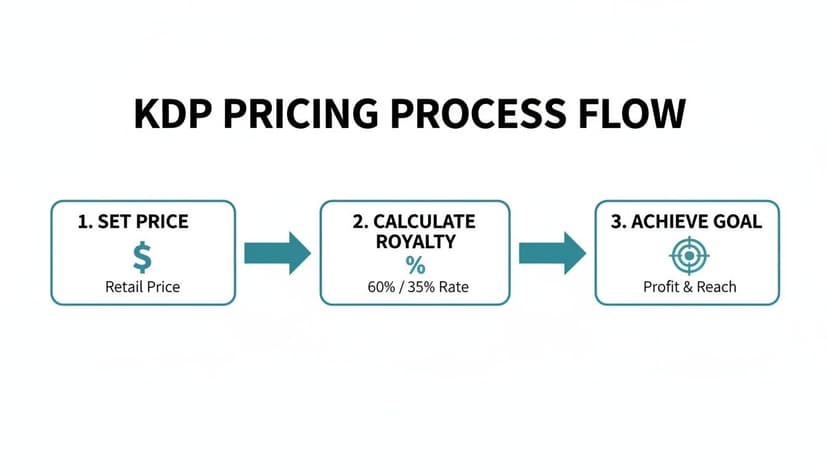
As you can see, your price directly controls your royalty percentage. Get that right, and you’re on a much faster track to hitting your financial targets.
Understanding KDP Royalty Tiers
The most important concept to grasp is the difference between Amazon's two main royalty options. In the competitive world of self-publishing, getting this right can make or break your profitability.
Amazon gives authors two choices:
- A 35% royalty for books priced below $2.99 or above $9.99.
- A 70% royalty for books priced between $2.99 and $9.99.
Why is this so important? Let's do the math. A book priced at $2.50 earns you approximately $0.87 per sale. Bump that price to $2.99, and your earnings jump to around $2.09. You would need to sell more than twice as many books at the lower price just to earn the same amount.
To make it even clearer, here's a quick breakdown of how these tiers work in practice.
KDP Ebook Royalty Tiers at a Glance
This table simplifies the decision-making process, showing exactly what you get at each price point.
| List Price Range | Royalty Rate | Best For | Key Consideration |
|---|---|---|---|
| $0.99 - $2.98 | 35% | Perma-free series starters or promotional pricing. | Requires high sales volume to be profitable. |
| $2.99 - $9.99 | 70% | Maximizing profit on standalone books and full series. | This is the sweet spot for most indie authors. |
| $10.00 and up | 35% | Niche non-fiction, textbooks, or bundled box sets. | You lose a huge chunk of royalty for a small price jump. |
As you can see, the 70% royalty tier is where most authors want to be. It offers the best return on your hard work without pricing your book out of the market.
How Price Signals Value
Your price tag sends an immediate message to potential readers. A $0.99 price might generate impulse buys, but it can also suggest low quality. Conversely, pricing a debut indie novel at $12.99 might feel too risky for a reader unfamiliar with your work.
The $2.99 to $9.99 range strikes the perfect balance. It tells readers the book is a professional product worth paying for, but it’s not so expensive that they won't take a chance on a new author.
Your price tag is part of your book's first impression, just like your cover. It needs to align with genre conventions and reader expectations to build trust before they even read the blurb.
As you build out your pricing framework, it helps to understand the core principles of valuing and pricing goods and services to ensure your strategy is solid. And remember, pricing is just one piece of the puzzle. For a complete overview of the process, check out our guide on how to self-publishing on Amazon.
Decoding Genre and Competitor Pricing
Your book doesn’t exist in a vacuum. The moment a reader sees your ebook on Amazon, their brain instantly starts comparing its price to every other book in that genre they’ve ever considered buying. If you want to set a price that feels both fair and compelling, you first have to understand those ingrained reader expectations.
This isn’t about just glancing at the top 100 bestsellers. Your real job is to find your book's specific "price neighborhood"—the range that readers in your niche are already comfortable paying.
Identify Your True Competitors
It's tempting to look at what the big names are charging, but bestsellers are often outliers. They benefit from massive marketing budgets or are running temporary price promotions that you can't replicate.
Your most valuable intel comes from the mid-list authors in your genre. These are the writers who have built sustainable careers book by book, the ones who are your true competitors.
Here's how to find them:
- Start Broad: Kick things off with your main genre keyword, like "epic fantasy" or "contemporary romance."
- Dig Deeper: On the pages of popular books, scroll down to the "Customers also bought" section. This is a goldmine for finding other authors your target readers already love and trust.
- Analyze Their Strategy: Click through to the author pages of these mid-list writers. Look for patterns. How do they price new releases? What about older backlist titles? Do they price the first book in a series differently?
This kind of research reveals the unwritten rules of your genre. For instance, you’ll quickly see that a sprawling, 150,000-word space opera can comfortably sit at $5.99 or $6.99. But a snappy, 25,000-word paranormal romance novella is more likely to be priced at $2.99—or even $0.99 if it's designed to pull new readers into a series.
Get a Feel for Genre-Specific Pricing Norms
Every genre has its own pricing culture. Romance readers, who often consume books at a rapid pace, have different expectations than someone buying an exhaustively researched historical non-fiction book.
Here are some general benchmarks:
- Romance & Erotica: These often land between $2.99 and $4.99. Shorter novellas or the first book in a series frequently use a $0.99 or even a perma-free strategy to get readers hooked.
- Sci-Fi & Fantasy: Full-length novels here typically go for $3.99 to $7.99. The higher end of that range reflects longer word counts and the complex world-building readers expect.
- Thriller, Mystery & Suspense: The sweet spot is usually $3.99 to $5.99. These genres thrive on a fast pace and high volume, so making the price an easy "yes" is key.
- Non-Fiction: This is the most variable category. It's all about perceived value. A short "how-to" guide might be $2.99, while a comprehensive business framework could easily command $9.99 or more.
Key Takeaway: Your price isn’t just a number; it’s a signal. It tells readers where your book fits on the shelf. If you price too far outside your genre’s norms, you risk confusing potential buyers and causing them to hesitate.
Recent data backs this up. A 2023 analysis found that while many authors priced their most valuable ebook at $4.99 or higher to signal quality, a full 50% used $0.99 or free for their cheapest ebooks—a classic strategy to draw readers into a series. You can explore more ebook statistics to see how authors are tackling this themselves.
How Perceived Value (and Your Cover) Changes Everything
Never forget: your book cover does a ton of the heavy lifting when it comes to justifying your price. A professional, genre-appropriate cover makes a higher price point feel earned. On the flip side, a cheap or amateurish cover can make even a $0.99 price tag seem too high.
Your price is a promise, and your cover is the proof.
Think of it this way: a stunning thriller book cover with sharp typography and evocative imagery instantly communicates a high-quality reading experience. When a reader sees that cover next to a $4.99 price, the decision to buy feels like a great deal, not a risk. You can even use an AI tool to generate several cover concepts to test which design best communicates the value you're aiming for at your target price.
Getting a Handle on Costs to Protect Your Profit
Pricing your ebook is more than just picking a number that feels right or copying what other authors are doing. It's about building a sustainable business. And you can't do that until you know exactly what it cost you to get your book to the starting line.
Profit isn't revenue. It's what's left after you've paid for everything. Knowing your financial baseline transforms pricing from a guessing game into a strategic business decision. Flying blind means you're just hoping to eventually break even, which is a tough way to build a career.
Tallying Up Your Production Expenses
Every single book comes with upfront, one-time costs. Think of these as the essential investments you make to create a professional product that can actually compete. Before you see a dime in royalties, these are the bills you have to cover.
Your basic production checklist is going to look something like this:
- Editing: This one is non-negotiable and often the biggest line item. It can be anything from a developmental edit to shape the story all the way to a final proofread.
- Cover Design: Your cover is your #1 marketing tool. It’s what stops the scroll. Don’t skimp here, whether you hire a top-tier designer or use a high-quality AI tool.
- Formatting/Typesetting: A clean, professional interior makes for a happy reader. This ensures your book looks great on any device, in both ebook and print.
- Marketing & Promotion: This bucket can include everything from your first ad campaigns, paying for a spot on a promo site like BookBub, or software for your author newsletter.
Add it all up. That final number is your break-even point—the amount of money you have to earn back before you’re officially in the black. For a deeper dive, our guide on the costs of self-publishing breaks down a full budget.
The Hidden Cost of KDP Delivery Fees
Here’s a detail that trips up a lot of new authors. When you select the 70% royalty option on KDP (for books priced between $2.99 and $9.99), Amazon subtracts a "digital delivery fee" from your earnings.
This fee is based on your ebook's file size, charged per megabyte. For a standard, text-heavy novel, it's usually just a few pennies and not a big deal. But for other books, it can be a profit killer.
Think about a children's book, a graphic novel, or a non-fiction guide packed with high-resolution images. A 15 MB file could rack up a delivery fee of over $2.00. On a $3.99 ebook, that fee just ate half your royalty.
Always check the "Estimated Delivery Cost" on your KDP pricing page before you publish. If that number seems high, you may need to optimize your images or adjust your price point to protect your margin.
Forecasting Your Potential Earnings
Once you know your total costs and you're aware of any delivery fees, you can start playing with the numbers. This isn't complex financial modeling; it's basic math that puts you in the driver's seat.
Just open up a simple spreadsheet and create a few columns:
- List Price: Plug in a few options that fit your genre, like $3.99, $4.99, or $5.99.
- Royalty Per Sale: Calculate your 70% royalty and then subtract that estimated delivery fee.
- Break-Even Point (Units): Divide your total production cost by your royalty per sale.
This simple exercise is incredibly powerful. It shows you exactly how many copies you have to sell at each price just to get your money back. Seeing that you need to sell 85 copies at $4.99 versus 115 copies at $3.99 gives you hard data. Suddenly, your pricing isn't a guess—it's a strategy.
Advanced Pricing Strategies for Long-Term Growth
Your ebook's price shouldn't be a "set it and forget it" number. For authors building a real career, price is one of the most powerful marketing tools you have, and it needs to evolve as your backlist grows. Moving beyond a single, static price opens up a world of new ways to attract readers, boost sales across your entire catalog, and build a sustainable business.
This is about learning how to make your price work for you. You'll want to adapt it to your career stage, the size of your catalog, and what you’re trying to accomplish right now. It’s the difference between just selling a book and strategically building a readership that will follow you for years.
The Power of Psychological Pricing
Ever wonder why so many books are priced at $3.99 instead of a nice, round $4.00? It’s not an accident. This is a classic tactic called charm pricing.
Our brains are wired to focus on the first digit we see. So, $3.99 feels like it's in the "$3 range," making it seem significantly cheaper than $4.00, even though it's just one cent less. This tiny psychological nudge can make a huge difference. A price of $4.99 feels like a bargain, while $5.00 mentally crosses a threshold into a higher price bracket. There’s a reason this is the standard on Amazon—it just works.
Architecting a Smart Series Pricing Strategy
If you write a series, your pricing strategy is your single best reader-acquisition tool. The entire goal is to make the first book an absolutely irresistible entry point that gets readers hooked, compelling them to buy the rest of the series at full price.
This is often called a "loss leader" strategy, and it's incredibly effective in the indie world.
- The Perma-Free First Book: This is a classic for a reason. Making your first book permanently free removes all risk for a new reader. They can try your world and your writing without spending a dime. The goal isn't to make money on book one; it's to drive a high volume of follow-on sales for books two, three, and beyond.
- The Deeply Discounted First Book: If you're not ready to go perma-free, pricing the first book at $0.99 accomplishes nearly the same thing. It's a low-risk impulse buy that serves the same purpose: funneling new readers into your higher-priced sequels.
A smart series pricing strategy transforms a single sale into a loyal fan. By lowering the barrier to entry, you’re making a long-term investment in a reader who might just buy everything you ever write.
This isn't just theory. Top-tier authors have figured out the system. They use a low entry price to hook readers, then confidently price the rest of their catalog from $5.99 to $10 and up.
Using Promotions and Kindle Unlimited Strategically
Promotional pricing is all about creating urgency. This means temporarily dropping your book's price to coincide with a big marketing push, like a BookBub Featured Deal or a major social media campaign. A limited-time discount to $0.99 or $1.99 can send your book soaring up the charts, creating a massive spike in sales and visibility.
Enrolling in Kindle Unlimited (KU) adds another fascinating layer. In KU, you get paid for every page a subscriber reads, which changes the entire financial equation. A lower retail price might seem less important, but it can still influence whether a reader decides to "borrow" your book or buy it outright.
Many authors also use KU itself as a promotional tool. They might enroll a new book for its first 90 days to tap into that massive pool of voracious readers, then "go wide" to sell it on other platforms later. For those looking at recurring revenue, it's worth exploring the concepts behind effective subscription pricing strategies to see how those principles can apply to building a loyal author platform.
A well-planned pricing strategy is more than just picking a number; it's about building a flexible system that serves your specific goals as an author. Below is a breakdown of common models to help you see where your own books might fit.
Strategic Pricing Models for Indie Authors
| Strategy | Typical Price Point (Book 1) | Main Objective | Best For |
|---|---|---|---|
| Perma-Free | $0.00 | Maximum reader acquisition | Authors with a series (3+ books) looking for rapid audience growth. |
| Loss Leader | $0.99 | Low-risk entry point to a series | Authors with a new series who want to build momentum quickly. |
| Mid-List Standard | $2.99 - $4.99 | Balance of accessibility and profit | Standalone novels or authors with a smaller backlist. |
| Premium Pricing | $5.99 - $9.99 | Maximize revenue per sale | Established authors with a loyal following or for non-fiction books. |
| Promotional Pulse | Temporary $0.99 | Chart ranking & visibility spike | Launch weeks, special events, or to revive a backlist title. |
Choosing the right model depends entirely on where you are in your career and what you want to achieve next. A new author’s goal is discovery, while a seasoned author with twenty books is focused on maximizing lifetime value. Your strategy should reflect that.
Testing and Adjusting Your Ebook Price with Data
Your launch price is just the beginning. Think of it as your best-educated guess, not the final word chiseled in stone. The real story of what your book is worth—what readers are actually willing to pay—unfolds in your sales data.
Smart, career-minded authors treat pricing as an ongoing experiment. You’re not just guessing; you're gathering intelligence. By running simple tests and paying close attention to the numbers, you can shift from hope to a data-backed strategy that grows your income over the long haul.
The idea is incredibly simple: change one thing—your price—and watch what happens. This isn’t about chaotic, daily price swings from $0.99 to $9.99 and back again. It’s about methodical, patient observation.
Running Simple Price Tests
The most direct way to test the market is to change your price for a set period and measure the impact. Don't rush this. A solid test window is anywhere from 30 to 60 days. That's long enough to smooth out random daily spikes and dips, giving you a reliable set of data to work with.
Here’s a practical way to approach it:
- Set Your Baseline: Let your book sit at its initial price (say, $3.99) for at least a month. Get a feel for your average daily sales and KU page reads right from your KDP dashboard. This is your control group.
- Make One Change: Now, adjust the price to your test point (maybe you want to try $4.99). Crucially, this must be the only major change. If you simultaneously launch a huge ad campaign, you’ll muddy the waters. You won’t know if the ads or the price shift caused the new results.
- Analyze the Results: After another 30 days, sit down and compare the two periods. Did your total royalties go up, even if you sold fewer units? Did your page reads tank? This is your audience telling you exactly what they think your book is worth.
Don't be shy about running multiple tests. You could try $3.99, then bump it to $4.99, and then maybe even drop it to $2.99 to see which price point hits that sweet spot of maximum overall profit.
Key Metrics to Watch on Your KDP Dashboard
It’s easy to get tunnel vision and fixate on a single number, like unit sales. But to get the full story, you need to look at how a few key metrics work together.
- Total Royalties: This is your north star. It's the bottom line. Selling 100 copies at $2.99 (about $209 in royalties at the 70% rate) is actually less profitable than selling just 50 copies at $4.99 (which nets you around $174). Your goal isn't just to move units; it's to find the price that maximizes your total earnings.
- Kindle Edition Normalized Pages (KENP) Read: If your book is in KDP Select, this is huge. A price change can have a massive impact on borrows. A lower price might encourage more outright sales but discourage KU readers from taking a chance on a borrow. Track your KENP Read to see how your price is influencing the KU crowd.
- Sell-Through Rate (for a series): For series authors, this might be the most important metric of all. How many readers who buy book one go on to buy book two? A lower price on the first book—or even making it permafree—could dramatically boost your sell-through rate, making you far more money across the entire series than you would have with a higher-priced book one.
Pro Tip: Never make a pricing decision based on one or two days of data. Amazon's reporting can lag, sales fluctuate wildly, and you'll drive yourself crazy. Look for trends that hold steady over several weeks, not hours.
Your Cover is Part of Your Pricing Strategy
Your book cover and its price are in a constant, silent conversation with potential readers. A professional, genre-perfect cover makes a higher price feel justified. An amateur-looking one makes even a low price seem like a risky bet.
This is where your cover becomes a powerful lever in your pricing tests. An amazing cover doesn’t just attract clicks; it builds perceived value, giving you permission to charge more.
For example, a dark, gritty cover for your crime thriller might signal a premium read that converts best at $4.99. But what if you tested a brighter, more character-focused version? It might appeal to a broader audience who responds better to a $3.99 price point. You can discover more insights about ebook statistics that show just how much visuals matter.
The only way to know for sure is to test. By pairing different cover designs with different prices, you can pinpoint the exact combination that makes readers feel they're getting a fantastic deal, maximizing both your sales and your royalties.
Global Pricing and the Kindle Unlimited Question
As an indie author, your bookshelf isn't in a single store—it's worldwide. This means you have to think globally, and two of the biggest pieces of that puzzle are international pricing and the Kindle Unlimited (KU) program. Getting these right can be the difference between reaching a handful of readers and building a massive, international audience.

Let's start with the basics. When you set your book's price in USD on KDP, Amazon helpfully converts it for all its other marketplaces. It’s convenient, but it’s lazy. This automation often spits out weird, clunky prices like £4.17 or €5.23. These numbers just scream "auto-converted" and miss a huge opportunity.
Take a few extra minutes and manually set your prices for the big English-speaking markets: the UK, Canada, and Australia. Adjust that awkward £4.17 to a crisp £3.99. It’s a small tweak that makes your book feel like it belongs in that market, tapping into the local pricing psychology we’ve already talked about.
Diving into the Kindle Unlimited Ecosystem
Now for the big one: KDP Select, the gateway to Kindle Unlimited. Enrolling your ebook here puts it into a massive subscription library where readers pay a flat monthly fee to read as much as they want. It sounds great, but there’s a catch—exclusivity. For each 90-day term you're enrolled, you cannot sell that ebook anywhere else. No Kobo, no Apple Books, no Nook.
So what's the trade-off? Eyeballs. Millions of them. KU is packed with voracious readers who are constantly hunting for their next favorite author. They’re far more likely to take a chance on someone new because, for them, your book is essentially "free."
Instead of a flat royalty per sale, you get paid for every page a subscriber reads. This is calculated from a massive pot of money called the KDP Select Global Fund. And this isn't pocket change—in just the first half of 2023, Amazon paid out a staggering $272 million to authors in the program.
Should You Go All-In on KU?
The "KU or go wide" debate is a constant in author circles, and honestly, there's no single right answer. It's a strategic choice that depends entirely on your goals.
Checklist: Deciding Between KU and "Going Wide"
- Are you a new author? KU offers unparalleled visibility for getting discovered.
- Do you write in a series? KU's page-read model heavily rewards long, bingeable series.
- Is rapid audience growth your top priority? KU provides the largest single pool of readers.
- Are you comfortable with exclusivity? If relying solely on Amazon makes you nervous, "going wide" offers diversification.
- Do you have a plan to market on other platforms? Going wide requires a marketing strategy beyond Amazon.
Ultimately, this decision shapes your entire author career. Are you aiming for rapid growth and visibility within the biggest ecosystem on the planet? Or is your goal to build a slower, more resilient brand across multiple storefronts? Both paths are valid.
Making these strategic choices is a core part of the author journey. For a deeper dive into the whole process, from writing to hitting "publish," our guide on self-publishing on Amazon is the perfect place to start.
Ebook Pricing FAQs: Your Questions Answered
Pricing feels like a dark art when you're starting out, but it doesn't have to be. Let's tackle some of the most common questions indie authors have about getting their ebook price right.
Can I Change My Ebook Price After Publishing?
Absolutely. In fact, you should.
One of the biggest perks of publishing on platforms like Amazon KDP is the total control you have. You can log in, change your price, and see the update live across Amazon's stores in just a few hours.
Think of your launch price not as a permanent decision, but as your first data point. This flexibility is your secret weapon for running price promotions, A/B testing, or simply adjusting your strategy as your backlist grows.
Should My Ebook Always Be Cheaper Than My Paperback?
Yes. There are very few exceptions to this rule.
Readers are hardwired to expect a digital product to cost less than its physical counterpart. No printing, no shipping, no warehousing—in their mind, the value proposition is different, and the price needs to reflect that.
A good rule of thumb is to set your paperback price to guarantee a decent profit margin, then price your ebook according to the conventions of your genre. For most fiction, that sweet spot is somewhere between $2.99 and $5.99. This creates a logical price ladder for your readers.
Your ebook price must feel like a smart buy next to the print version. If they're too close, you don't just lose ebook sales—you make your paperback look overpriced and confuse readers who expect a clear digital discount.
What’s the Best Price for the First Book in a Series?
When it comes to Book 1 in a series, your goal shifts from profit to acquisition. You're not trying to make a killing on the first book; you're trying to get a reader so hooked they have to buy the rest.
Your first book is a hook. A gateway. A marketing tool.
With that in mind, you have two powerhouse strategies:
- Go cheap with $0.99: This price is low enough to be an irresistible impulse buy, removing nearly all friction for a new reader to take a chance on you.
- Go free with Perma-Free ($0.00): If you have two or more books out in the series, making Book 1 permanently free is the ultimate way to maximize downloads and get your story into as many hands as possible. The goal is to drive sales of the full-priced sequels.
For either strategy to work, your packaging has to scream "premium." A killer cover is non-negotiable. A professional romance book cover, for instance, makes a free or cheap book feel like an incredible find, not a bargain-bin throwaway.
Ready to Create Your Own Book Cover?
Turn your story into a visual masterpiece. Fill in the details below to start generating professional covers instantly.